













The other Ecuador: If you find Cuenca culturally shocking, spend some time in the campo
When we’re at our farm in Cañar Province, an hour-and-a-half drive north of Cuenca, I have my morning coffee beside the banana trees in the back yard. The neighbors can see me from the road and we exchange “Buenos Diases.” Most of them  are on foot but a few ride horses or donkeys. Some lead a cow or two to pasture.
We got in late last night, but the word is already spreading: the gringo is in town! I’m the village oddity — maybe the village idiot — but they treat me kindly.
The locals talk about another “gringo,” a young Norwegian or Swedish man, who spent a couple weeks in the valley 20 years ago. They think he worked for the United Nations but no one can say for sure. He was the last one before me.
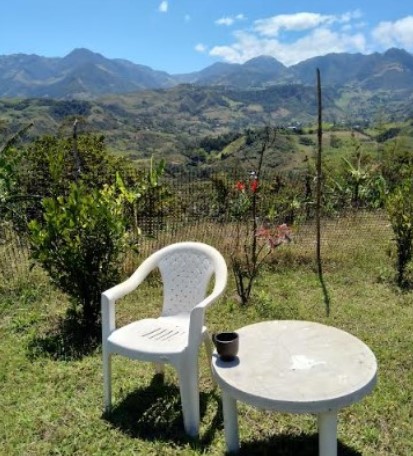
My morning coffee in the campo.
I usually read a book and listen to music with my coffee, which seems bizarre to folks around here. Who has time to sit in the yard and read a book? Aren’t there pigs to slop, a field to plow, a calf to castrate? What a strange thing to do.
I share a breakfast roll with a bantam rooster who stands sentry by my chair in exchange for crumbs. Hummingbirds nurse the poinsettias behind me.
Earlier, my wife was by the road when two passing women asked what kind of music I was listening to.
“I think it’s a symphony,” she told them, turning and shouting across the yard, “Is that Mahler?”
“Yeah, the fifth,” I shout back.
“Who’s Mahler?” one of them asks.
“Some dead guy from Europe,” she says.
Last month, two girls from down the road asked my mother-in-law to get me to say something in English. I asked them what their weekend plans were, and they thought it was hilarious, muffling laughter behind their hands. It was true, I sounded ridiculous, and laughed with them. They think it’s even funnier when I speak Spanish.
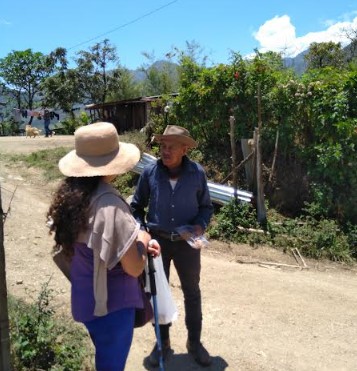
My wife talks to Jorge.
A weekend in the country reminds me how utterly different life is in rural Ecuador from the life most expats and city-dwelling Ecuadorians know. It’s a separate reality out here, and in other small communities burrowed into the nooks and hollers of the Andes.
I’m also reminded of a late-1960s book by Gloria Jahoda, “The Other Florida.” She wrote of the Florida you didn’t read about in the newspapers or hear about on television. It had nothing to do with the real estate boom, the new theme parks, the upward thrust of the Miami skyline and the dreams of easy money. She wrote about the oystermen and shrimpers in Apalachicola, the granddaughter of a slave who embroidered lace for a rich lady in Jacksonville, and one of the last moonshiners on the Sopchoppy River.
There’s another Ecuador too. It’s as different from Cuenca as Cuenca is from Miami.
Around here, there’s not much interest in politics unless it affects agricultural prices. All that stuff is for city slickers, says Jorge, 87, one of the few older residents who finished high school and can speak a little English. “I read about all the subsidy stuff but don’t care unless they go after the cooking gas. Then there will be trouble.”
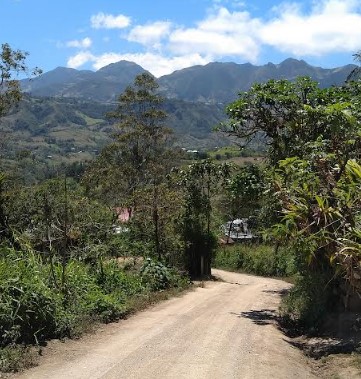
Take me home, country road.
Jorge and his neighbors know about the drug violence and the killings in Durán, Guayaquil and Portoviejo. “We have some crime here but not much,” he says. “Someone stole two mattocks and a chainsaw in February, and we know who it was,” he says. “The problem is he lives way down by the river. Some of the younger guys talked about going there but I don’t think anything will come of it. It was an old chain saw.”
One thing you learn in the valley is when folks talk about “way down by the river,” they mean way, way down. Maybe 400 or 500 meters, in this case, with a 30-degree grade approach.
The last killing in the parish was in 1993. A man came home and found his neighbor in bed with his wife and used a shotgun on him. The police paid a brief visit, talked to Jorge and several other village elders and concluded that justice had been served. Most of the folks here are Cañari, quite a few of them full-blooded.
The dead man was buried next to the compost pile behind his house. “That was Carlito,” Jorge says. “He made a bad mistake.”
Occasionally, our family is of useful service to the community. We donated land up the mountain for the new potable water facility and helped in the pipe-laying mingas. Before that, household water came, lightly filtered, from the irrigation ditches. In January, after a boy was kicked in the face by a cow, we took him to the public clinic in Ducur. Last year, we did the same for a lady who cut herself with a machete.
Despite the drought early in the year, the corn crop is coming in pretty decently. Last weekend the two girls who laughed at me came by to help my wife and her mom make chiviles, a cornmeal and cheese specialty of the area. We took turns grinding corn with a hand-cranked molinillo.
Later, when the girls headed home I thanked them for all their help. They laughed.
________________
David Morrill is editor of CuencaHighLife.