















Andean Tiwanaku culture continues to intrigue researchers as new temple is discovered
By Juan Pablo Calero
An ancient society near the southern shores of Lake Titicaca in modern-day Bolivia was once one of the continent’s most powerful civilizations. Known as Tiwanaku, the ancient society is widely considered by archaeologists to be one of the earliest examples of civilization in the Andes and a precursor of the Inca empire, but it mysteriously disappeared about a thousand years ago.
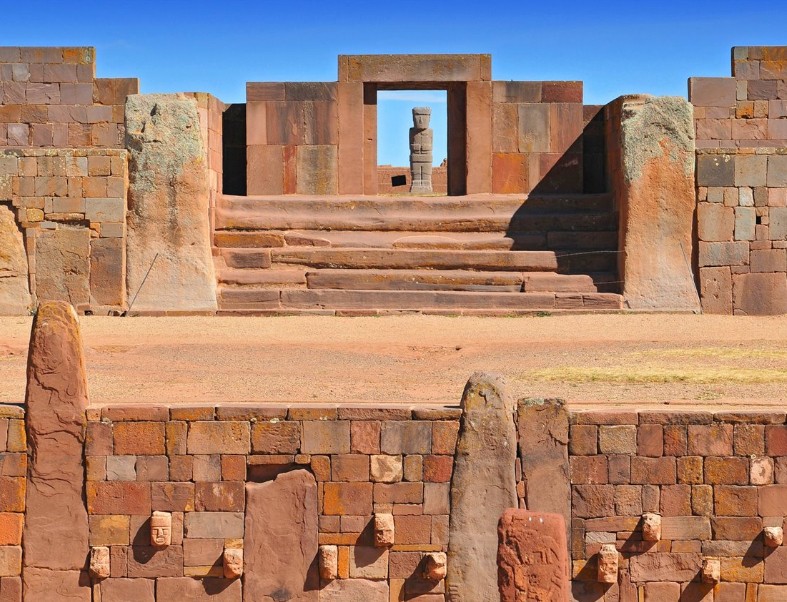
Tiwanaku, in Bolivia near Lake Titicaca, was the most advanced civilization in South America prior to the Incas.
Now, a team led by scientists at Penn State and in Bolivia have discovered a Tiwanaku temple, shedding new light on what the society looked like in its prime. Much about the Tiwanaku civilization remains unknown, explained José Capriles, Penn State associate professor of anthropology and lead author on a study about the temple discovery published in the journal Antiquity.
“Their society collapsed sometime around 1000 AD and was a ruin by the time the Incas conquered the Andes in the 15th century,” Capriles said.
“At its peak, it boasted a highly organized societal structure, leaving behind remnants of architectural monuments like pyramids, terraced temples and monoliths, most of which are distributed in sites around Lake Titicaca and, while we know Tiwanaku’s control and influence extended much further, scholars debate how much actual control over distant places it had.”
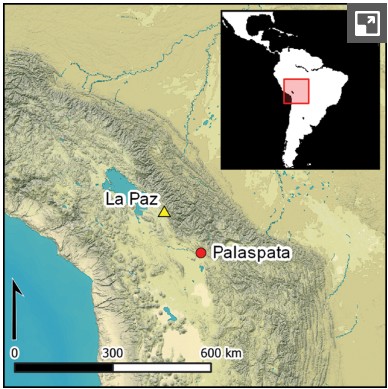 The newly discovered temple complex is located roughly 130 miles (209 kms) south of Tiwanaku’s established historical site, on top of a hill that was known to local Indigenous farmers but was never explored in depth by researchers due to its unassuming location. However, the position of the site is actually very strategic, Capriles explained.
At the time of Tiwanaku, the spot connected three main trade routes for three vastly different ecosystems: the productive highlands around Lake Titicaca to the north, the arid Altiplano ideal for herding llamas to the west and the agriculturally productive eastern Andean valleys of Cochabamba to the east.
As such, the researchers said they understood that the site must have held some importance for connecting people. Capriles explained that people moved, traded and built monuments in places of significance throughout the arid mountain landscape. After noticing an unmapped quadrangular plot of land, the researchers used various techniques to visualize the area.
________________
Credit: Ancient Origins