
















It’s not a loophole: How Ecuador designed the IVA refund system for old age
In my recent column about IVA refunds as they relate to expatriate retirees, I knew perfectly well that the comments section would not be a place of tame consensus. Topics that mix money, morality, and Ecuador have a reliable way of flushing out worldviews, and this one did not disappoint.
What surprised me was not disagreement, but range. Some readers revealed themselves as near-recluses who didn’t think the juice was worth the squeeze, proud of living lightly and leaving no fiscal footprints behind them. Others described lives deeply entangled with Ecuador, volunteering, donating, employing people, sponsoring children, supporting neighbors, and generally circulating money in the local economy in ways that never appear on a spreadsheet.
 Between those poles sat most people, muddling through with good intentions and imperfect information, although one of the oddest compromises suggested was paying someone else a monthly fee to handle the IVA refund, which is not quite a job creation scheme and not really tax avoidance either, but a small, voluntary redistribution in which paperwork turns into income and the tedium is outsourced.
I do not know the personal histories of most gringos in Cuenca, and I do not need to. What is obvious, though, is that when people discuss Ecuadorian social policy, they are often speaking from the deep imprint of where they came from and what they spent their working lives doing.
In my own case, decades spent around social policy and health care administration in three different countries meant that arriving in Ecuador felt less like culture shock and more like an invitation to observe another system on its own terms. That is not a universal experience, nor should it be assumed to be one, but it does explain why the same policy can look either baffling or remarkably coherent depending on the lens through which it is viewed.
That spread matters, because it reminds us that there is no single “expat retiree” moral type, and no single reason why someone might or might not claim an IVA refund.
Before going further, it is worth clearing up one recurring confusion: the famous $141 figure. This number does not come from the heavens, nor from some secret expat allowance. It comes from a formula. Ecuador allows seniors to reclaim IVA on up to two basic monthly salaries worth of eligible consumption. Multiply that cap by the IVA rate, currently 15 percent, and you arrive at roughly $141 per month. (Those who are good with numbers might notice that the magic number of $141 is exactly one tenth of the monthly earnings requirement to qualify for the first stage of the retirement visa.)
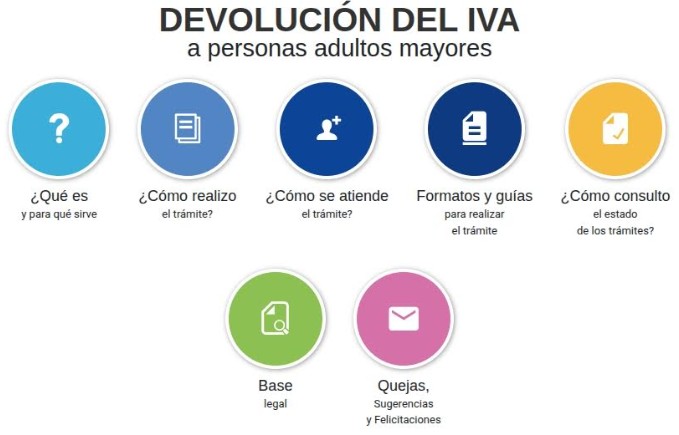 The more interesting question is what the policy is actually for. At a macro level, IVA refunds are not an exotic experiment but a redistribution choice made at the national scale. The overwhelming majority of claims are made by Ecuadorian seniors, not foreigners, and the fiscal impact rises or falls with domestic demographics rather than with the relatively small expatriate population.
From an economic point of view, refunded money tends to reappear quickly in neighborhood shops, markets, and service businesses, where it supports ordinary local consumption rather than being frittered away on luxury personal imports or overseas travel.
Gringo seniors, by comparison, are a statistical rounding error. Whether they claim or decline the refund has no measurable effect on national finances, and only a modest effect on local circulation, which is why debates about their participation often generate more heat than light. To put it another way, if gringas and gringos decline to accept their IVA refunds, it does not mean that shiny new hospitals will be built for the public health department tomorrow.
What is significant is that IVA refund for seniors is not just a tax perk for gringos, but a social signal that says, in effect, that Ecuador prefers its elderly to remain inside family life rather than being outsourced to institutions. In a country where multigenerational households are normal, the refund reinforces that arrangement. If abuela lives with her children and grandchildren, some household expenses can legitimately be invoiced in her name, easing the family burden at the margins. The state does not pretend that seniors live as isolated economic units, because culturally they often do not.
Contrast this with the United States or the United Kingdom, where elderly care is frequently professionalized, commercialized, and physically separated from family life and retirement pensions are rerouted to corporations that warehouse the elderly and decide which channel to tune the communal TV to. Ecuador’s system nudges things in the opposite direction and makes it just a little easier for families to keep elders at home, supported, visible, and useful.
That point is not abstract for expatriates, even if some would prefer it to be. Today you may be spending your mornings in the gym, before going out to almorzar, and then to the opera in the evening, independent, and faintly amused by the idea of claiming up to $141 a month in tax refunds. Tomorrow you may need someone to come to your apartment daily to help with meals, laundry, mobility, or medication. When that day comes, you may find yourself rather grateful that Ecuador has mechanisms, however modest, that soften the cost of home-based care rather than funneling everyone toward institutions.
It is also worth stating clearly that the IVA refund for foreign seniors is not accidental, or something that slid in under the radar. It is explicitly addressed on the Servicio de Rentas Internas website. Resident foreigners over 65 are mentioned and the rules are spelled out. This is not a loophole exploited by crafty gringos, but a policy choice.
Equally explicit is the right to make back claims for up to five years, counted from the date a resident foreigner is issued a cédula. Anyone who did not know this, or assumed the benefit did not apply to them, is entitled under the rules to claim retroactively within that window. Whether one chooses to do so is a personal decision, but the entitlement itself is unambiguous. It is nice to know that there is a refund worth $1000 waiting for you, even if you nobly decline the offer for reasons of moral purity.
But surely there must be a concern about fraud, particularly in family settings? That concern is not foolish, but it misunderstands the design. The system accepts a degree of household pooling because the alternative would be intrusive, bureaucratic, and culturally tone-deaf. The $141 monthly cap limits excess and the trade-off is deliberate, so if abuela shares her family-size bucket of tax-free laundry detergent with the rest of the family and the neighbors, the IVA Inquisition is not going to burst in, put her in shackles, and remove her to an old person’s home in Manta.
I never expected universal agreement on this topic. The original article was written precisely because it sits at the junction of law, culture, economics, and personal ethics, and because the editor thought it would get a lot of clicks. If it had passed without comment, that would have been a failure.
What matters, in the end, is clarity. The IVA refund exists and it applies to Ecuadorian seniors and resident foreign seniors alike. It is capped, legal, and intentional. It supports a model of aging that keeps elders embedded in family life rather than parked elsewhere. Whether you claim it, decline it, donate the equivalent to charity, or ignore it entirely is up to you. If you have a backdated 5-year refund worth $1000 waiting for you, the question is not what Ecuador expects of you, but what you expect of yourself.



Hogar Esperanza News

The Cuenca Dispatch

Week of September 20

Ecuador turns to industrial power cuts to protect Mazar and keep homes from going dark.

Ecuador raises its 2026 growth forecast, but El Niño could spoil the outlook next year.
Cuenca retirees challenge medical and therapy changes at IESS senior center.
Fabianos Pizzeria News

Fund Grace News