















Trans-national drug gangs pose a growing threat to European security, EU drug agency warns
By Barney Jopson
Criminal drug gangs have become a grave threat to European security by flooding the streets with South American cocaine, seeking to corrupt officials and hiring a new wave of paid assassins, according to the EU’s drugs agency.
 Due to financial crises, terrorism, Covid-19 and the Ukraine war, European policymakers had not paid enough attention to the criminal organisations that had built sprawling drugs businesses, said Alexis Goosdeel, outgoing director of the EU Drugs Agency (EUDA).
Now, Europe was belatedly waking up to the “hyper-availability” of illegal drugs and to traffickers’ pervasive attempts to intimidate and corrupt officials in ports, police forces and the judiciary, Goosdeel added.
“We discovered the tip of the iceberg and we have not seen what is under the surface,” he told the Financial Times at the end of his 10-year term as head of the Lisbon-based EUDA. “I think for the moment it’s not even possible to imagine the dimensions.”
This year has served up stark examples. A police union in southern Spain said the state had “lost control” of the fight against traffickers. A judge said Belgium was at risk of becoming a “narco-state”. And the killing of an anti-drug activist’s brother in Marseille heightened fears that France was heading the same way.
Goosdeel warned that the trade in illicit drugs posed a “multidimensional” menace to Europe, extending from lethal violence to institutional corruption. “The threat today is very high,” he said.
This month, the European Commission unveiled a new narcotics action plan, calling drug trafficking a “major threat to Europeans’ wellbeing” that demanded a “stronger, co-ordinated response across the EU”.
The biggest recent change has been a surge in the production and trafficking of cocaine, mainly from Colombia, Peru and Bolivia, Goosdeel said.
“For the last six, seven years we have seen a really exponential increase in the availability of cocaine on the European market, with stable prices, a very high level of purity,” he said. As a result, “there is pressure from the producers to find new customers or to make customers use more”, creating sharper competition between rival drug organisations.
Europe is also experiencing a rise of “crime as a service”, including hired assassins to take out rivals and contractors who can set up industrial-scale amphetamine labs. “Assassination as a service involves young people who are recruited using social media,” Goosdeel said. “They are brought to another country to commit a crime, then they are brought back.”
Goosdeel said it was not possible to know how US President Donald Trump’s recent strikes on alleged Venezuelan drug trafficking boats would affect Europe “because there is no documentation” and “there were no legal cases brought against those people and those boats”.
The ubiquity of drugs in Europe is linked in part to large-scale trafficking via commercial shipping containers, an import route that was far less common 10 years ago, he said.
Ports are joining forces to fight trafficking. Some, such as Antwerp, have introduced stricter controls on dockers, including biometric IDs and preset timeframes for access to containers and cranes. But Goosdeel said that had prompted criminal gangs to shift their attention to managers who control container movements.
“Criminal organisations will not easily renounce corruption. Corruption is a way for them to reach their objectives,” he said. “They try at every level.”
But Goosdeel said there has been an “encouraging” increase in European criminals finally being extradited from their sanctuaries in Dubai, which remains home to notorious figures including Daniel Kinahan, the Irish boss of the Kinahan organised crime group.
He argued that governments must go beyond enforcement to address why demand for dangerous substances — both illicit drugs and misused medicines — was rising.
“Using substances at different moments in our life or in the day to cope with anxiety, with difficulties or to improve our performance is much more widespread than it was 10 or 20 years ago,” he said.
He linked the change to socio-economic pressures, such as the struggles of young people to find a job or afford a home, together with anxiety over Covid and the Ukraine war.
“We need to understand that the fact that we have more users doesn’t mean that they are all criminals or all addicts,” Goosdeel said.
A new approach would involve more investment in harm reduction plus new treatment protocols for drug dependence, especially on cocaine.
But he said it should also encompass the root causes of drug abuse, even as countries across Europe are pressured to spend less on social welfare and more on defence. “We are at a moment where it’s really time to find a way to reinvest in living together,” he said.
_________________
Credit: Financial Times



Hogar Esperanza News

The Cuenca Dispatch

Week of September 20

Ecuador turns to industrial power cuts to protect Mazar and keep homes from going dark.

Ecuador raises its 2026 growth forecast, but El Niño could spoil the outlook next year.
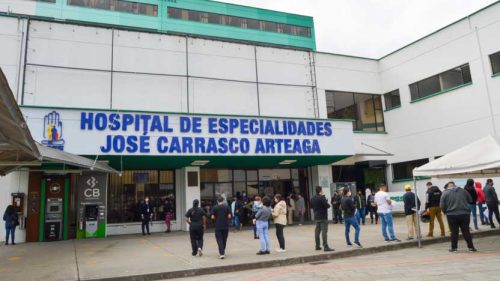
Cuenca retirees challenge medical and therapy changes at IESS senior center.
Fund Grace News

Fabianos Pizzeria News