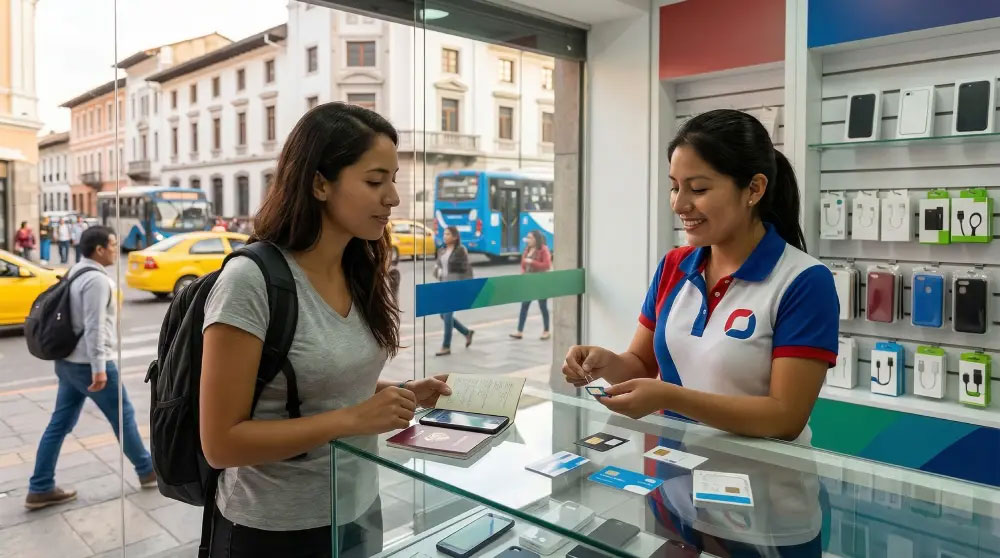















Weight watching in Cuenca: How Temu helps keep you under the 4 kilo limit for shipments
Several readers have asked Charlie to comment further on imported packages and the pros and cons of various sources, so I have been peering again into the mysterious world of cross-border shopping from my desk here at Larga Towers in Cuenca.
As many of you will already know, the 4×4 courier system in Ecuador allows you to bring in a package under 4 kilograms and under 400 dollars in value for a flat twenty-dollar fee. The twenty-dollar fee does feel a bit steep if you only buy one small thing, such as a seventy-dollar mini projector. But if you fill the same box with a selection of useful bits and pieces that you can’t find in Cuenca, like shoe horns and USB adapters, the fee begins to look more like a simple service charge on your ability to organize your shopping life sensibly or an IVA substitute.
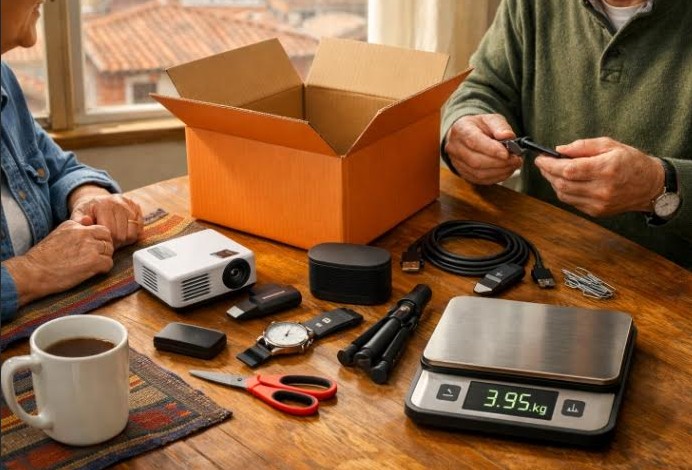 Enter Temu, stage right, with what I now think of as the Magic Basket. Prices are already low since the dedicated Temu Ecuador website is geared to the 4×4 system, and the shipping is surprisingly reasonable. You add your little HY320 projector to the basket, then perhaps a tripod, a USB stick, an Android TV dongle, a Bluetooth speaker, an HDMI cable, a pair of kitchen scissors, and maybe even a small folding table on which to perch your new home cinema empire. At some point you inevitably trip over the famous 4-kilogram line. The app pauses, addresses you sternly about the rules laid down by the gobierno of Ecuador, and suggests you remove something large.
Then, once you do, a remarkable thing happens. The basket lets you keep adding small items back in, recalculating the package weight every time. You are no longer just shopping, but packing for international cargo like a professional freight handler. The Temu shopping basket is not just a shopping cart. It is an online digital scale as well as a coaching session in Ecuadorian courier economics.
So now you add items one by one, a memory card, a pair of nail clippers, a pair of socks, until you arrive at 3 Kgs and 99 grams. Then Temu tells you to stop while you are ahead.
This is one of the reasons Temu has taken Ecuador by storm. It teaches you how to make the twenty-dollar fee disappear almost entirely. If you send one seventy-dollar item, the fee is painful. If you send twelve useful items in the same box, the import overhead per item drops to a couple of dollars at most. And yes, that usually means you avoid paying the 15% IVA as well. Meanwhile Temu’s consolidation warehouses do their thing, your parcel drifts across the Pacific, Aduana receives its twenty dollars, and the local courier delivers your carefully curated parcel of practical delights.
Temu was even predicted to hit one billion dollars in annual sales to Ecuador in 2025, which is a number large enough to make one put down one’s coffee. I do not know how much this prediction has been affected by the new twenty-dollar import fee and the clampdowns on wholesale importers, but it tells you something about how popular the orange app has become, and it is not hard to see why.
Most newcomers browse Temu the way they stroll through Supermaxi, looking at whatever is stacked on the end of the aisles and assuming that must be the entire store, but it is not. The front page is simply Temu’s idea of what you should want, sprinkled with a few algorithmic guesses and a lot of “bargains” and “new arrivals” that are probably stinking up a warehouse in Shenzhen. The real treasure is in the search bar. Type in something specific and Temu will suddenly reveal entire underworlds of merchandise that never show their faces on the front page, sometimes, for good reason. Adult toys, for example, are invisible until you go hunting, yet behind the back-of-the-store curtain there are hundreds of them throbbing away in their demo videos and apparently satisfying loyal customers across Latin America. The same applies to dozens of other categories that Temu treats like a speakeasy. If you knock politely and type “buscar,” alguien le abre la puerta.
Watches are a good place to begin your detective work. You can search for men’s watches and you will be offered everything from automatic mechanical timepieces priced at $399.99 to fake Swiss Swatches for about $2.99. Ladies’ watches lead into a different rabbit hole entirely, full of delicate sparkly things that often cost less than a ciabatta at Fabiano’s. Then there are tools, kitchen gadgets, cosplay wigs, sewing supplies, sheets, window drapes that can replace your view of the neighbor’s wall with a sweeping vista of the Bay of Naples on a sunny morning, magic tricks, wall art, jigsaw puzzles, ladies’ lingerie, false eyelashes, exercise equipment, hobby electronics, and much more, each with their own secret ecosystem, none of which Temu is going to take the initiative to show you unless you ask. Learning to use the search bar feels a bit like finding the service entrance to a department store. You begin to realise that the front page is just the plate-glass window at street level, while the real action is all at the back on the third floor behind a door where only clients with membership cards are admitted.
Once you get the hang of this secret life you may find yourself browsing for things you never knew existed. Replacement rings for pressure cookers that Ecuador stopped importing a decade ago. Bicycle tools that no one in the ferretería has ever heard of. Travel adapters, hammock straps, eyebrow stencils, and repair kits that would have saved your glasses three months ago if only you had known. Temu rewards curiosity, or as people around here say, solo por si acaso.
Now here is where the story becomes interesting. An inversion has occurred, because in the United States, both Temu and Amazon buyers often have to pay state sales taxes and, depending on how the products enter the country, they may also face huge China, India, or Korea import tariffs or added “import charges.” On top of that, many U.S. orders are handled through domestic warehouses, which carry their own costs. Meanwhile, here in Ecuador we still enjoy the simple rule that one parcel under 4 kilograms and under 400 dollars in value equals one twenty-dollar fee. The result is that some people in Cuenca are paying a lot less overall for a box of imported goods than someone in Chicago or Phoenix buying the exact same things with delivery to a suburb.
Amazon operates with an entirely different logic from Temu. Its whole structure revolves around domestic fulfillment, inventory control, and the protection of warehouse processes. Amazon Global may estimate duties for you, but it does not gently encourage you to top up your parcel to 3.99 kilograms. It simply thanks you for your order. Temu, on the other hand, behaves like a customs consultant perched on top of your computer monitor, guiding you through the limits of the courier system and suggesting that you might like to add a USB cable or a packet of paperclips to balance the scales. It is online shopping with a built-in cargo supervisor.
There are, of course, two sensible cautions. Returns are theoretically possible but often impractical, so assume whatever you order is staying with you, for better or worse, though Charlie did get a store credit for a watch that somehow got away from its packet companions somewhere in customs clearance. If this happens, you can congratulate yourself on your taste being so good that someone in customs thinks one of your purchases is worth snaffling.
Still, the Magic Basket remains the real star. It feels like solving a subtle puzzle. Can I get to 3.99 kilograms? What else do I actually need? Maybe a small tool or a cable, or at least something that will be useful rather than a frivolous waste of money. Before you know it, you have assembled a small home theater, boosted your kitchen drawer arsenal, and stocked up on toys for visiting grandchildren, all under a single twenty-dollar fee.
So yes, imported packages can be a blessing or an irritation depending on how you approach them. For now, Temu seems to understand Ecuador’s rules better than its competitors, and has wrapped them into a shopping experience that rewards those who pay attention. Here in Cuenca we find ourselves living like pensioners and shopping like billionaires’ mistresses, so it might have been a great deal worse.