















The Verdict: Is Moving to Ecuador Still the Right Choice in 2026?
 After months of navigating the online noise—the conflicting forum posts, the sensational YouTube videos, and the “I left Ecuador” blogs—it’s easy to feel more confused than ever. We’ve spent this entire series cutting through that noise. We have analyzed the hard data. We have dissected the two-tiered healthcare system, broken down the real-world 2026 cost of living, and, most importantly, separated the reality of on-the-ground safety from the fear of sensational headlines.
So, what is the final verdict? After all the research, is moving to Ecuador—and specifically to the Andean haven of Cuenca—still the right choice in 2026?
The answer is a resounding, “Yes… if.”
That “if” is the most important part of the equation. It’s the variable that determines success or failure. But as we’ll see, the biggest “if” isn’t about the country; it’s about you. Let’s break down the verdict on the “Big Three” concerns.
The Healthcare Verdict: Excellent, If…
The verdict is “Yes, if you understand and embrace the ‘hybrid system’.”
Healthcare is non-negotiable, and the good news is that Ecuador, and Cuenca in particular, excels. The system’s quality isn’t the question; navigating it is.
The private system is fast, affordable, and high-quality. You can see a top-tier, English-speaking specialist for $40-$50, often on the same day. Dental care is a fraction of U.S. costs, with clinics like smilehealthecuador.com offering world-class cosmetic and restorative work that would cost a fortune back home. A private health insurance plan, for a healthy person in their 60s, can be found for $150-$200 a month.
The public IESS system (Ecuador’s social security) is the bureaucratic, crowded, and slow counterpart. However, it has one superpower: it covers everything, including pre-existing conditions, with no co-pays or deductibles (once you’re fully enrolled).
Relying on either system alone is a mistake. The savvy expat uses the “hybrid strategy”: You pay your $80-$90 a month into the IESS system as your catastrophic, “sleep-at-night” insurance. It’s your ultimate backstop. But for 95% of your needs—the check-ups, the dental cleaning, the prescriptions, the minor procedures—you use the convenient, low-cost private system and simply pay out-of-pocket or use your affordable private plan.
The Cost of Living Verdict: Unbeatable, If…
The verdict is “Yes, if you are arriving with a foreign-based income.”
The value proposition remains undefeated. Yes, inflation has touched Ecuador like everywhere else, but the baseline is so low that the impact is minimal for those with foreign currency.
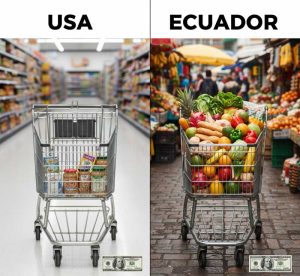
A couple can still live a very comfortable, amenity-rich life in Cuenca on a budget of $1,900 – $2,100 a month. What does that “comfortable” life include? It means a modern, 2- or 3-bedroom apartment in a desirable neighborhood, high-speed fiber-optic internet, eating out at lovely restaurants several times a week, regular housekeeping, and still having money left over for healthcare and travel within this beautiful country.
This is a feat that is simply impossible in almost any desirable city in North America or Europe, where that same budget would barely cover rent in a studio apartment. The “if” here is critical: this budget is based on receiving Social Security, a pension, or remote work income. It is not achievable if you plan to move and find work in the local economy, where the minimum wage is around $482 a month.
The Safety Verdict: Secure, If…
The verdict is “Yes, if you make the smart choice and live in Cuenca (or a similar Andean town).”
Let’s address the elephant in the room: the national headlines about violence are real. But they are also geographically isolated. The security issues are overwhelmingly concentrated in the coastal port cities (like Guayaquil and Esmeraldas) and are tied to drug trafficking routes.
To judge Cuenca by the situation in Guayaquil is like deciding not to move to Denver because of crime rates in Baltimore. The two are separated by the massive Andean mountain range and are worlds apart in culture and safety.
Cuenca remains a bastion of peace. Nestled in its mountain valley, it has a different rhythm. Walkability is high, community policing is present, and families are out in the parks until late. Of course, it is not a utopia. You must practice the same “big city” common sense you would anywhere: don’t flash expensive jewelry, be aware of your surroundings, and avoid walking alone in isolated areas late at night. But for the average expat living a normal life, Cuenca feels, and is, remarkably safe.
The Real “If”: The Verdict on You
The data is clear. The “Big Three” of healthcare, cost of living, and safety are all overwhelmingly positive for a Cuenca-based expat. If you fail, it won’t be because of these things.
The real test—the real “if”—is whether you can handle the “little things.”
These are the daily friction points that, for the wrong personality, can become overwhelming.
- Can you handle the noise? Not just traffic, but the weekend-long neighborhood festivals with booming fireworks, the gas truck endlessly blaring its looped jingle, and the chorus of barking dogs?
- Can you handle the “mañana” culture? This isn’t just “tomorrow.” It’s a fundamentally different relationship with time. Can you wait patiently when a bank errand takes two hours, or when the plumber shows up two days late? It’s a culture that prioritizes relationships over rigid schedules.
- Can you handle the bureaucracy? Getting your visa, opening a bank account, or setting up a utility will require patience, paperwork, and persistence.
- Can you handle the “mule system”? Amazon doesn’t deliver here easily. Can you adapt to buying local or relying on friends (or paid services) to “mule” your favorite products from home?
For the right person—someone who is patient, adventurous, flexible, and armed with a sense of humor—the answer is easy. These aren’t “cons”; they are “trade-offs.”
For the minor frustration of a slow bank line, you get a life of financial freedom. For the trade-off of a barking dog, you get a community where you can afford high-quality personal healthcare. For the trade-off of not having Amazon Prime, you get a safe, vibrant, and culturally rich city to explore.
Is Ecuador the right choice in 2026? We think so. It’s a country that gives you a million reasons to smile.
This entire guide was sponsored by the team at smilehealthecuador.com, who believe that living your best life in Ecuador should include a smile you’re proud of. They are the best in the business, and the perfect first stop on your new adventure. Visit them in Cuenca and tell them this guide sent you. You won’t just get a world-class smile—you’ll get it at a price that makes this incredible country an even smarter move.