













Cuenca public hospital on ‘life support,’ doctor says; Mazar reservoir continues recovery; EU opens drug trafficking intel center at the Gulf of Guayaquil
A doctor at Cuenca’s Vicente Corral Moscoso Hospital has filed a complaint against the Health Ministry due to the lack of medicines, equipment and access to medical specialists. He claims conditions at southern Ecuador’s largest public hospital “put at risk the care of thousands of patients and create a climate of constant tension for both patients and hospital staff.”
The doctor filed the complaint anonymously with the national Ombudsman’s office. “In the past, health professionals at the hospital have been fired for complaining about poor conditions and I do not wish to make this a personal matter,” he said. “This involves the welfare of the people and the collapse of a facility that should be serving them.”
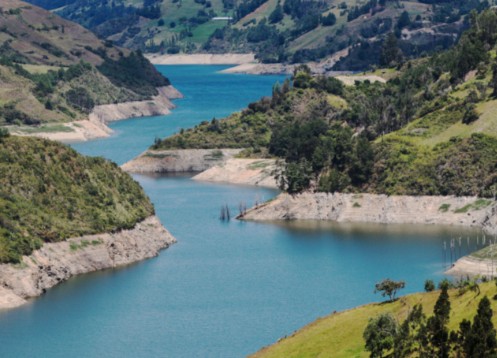
The water level at the Mazar reservoir continues to rise following recent rains. The hydroelectric turbines at the Mazar complex generate 39% of Ecuador’s electricity.
The complaint listed “basic medicines” that were out of stock or availed only in limited quantities at the hospital pharmacy including: paracetamol, ibuprofen, diclofenac, losartan, chortalidone, amlodipine, espironolactone, metformin, acetylsalicylic acid, tamsulosin, insulin, magaldrate, phosphomicin, as well as various painkillers, including anesthesia for stitches.
The doctor charged that the Health Ministry’s January 11 claim it had restored pharmaceutical supplies and repaired broken equipment was not true. “This is false and was a public relations stunt by the government,” he said. “Small amounts of medicines were delivered but this did not overcome critical shortages. Scanning equipment and operating rooms were not repaired and no specialists were hired.”
He added: “Vicente Corral Moscoso Hospital remains on life support.”
Mazar reservoir continues recovery
The water level at the Mazar reservoir in eastern Azuay Province continues to recover. As a result of increased rainfall since early January, the reservoir level stood at 2,143 meters above sea level Monday afternoon, according to the Electric Corporation of Southern Ecuador (CelecSur). The maximum level of the reservoir is 2,153 meters.
On January 8, following six weeks of drought conditions, the water level had fallen to 2,137 meters, requiring the shutdown of one of three electric turbines operating at the Mazar complex.
Engineers at Mazar also say the inflow from the Rio Paute has returned to “normal,” meaning that the level at the reservoir will continue to rise.
When operating under optimal conditions, the Mazar complex produces almost 40% of Ecuador’s electric power.
EU opens intel center in Guayaquil
The European Union has opened a “maritime and port intelligence” center in Guayaquil. Called the Fusion Center, the facility will coordinate with Ecuadorian law enforcement to fight drug trafficking in the Gulf of Guayaquil.
According to EU officials, the center will focus on cocaine being illegally exported from the ports in Guayaquil. “We are targeting the drug trafficking structures that operate in the Gulf of Guayaquil, from the transport of illegal drugs to the docks, their loading into containers and onto cargo vessels, and their departure from the docks,” the EU drug control office said in a statement.
The statement continued, saying that EU personnel, working with Ecuadorian police and military personnel, would develop an “intelligence network” to track shipments to the ports and work to improve inspection procedures for shipping containers. “Our task is not to physically confront drug traffickers – that is the job of Ecuadorian law enforcement — but to negatively impact their shipping operations in the ports at Guayaquil and elsewhere in the country.”
The EU said its investment in the center recognizes the fact that European nations are the destination for much of the cocaine shipped from Ecuadorian ports.