












Forty-five years later, still paying for convenience
There was a time when the future of banking arrived before the machines required to use it, and I discovered this minor chronological error shortly after I arrived in Bermuda on July 3rd 1980 to work for the health ministry, where I was paid by electronic transfer into my account at NT Butterfield, a system presented as modern, efficient and faintly space-age, except that at that point ATMs had not yet been invented, or at least I had never seen one and, like video cassette recorders, they had not yet washed up in Bermuda.
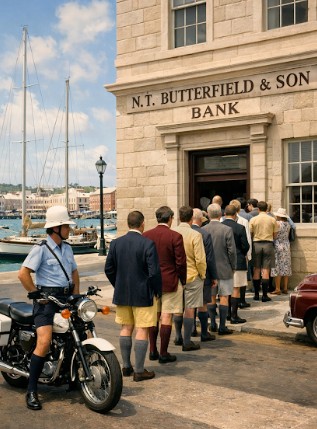
This mattered because most people in that economy were paid monthly, and paid on the last Friday of the month, which meant that the entire island workforce would therefore perform a distinctly traditional ritual at the same time, leaving work to form a long lunchtime queue inside and sometimes outside the bank to withdraw cash that had arrived invisibly through wires so that we could pay our grocery “tick” account with paper notes and metal alloy coins. The computers had arrived, the payroll had modernized, and yet payday still required a line that could swallow your lunch hour, along with the patience of a saint and the stamina of a man waiting for a delayed ferry.
 Local grocery stores often maintained a ledger that was settled in cash once a month, the telephone and electricity bills were paid by writing and autographing a paper check by hand, sealing it in an envelope and dropping it into a red cast iron pillar box that sometimes bore the initials of the late Queen Victoria, but water required no payment at all because it fell obligingly from the sky onto a whitewashed roof and was stored in tanks beneath the house, with the heavens providing the supply chain free of charge. In those days the act of “moving money” still involved paper, pen, envelopes and small walks, and the most advanced part of the system was the bank’s internal machinery rather than anything the customer could see.
Even then we were told, in confident tones, that electronic banking would reduce costs because there would be less paper shuffling, fewer bank tellers and fewer armored trucks, and although the logic was impeccable, since computers do not take lunch breaks and rarely request pensions, what was left unsaid was that lower internal costs for banks do not automatically translate into lower external costs for customers.
Yes, the marginal cost of processing a transaction almost certainly declined, yet as branches were trimmed, then consolidated and eventually redesigned to resemble airport lounges, and as tellers vanished while apps appeared, the fee schedule demonstrated a remarkable capacity for evolution, sprouting ATM fees, out-of-network ATM fees, account maintenance fees, overdraft fees and assorted service charges that were modest in isolation and substantial in aggregate.
Digitization reduced friction, and in doing so it increased volume, because once money can move instantly it tends to move more often, which creates more transfers, more subscriptions and more recurring payments, along with more opportunities for small embedded charges that feel administrative rather than transactional. At the same time, the savings from fewer tellers were absorbed by vast expenditures on core banking software, cybersecurity, fraud detection and compliance departments that would have astonished the managers of the old pillar box era, so that efficiency did not abolish cost but merely rearranged it.
Here in Cuenca, the Pichincha and JEP apps on my phone are undeniably convenient, and I can even use the JEP one, although not Pichincha for some reason, to pay for a tranvía fare on the fly should I forget to carry or top up my preferencia card, which is a small mercy when one is standing at the parada and hearing the ding-ding of the approaching street car, and it is also a quiet reminder of what we have gained even when we suspect we have not saved any money. I do not miss the Bermuda ritual of surrendering part of my lunch hour on the last Friday of the month in order to stand in line at the bank without air-conditioning with every other monthly employee on the island, because time has value even when it is not itemized on a statement, and the avoidance of that queue must be worth something even if it never appears as a credit entry.
What I have come to understand over the decades is that technology rarely eliminates costs; it shifts them from visible to embedded, from transactional to structural, and from the counter window to the code that runs silently in the background. We were told that electronic banking would be cheaper because computers do not eat, sleep, call out sick or go on strike, and in a narrow operational sense that was true, but the broader promise of cheaper banking turned out to be a hopeful extrapolation rather than a binding pledge.
The rain, which the Department of Tourism craftily chose to call Liquid Sunshine, still falls freely in Bermuda and fills the tanks without invoice or surcharge, yet banking is not rainfall but a business, and businesses are adept at capturing the benefits of their own efficiencies, so that although we no longer have to give up a lunch hour to the payday queue and we tap our phones to pay bills with enviable ease instead of licking envelopes, we still seem to be somehow paying for the cost of envelopes, ink, paper checks with our name on them and postage stamps.