















Review of Carmina Burana: Singing Latin in the rain
It was raining hard the night I went to hear Carmina Burana at the cultural theater in Cuenca, which seemed appropriate because the piece begins with the famous chorus about the wheel of fortune turning and humans being tossed about like socks in a washing machine.
Outside, the narrow streets around the theater were shining under the streetlights and the usual evening traffic of taxis and buses moved slowly through the rain, while people hurried toward the entrance carrying umbrellas and the slightly damp optimism that accompanies any cultural event in this city.
 Cuenca rain is not normal. It usually starts just as you leave your front door and stops at the moment you arrive home, and Saturday night was no exception.
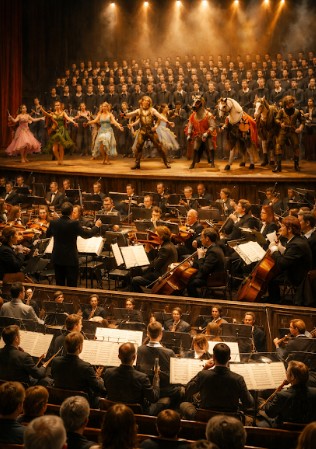
The theater of culture was nearly full. People shook umbrellas dry in the foyer and folded them with the small ceremony that wet umbrellas require. Below the stage, in the orchestra pit, musicians were settling themselves among a forest of music stands and instruments, which immediately raised expectations because any musical event that requires this many chairs for the orchestra usually intends to do something serious.
Carmina Burana, for those who have never encountered it, is not really an opera in the usual sense. It is more like a medieval songbook that someone attached to a very large orchestra and massed choirs. Dancing is actually optional, but read on.
The texts come from wandering scholars and monks who apparently spent much of the thirteenth century drinking wine, celebrating spring, and writing poems about love and fate.
The lyrics are sung mostly in medieval Latin, which gives the lyrics a certain ecclesiastical authority while at the same time making the precise nuance somewhat mysterious for the average expatriate in the audience.
The music begins with the famous “O Fortuna,” which many people recognize even if they cannot quite place it. It has been used so often in movies that one half expects an epic Viking fleet or an army of gladiators led by Simon Bolivar to march onto the stage during the first chorus.
Instead what appeared in Cuenca was an excellent orchestra below the stage, a very large choir above it, and a troupe of dancers who seemed to represent nymphs, fauns, and other creatures who clearly spend a great deal of time hopping around in forests and picking each other up while in a state of semi-nudity. The choreography was energetic enough that, for a moment or two, the evening felt less like a medieval cantata and more like a South American version of Saturday Night Fever even though a few of the more contemplative songs also put one in mind of The Sound of Music.
The singing was impressive, the orchestra powerful, and the dancers enthusiastic in the way dancers often are when they have been given music that practically dances for them.
One curious feature of the work is that it has no real story. The songs jump from springtime to drinking to love and back again, which can make the audience wonder where and when the action is supposed to take place. The answer is that it does not really take place anywhere. It exists mostly inside the music.
While listening I found myself noticing something else about the evening. Human beings are, as far as we know, the only species that composes music, builds orchestras, choreographs dances, forms choruses, and then gathers in large rooms to watch other members of the species perform these complicated rituals. At the end we clap our hands, stand up, and applaud people who have spent months learning to sing, play, or dance in harmony with one another.
There is something rather wonderful about several hundred members of a community encircled by mountains assembling on a rainy night simply to enthusiastically take part in that process.
At one point a portly tenor appeared dressed in a black suit to sing the famous lament of the roasted swan, a bird who once swam proudly on the lake but now finds himself turning slowly on a spit above a fire. The role is tragic for the swan but often comic for the audience, and the singer performed it with admirable conviction.
While listening I could not help noticing something else about the theater. It is a handsome hall with good acoustics and excellent sight lines, but it does not appear to have much in the way of fire exits. One begins to think about such matters when surrounded by several hundred enthusiastic music lovers and a stage full of performers.
Still, fortune was kind to us that evening. The rain continued outside, the orchestra thundered through the final chorus, the expected standing ovation was stood, and the wheel of fortune completed its turn without incident.
A few minutes later the umbrellas opened again and several hundred people stepped back into the Cuenca rain, which seemed, somehow, like exactly the right ending for an evening spent singing in Latin about the unpredictable turns of fortune.