







Noboa visits Cuenca and brings the government with him; Ecuador and Colombia officials to meet in Peru; China becomes Ecuador’s main trade partner
In a two-day visit to Cuenca, President Daniel Noboa signed contracts for public housing units and highway repairs, and said his national focus remains on fighting corruption and drug trafficking crime. The president was accompanied by members of his cabinet and the National Assembly.
In a Wednesday event, Noboa reactivated the Iskay Housing Project in northeast Cuenca that had lain dormant for six years. The seven-building high-rise complex will provide more than 200 residential units for low-income families when it is completed.
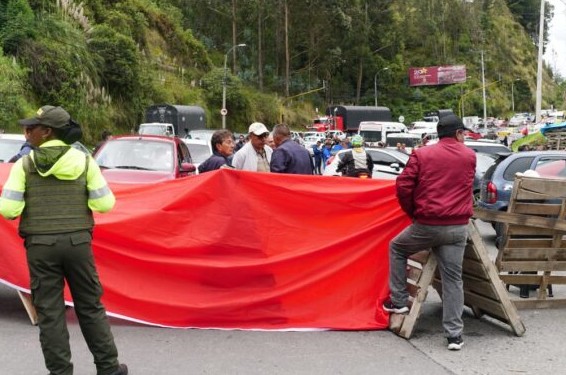
Ecuadorian and Colombian business groups protested reciprocal tariffs at the border on Wednesday and Thursday.
On Thursday, he held a public meeting on the Cuenca-Molleturo-Guayaquil highway to announce the signing of a $7 million contract for “major interventions” to stabilize the highway. The major artery between Cuenca and Guayaquil has been plagued by landslides and structural problems for years.
In general comments, Noboa attacked “corrupt” judges for allowing alleged criminals to go free and said he is working with the judicial authorities to identify and remove judges who “endanger the public.”
Ecuador and Colombia officials to meet in Peru
Delegations from Ecuador and Colombia will meet March 25 in Lima, Peru to negotiate a resolution to the conflict that has resulted in reciprocal 50% tariffs on imports. The meeting will be held at the headquarters of the Andean Community (CAN).
In a statement, CAN said the meeting will between the foreign affairs ministers of the two countries and their staffs, and will be moderated by the General Secretariat of CAN.
The two governments have been under increasing pressure from business interests to find a solution since Daniel Noboa imposed a 30% tariff on most Colombian imports in February, claiming the Colombian government was allowing drug traffickers to “pass with impunity” into Ecuadorian territory.
On Wednesday, business groups from both countries issued a joint statement saying that the import tariffs had created “terrible hardships” for thousands of families in both countries, especially in the border region. “We are desperate for a solution since the crisis is creating unemployment and economic uncertainty for the people of our two countries,” the statement said. “Please resolve the binational problem as soon as possible so business can be restored.”
China becomes Ecuador’s main trade partner
China has overtaken the U.S. as Ecuador’s main trading partner, the Trade Ministry reported Thursday. “In January, for the first time in history, total imports and exports with China exceeded those with the U.S.,” the ministry said in a statement, adding that the change was not unexpected and reflected a “multi-year trend.”
On Thursday, President Daniel Noboa acknowledged the news, saying the “trade friendships” between both China and the U.S. were essential to Ecuador’s prosperity. “Our relationship with China has been strong for many years and the recent news only makes it stronger,” he said, acknowledging a trade agreement signed between the two countries in 2025.
In January, exports to China totaled $664.6 million compared $583.7 million to the U.S. China exports grew 52.4% from Janurary 2025, while U.S. exports rose 9.6%.
Petro backs off bomb claim
Colombian President Gustavo Petro backed off an earlier claim the Ecuador intentionally dropped a bomb in Colombian territory last week. Following a meeting between Ecuadorian and Colombian military commanders on Thursday, Petro said the bomb apparently “ricocheted” off another bomb, landing on the Colombia side of the border.
In a Friday social media post, Petro urged Ecuador to carry out anti-trafficking operations further from the border. “I understand and respect the objectives of Ecuador’s military actions but I ask the military command of that country to respect our border area,” he said.