














Ecuadorian fishermen say they were attacked and kidnapped at sea by the U.S. military
In an interview in the newspaper Primicias, Ecuadorian fisherman Erick Fabricio Coello Saltos described how he and 19 other fishermen were attacked on the high seas by drones and then kidnapped on a U.S. military vessel.
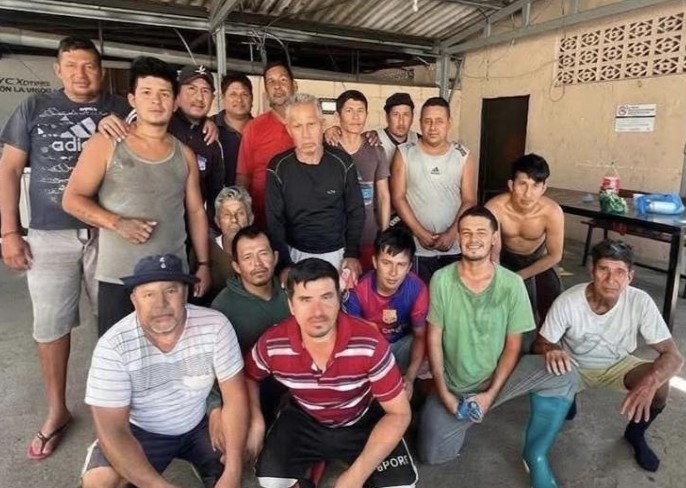
Some of the Ecuadorian fishermen that were aboard the Don Maca fishing vessel that was attacked at sea last month.
According to his testimony and that of others, the men were hooded, held in a shipping container and transported to El Salvador. There, the Ecuadorian fishermen were handed over to local authorities who, after medical evaluations, kept them in a reception center until their deportation to Manta (costing their families nearly $400 for a return ticket).
Upon his return to Ecuador, 27-year-old Coello reported that he lost nearly 90% of his vision, and that his eardrums suffered significant damage from the powerful explosion that rocked the Don Maca. His left eardrum is perforated, and his right one is severely damaged. In addition, the fisherman says he suffers from nightmares and has filed a series of petitions to obtain funds to treat his physical and psychological ailments.
“What we went through was very difficult; I’m left with that trauma. Sometimes I get scared at night; it comes back to my mind. I’m giving up this life as a fisherman for good. I would never go fishing again … I was the person most affected on the boat, because it all happened while I was hanging my clothes up in the cabin and had no warning of the attack,” Coello told Primicias.
According to Coello, he needs $7,000 for eye surgery and another $4,500 for a procedure on his eardrums, in addition to the nearly $60 a day he spends on doctor’s visits. Several raffles and bingo games have been organized in Manta to raise funds; however, Coello has requested assistance from the government and has yet to receive a response.
Chronicle of an attack
Coello says the attack took place on the high seas. The fishermen set out from Manta on March 17 aboard the Don Maca, a commercial fishing vessel, along with six trawlers, which are used to catch fish and then load the catch onto the Don Maca.
One night, after several days at sea, they spotted an unfamiliar vessel approaching the Don Maca that, according to Coello, resembled a tuna boat. Shortly after, they observed a drone approaching and then flying away. Coello says that he recorded a video of the drone and sent it to his father.
Two days later, the attack occurred: “Suddenly there was an explosion, and then another; I was covered in blood.” After that, the Ecuadorian fisherman, the father of a 4-year-old autistic boy, recounts that some fishermen took a small boat and approached the strange vessel. There, they were asked how many of them there were, how many were injured, and to bring all the fishermen to the boat operated by the U.S. military. The fishermen obeyed.
Onboard the U.S. vessel, the fishermen were hooded, handcuffed, and locked up until they arrived in El Salvador. According to Coello, the alleged captors lied to Salvadoran authorities about the encounter. “The gringos told them they’d found us in the water, adrift and shipwrecked. But that’s not how it happened.”
At least two crew members were told by U.S. personnel that the Don Maca was misidentified as a drug-transporting ship and that the attack against it was a mistake.
Other vessels attacked and missing
The Don Maca incident may not be the only attack on Ecuadorian vessels on the high seas. Several days ago, the missing crew members of the vessel Negra Francisca Duarte II were located in El Salvador and reported something similar to what the fishermen of the Don Maca had described happened to them: drones flying overhead, explosions on deck, the crew being detained, and their transfer to El Salvador.
“We were returning from fishing; we weren’t armed. Suddenly, we saw a drone approach and explode in the wheelhouse. Then I looked toward the back; the fire was already spreading … In two boats, we approached a US vessel, and they handcuffed us and treated us like prisoners. We were afraid they were going to kill us,” Hernán Flores, captain of the “Negra Francisca Duarte II”, told Primicias.
These recent accounts have led the families of the missing fishermen who set out to work aboard the Fiorella to fear that they have met the same fate. The eight fishermen from Jaramijó and Manta have been missing since January 20, 2026.
“Two crew members returned (in a small boat) because they were fishing on their own, but before the (mother) ship disappeared, they saw a drone circling them, yet they continued fishing; after that, they spotted smoke to the north,” stated Juan Alvia Cevallos, the lawyer for the families of the missing.
The mother of one of the missing fishermen, María Cueva, said: “The two survivors say they saw the drone and a patrol boat. We are certain that they (the United States) took them, just as they have done with the other boats. I want my son to come home.”
The Ecuadorian government’s “strange” response
For its part, the Ecuadorian government, led by right-wing Daniel Noboa, a staunch ally of the Trump administration, has said nothing about the incidents. When Ecuador’s foreign minister, Gabriela Sommerfeld, was asked about possible U.S. attacks on Ecuadorian fishermen, the head of Ecuadorian diplomacy dodged the question: “I couldn’t tell you for certain what activities the fishermen were engaged in, or the situations they find themselves in … The relevant authorities, particularly those responsible for security, will be able to say what kind of activities they were carrying out.”
The family of one of the fishermen on the Don Maca was told by an assistant to Sommerfield that the attack on the ship and the detention of the crew was “an error” by the U.S. military. The assistant refused, however, to reimburse the fisherman his airfare home from El Salvador.
The fishermen and their families have categorically rejected the accusation that the Ecuadorians that were attacked and captured on the high seas were drug traffickers: “They are just fishermen, not drug traffickers, thieves, or murderers – that’s no reason for them to have been taken,” states María Mero, a relative of the fishermen from the “Fiorella.”
Attorney Jorge Chiriboga agrees: “They have had to endure violence on the high seas despite having nothing to do with illegal activities; they are unarmed, were returning from a fishing trip, and were attacked by a foreign nation.”
In addition, Chiriboga told Primicias that he will file a legal complaint and bring the matter before the National Assembly to investigate the facts, and he demanded that Ecuadorian authorities ensure respect for Ecuadorians attacked by other countries: “This is an act of terror against Ecuadorian fishermen in the exclusive economic zone of the Ecuadorian state; therefore, it is Ecuador, the State, and the Government that must safeguard the interests of Ecuadorian citizens.”
For now, the fear of an attack has led many fishermen to decide to not go out to sea and thus to forgo one of the few sources of income available to residents of Ecuador’s coastal areas. Added to this are the constant threats from extortionists and pirate ships that prey on fishermen, which have created an atmosphere of terror, uncertainty, and the risk of losing income vital to their survival.
“This will also hurt the Manta’s economy and make it harder to hire people to go out to sea, because their families are afraid they won’t come back,” Chiriboga said.
Quito and Washington: The new military alliance
Noboa has made Ecuador a part of the Shield of the Americas, a hemispheric military alliance between several right-wing governments in Latin America and Washington, under which U.S. forces would lead counterterrorism activities throughout the Americas.
Quito and Washington announced the start of coordinated military operations on Ecuadorian territory. In one such operation, both US and Ecuadorian forces released videos showing the bombing of a building allegedly used by drug traffickers, although several human rights groups, local residents, and The New York Times have claimed it was a dairy farm. Following the bombing, residents of the area reported being beaten and electrocuted by Ecuadorian forces.
________________
Credit: Peoples Dispatch