















Criticism mounts against government’s anti-crime campaign days before another curfew takes effect
“It doesn’t work and it doesn’t solve anything,” says Luis Córdoba, researcher at the Ecuadorian Observatory of Conflicts at Central University in Quito, referring to the government’s two-week curfew that goes into effect May 3. “We have two-year’s experience to this approach of fighting crime and the results are clear. The situation has not improved.”
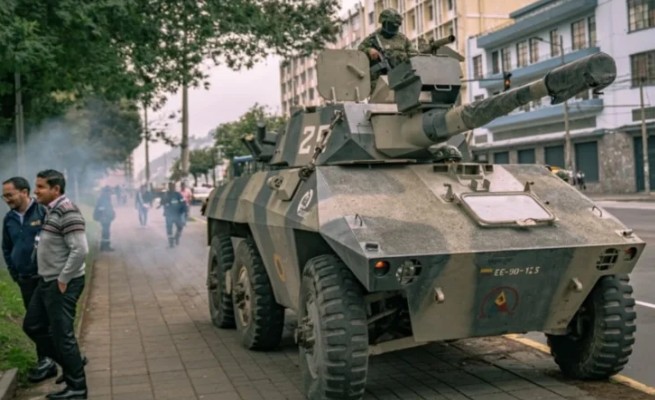
A military vehicle on a sidewalk in Quito in January.
Córdoba is one a growing number of academics and elected officials questioning the new round of curfews as well as the government’s overall strategy of combating organized crime.
The curfew will apply from 11 p.m. to 5 a.m. in Manabí, Santa Elena, Pichincha, Esmeraldas and Sucumbíos Provinces and in the cantons of La Maná (Cotopaxi), Las Naves and Echeandía (Bolívar), and La Troncal (Cañar).
Córdoba also questions the decision to impose the curfew in Quito and Pichincha Province. “The murder rate and crime rate generally is less than 10% here compared to the coastal cities,” he said. “What is the logic? Is there a political motivation?”
Quito city Councilman Wilson Merino agrees and complains that city officials were not included in discussions to “lock down” the city at night. “There was no dialogue, no sharing of ideas with the people closest to the problem,” he said. “Yes, we have insecurity issues in the city but they are not the kind that affect Guayaquil and Manta and certainly not the kind that putting soldiers and army tanks on the streets will solve.”
Merino adds that basic questions about who will be allowed on the streets during the curfews have not been answered. “The Interior Ministry has not told us if garbage can be collected or if repairmen can fix electric transformers if they malfunction during curfews.”
Merino also worries about the impact the curfew will have on businesses. “My neighbor operates three pizza restaurants that depend on late-night customers and his employees who will have no work at night,” Merino says. “His restaurants are in safe neighborhoods and he’s never had a problem, but because of the curfew he is forced to operate at a loss for two weeks and miss out on Mother’s Day activity.”
David Alfonso, a retired international relations professor in Cuenca, says the government’s response to crime as “been improvised” from the beginning. “Going back to 2024, they are making up the strategy as they go,” he says. “They do not consult people with the expertise to develop a smart, coordinated plan and seem to think that armed forces in the street is the answer.”
He adds: “Firepower alone will not solve the problem and we are currently witnessing its failure on an international scale in Iran,” he says.