














Thinking about soup
There is a moment, usually around one o’clock, when the soup bowl arrives. It is placed in front of you efficiently, often before you have quite sat down. 
The color is usually some shade of yellow. Floating within it are lentils, perhaps a few grains of rice, and the occasional small cube of potato that has surrendered all resistance. On the side, a small dish of popcorn appears, which you are expected to tip into the soup — an idea that initially surprises and then, after a few months in Cuenca, no longer does.
 This is the opening act of the almuerzo. Many expatriates speak warmly of these soups and describe them as comforting, traditional, nourishing. Charlie, who has had a lot of them by now, finds himself less easily persuaded. There is a sameness to the experience. The seasoning is modest. The ambition, one suspects, is not culinary but economic: the soup must fill the belly, must warm, must prepare the way for the main course, and must do all of this at a cost that allows the entire meal to be sold for three dollars or thereabouts.
Soup has always belonged to that category of food that is both cheap and nutritive, which is why we have soup kitchens but never steak kitchens. The logic is sound, but the end result is often dull.
But dullness is not inevitable, and Cuenca is an excellent venue for making something more interesting.
The first place most soups go wrong is the stock. In many homes, and certainly in most almuerzo kitchens, the base will be water with the assistance of a foil-wrapped cube or some powder from a packet or jar, which is a practical solution and, used carefully, entirely serviceable. It is also the point at which most soups give up their chance to be memorable. A simple alternative is to build a base from onions, garlic, and whatever vegetables are to hand, softened slowly in a little oil before liquid is added, and already you are in a different category of soup.
The markets here have made even this easier: it is often possible to buy soup vegetables already washed and diced, which removes most of the labor without quite committing you to an afternoon in the kitchen. A catering-sized can of peeled tomatoes, pureed, opens the door to a range of soups that the average almuerzo has never considered, and a blender, which is one of the more useful pieces of equipment available all over Cuenca can take a serviceable vegetable soup and turn it into something smooth and deliberate, thickened or refined according to taste.
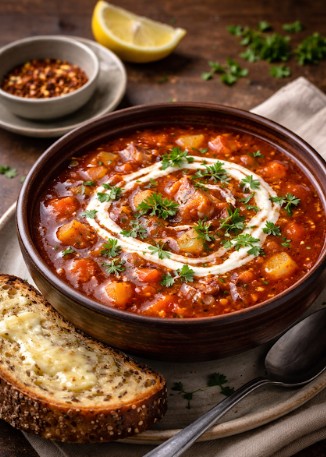
If there is one soup that rewards a little extra effort, it is the fish chowder that Charlie remembers from Bermuda. It is darker, sharper, and far less apologetic than anything that arrives in a Cuenca almuerzo, and it removes the need for the main course altogether.
You do not need anything particularly exotic to make it work. Start by softening a chopped onion and two cloves of garlic in oil, without rushing — most soups fail because this stage is treated as a formality. Add diced potato and carrot and let them take on a little color, then stir in a tomato or a small cup of tomato puree and a couple of squirts of soy or Worcestershire sauce and cook briefly before adding a liter of water or light stock, with a bouillon cube if you have one.
Simmer for twenty to thirty minutes, or ten minutes in a pressure cooker, which many households in Cuenca already own. Add 300 to 400 grams of firm white fish — corvina or tilapia work well — towards the end, since it does not need long and will fall apart if overcooked. Then add a small spoonful of panela. This does not make the soup sweet in any obvious sense, but it rounds out the acidity of the tomato and gives a faint suggestion of molasses, standing in rather well for the depth that might otherwise come from rum or sherry in the Bermudian original.
Finish with a small splash of vinegar or lime juice, a few drops of hot sauce if you like, and you have something satisfying and worth sitting down for.
Of course if you don’t want to make the chowder with fish, you could add cooked diced chicken or something else, and if you want to add a dash of rum, it will do no harm. Once the dish is complete you may wish to garnish the top with a swirl of cream, sour cream, yoghurt, grated parmesan cheese, or chopped fresh parsley, but that is up to you.
There are also practical considerations that change the economics of soup altogether. A refrigerator means soup can be made in quantity and improves overnight, which is likely the unspoken secret behind many of the better bowls served in town. A pressure cooker means tough cuts, dried lentils, beans, and bones can all be turned into something respectable in a fraction of the time, which is the difference between making soup occasionally and making it as a regular habit. And a liquidizer can be use to puree part of the soup, which is then mixed back in to thicken it.
Soup, at its best, is not merely a starter. It is what you do with what you have, how you stretch ingredients without telling anyone that you are doing so, and how yesterday’s excess becomes today’s meal without anyone feeling short-changed. The daily almuerzo bowl does its job reliably enough, arriving on time and, to be fair, it costs almost nothing. But in a city where the markets are full and the ingredients are good, it is not hard to make something much better at home and still spend hardly anything at all.