
















Yellow fever comes to Cuenca
There are moments in Cuenca when you suddenly realize you are no longer living in the sleepy colonial retirement brochure sold on Facebook by people wearing alpaca sweaters and holding cups of artisan coffee the size of flowerpots.
One of those moments arrives every four years with the FIFA World Cup.
Suddenly every taxi has football commentary on the radio. Men who normally discuss gas cylinders and plumbing fittings begin speaking solemnly about midfield pressing systems. Entire families appear in yellow jerseys to show their support for El Tri, as the national team is known, in reverence to the tricolor of the national flag of Ecuador.. Restaurants that usually struggle to attract customers before noon fill up with people staring at giant television screens while sipping encebollado very slowly and commenting on the faithfulness of the mothers of the referees and their need for eye surgery.
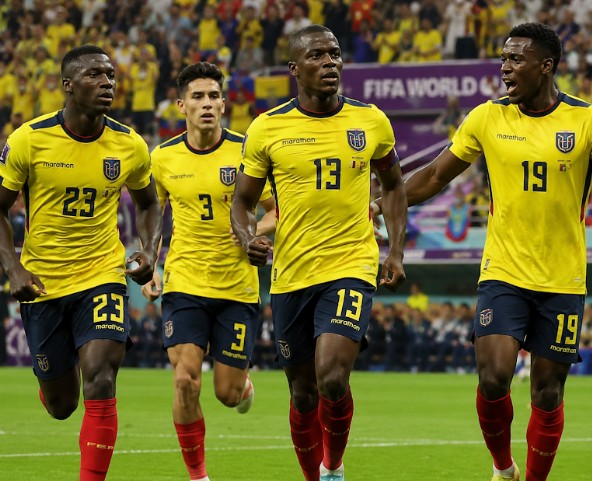 And this time Ecuador arrives with something rather unusual — great expectations.
For many years Ecuador at the World Cup felt slightly like being invited to a posh wedding where you were not entirely certain you belonged. The national team might perform bravely, perhaps trouble a respectable opponent for 45 minutes, and then disappear quietly after the group stage while Brazilians threw themselves on the turf and writhed theatrically if an opponent breathed on them, and Germans marched onward like Christian soldiers into the championship game.
Now things feel different, and the numbers support the feeling. In CONMEBOL qualifying, Ecuador finished second only to Argentina, accumulating 29 points from 18 matches with just two defeats, finishing ahead of traditional heavyweight nations including Brazil, Uruguay, and Colombia, and it wasn’t a fluke.
Part of the reason for Ecuador’s success is that modern football has changed in ways most people hardly notice.
The old idea that a national football team consists mainly of players living in that country has largely vanished. Small nations can now compete far above their weight because their team is not made up from the people living inside its borders. It is now the global diaspora against the rest of the world.
Morocco reached the semifinals in 2022 with players largely born and developed in European countries. The Caribbean island of Jamaica recruits heavily from English-born players with Jamaican parents or grandparents. Cape Verde, this year’s surprise turn, despite its tiny population, can draw its soccer team from expatriate communities spread across the soccer nations of Portugal, France, the Netherlands, and the Americas.
Even Portugal itself reflects this tangled football geography. Many people assume Cristiano Ronaldo was born in Cape Verde because of family ancestry stories and Portugal’s Atlantic island culture, but in fact he was born in Madeira, a Portuguese island group floating far out in the Atlantic Ocean.
Modern football nations are no longer neat little colored shapes on maps. They are global networks and Ecuador has become one too. Recent national squads have contained around 28 foreign-based players out of 32, with most of Ecuador’s best talent now scattered across England, Spain, Germany, Belgium, other European leagues, Mexico and Brazil. Ecuadorian football clubs increasingly function as exporters of raw talent, rather like plantations raising bananas to stock foreign tables.
The most famous example is Moisés Caicedo, the fourth most expensive English Premier League player of all time, whose transfer to Chelsea became one of the defining deals of his generation. In qualifying, the 24-year-old was first among Ecuadorians for tackles per 90 minutes and contributed three assists, though his competitive intensity also earned him four bookings and one red card. He is, in other words, exactly the kind of player you want when the stakes are real.
This still feels faintly surreal here in Cuenca where you can walk through Plaza Santo Domingo past elderly ladies selling herbs beside the church steps, see a man carrying a sack of potatoes on his shoulder, and then remember that somewhere in London a young Ecuadorian footballer worth more than $100 million on the transfer market is being discussed as a tactical investment by sports analysts with computerized heat maps.
What Ecuador has managed to build is not wealth, but a pipeline. Young players are identified early, trained seriously, sold abroad young, and hardened in elite leagues. Clubs like Independiente del Valle now produce footballers with almost industrial efficiency. Europe increasingly sees Ecuador not as a football curiosity but as a reliable supplier of raw materials.
Alongside Caicedo, the squad features Kendry Páez, a teenage Chelsea signing currently operating on loan at River Plate in Argentina, and Gonzalo Plata of Flamengo patrolling the wings. Up front, the evergreen 36-year-old Enner Valencia remains the beating heart of the attack, having scored six of Ecuador’s 14 qualifying goals — a remarkable return for a player who, by most logical calculations, should have been put out to grass by now.
The group draw has given Ecuador something both realistic and demanding. Group E contains Germany, Ivory Coast, Ecuador, and Curacao, which offers a navigable path and one potentially brutal evening. Ecuador must open against AFCON champions Ivory Coast in Philadelphia, then face Curacao in Kansas City, before closing the group stage against Germany at MetLife Stadium in New Jersey. The scheduling is significant. If Ecuador can secure some points from the first two matches, then the Germany game becomes a test of ambition rather than a matter of survival.
The German team arrives motivated by institutional Gesichtsverlust having failed to advance beyond the group stage in back-to-back World Cups since last winning the tournament in 2014. They will not be taking Group E lightly. Germany’s coach Julian Nagelsmann has already said publicly that Ecuador are “not easy to play against” and that his squad has “three or four real top stars.” Being described with cautious respect by a German coach is what the Germans would probably call Vorsprung durch Technik (leaping forward through expertise) for Ecuador’s soccer program.
Bookmakers currently place Ecuador at odds of 100/1 to win the tournament, grouping them with nations like Morocco, Japan, Switzerland, and Denmark in the tier of sides expected to navigate the group stage and then cause serious discomfort to the favorites in the knockout rounds before bowing out. That is a fair assessment, and probably the right frame for Cuenca residents deciding how anxious to become.
Not world champions. Let us remain within the bounds of sanity. This is still a tournament where countries like France can leave players with transfer fee values of more than entire national budgets sitting on the bench.
But troublesome, yes. Disciplined, yes. Capable of frightening the elites, definitely. Which is perhaps why World Cups are so compelling.
For a few weeks the ordinary rules of global status become unstable. Tiny Croatia has made it to World Cup final games. Morocco shocked Europe last time out when it advanced to the semis. Senegal has the ability to defeat giants. And Curacao, a Dutch Caribbean island of around 160,000 people, arrives in this very group as the smallest nation ever to qualify for a FIFA World Cup, which tells you something useful about what football has become and why expanding the finals from 32 teams last time out to 48 teams this year could produce some freakish scores and one-sided games in the early rounds.
Football allows small nations to imagine themselves large and in Ecuador, that feeling carries particular weight because this is still a country where many people have relatives overseas. Migration is woven into daily life here. Sons leave for Spain, cousins work in Nueva York and families send remittances home by Western Union. WhatsApp calls bridge the continents every evening and the football team simply mirrors the society.
Which means that somewhere during the next World Cup, perhaps while sitting in a Cuenca shopping mall food court surrounded by yellow shirts and nervous shouting, you may suddenly realize you are not merely watching sport. You are watching a small Andean country negotiate its standing in the modern world through the feet of young men who learned to play football in two hemispheres at once, and who now carry an entire nation’s hopes into stadiums in Philadelphia, Kansas City, and New Jersey.



Hogar Esperanza News

Property Manabi

Nice apartment banner

Fund Grace News

Fabianos Pizzeria News

The Cuenca Dispatch

Week of August 23

Ecuador’s economy grew 2% during the first half of 2026 compared with the same period a year earlier, according to new Banco Central del Ecuador data.

Cuenca gets a prime view of next week’s deep partial lunar eclipse.

Ecuador’s economy grows 2% in the first half of 2026.