















The Shawshank delusion (part one)
Within minutes of Ecuador announcing plans for a 15,000-person prison complex, the BTL Expat Think Tank had already produced a complete reform strategy involving desert fortresses, retired military consultants, signal jammers, biometric
scanners, and at least three breeds of attack dog.
“The solution is simple,” declared GringoKnowsBest, while ExpatExpert explained that the entire crisis could be solved by “running prisons properly,” a phrase which fortunately required no further explanation whatsoever. Meanwhile, GrandadGoneGringo suggested that what Ecuador really needed was “old-fashioned discipline,” preferably administered somewhere several hundred miles from the nearest cellphone tower, supermarket, or human settlement.
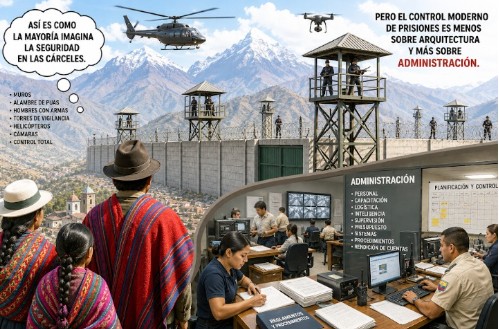 None of the contributors appeared eager to apply for a prison guard position themselves, which was unfortunate because staffing, rather than concrete, may turn out to be the difficult part.
Ecuador’s proposed mega-prison sounds enormous because it is enormous. Fifteen thousand inmates is not a prison in the traditional sense. It is a penal colony populated entirely by people whom the authorities would rather not have wandering freely around Guayaquil after dark. Such institutions require roads, kitchens, laundries, medical facilities, water systems, electrical systems, waste disposal, communications networks, payroll departments, and enough daily food deliveries to resemble a medium-sized military operation.
This is where public discussion often drifts into fantasy. The average citizen imagines prison security in cinematic terms with walls, razor wire and men with rifles in guard huts on stilts. Perhaps even helicopter or drone circling overhead and rigged up to a camera. Yet modern prison control is less about architecture than administration. The difficult question is not whether Ecuador can pour enough concrete. Ecuador can certainly pour enough concrete. The difficult question is whether it can recruit, train, supervise, and retain thousands of trustworthy employees year after year.
That is not a trivial matter in a country where criminal organizations may possess access to large amounts of cash and where prison staff themselves may become targets for bribery or intimidation. It is easy for online commentators to demand incorruptibility from prison guards. It is harder if somebody earning a modest salary is quietly informed that refusal may have consequences extending beyond the prison gates and into the neighborhood where his family lives.
The public also tends to misunderstand how prison-based criminal organizations actually function. Many people still imagine a prison gang as a loose collection of tattooed men lifting weights in a courtyard and sharpening arrows with homemade penknives made from safety razors and toothbrush handles. In reality, some prison gangs have operated more like decentralized corporations with communications networks, financial systems, discipline structures, outside contractors, and regional representatives.
This is where the phrase “protection racket”, known in Ecuador as vacuna, or vaccination, enters the discussion. The term sounds quaint, as though it belongs in a 1930s gangster film involving cigars and speakeasies. In practice it may involve a market vendor in Guayaquil receiving a WhatsApp message demanding twenty dollars a week, or a bus operator paying unofficial “security fees” to avoid punctures. The sums are often individually small but they add up.
One of the more uncomfortable realities of Latin America is that prison walls do not necessarily sever criminal authority from the outside world. In some systems, prison has functioned less as a place of isolation than as a kind of crime HQ. Orders may travel through smuggled cellphones, visitors, corrupt officials, relatives, girlfriends, or simply through reputation and fear. A local extortion collector on a motorcycle may ultimately answer to somebody serving a sentence hundreds of miles away.
Technology has changed the equation dramatically. Fifty years ago a prisoner wanting to coordinate outside operations needed letters, trusted visitors, or bribed guards carrying messages hidden in hollow shoes. Today he may require only a cheap smartphone and a charger. Ecuadorian prison raids have periodically uncovered enough electronics to resemble a student apartment occupied by unusually aggressive telecommunications engineers.
This leads many citizens to ask an apparently sensible question. Why not simply block all cell phone signals?
The answer is that authorities often try. Signal jammers exist. Managed-access systems and special shielding systems exist. Yet such systems are expensive, technically demanding, and difficult to maintain. Jammers may interfere with nearby neighborhoods, hospitals, police communications, or emergency services and criminal groups adapt quickly. Phones continue to enter prisons through drones, deliveries, visitors, corrupt staff, or methods imaginative enough to discourage detailed discussion over breakfast.
People also suggest placing prisons in deserts, jungles, or remote islands beyond cellphone range, as though geography itself could solve institutional weakness. Unfortunately prisons still require drinking water, electricity, roads, fuel, hospitals, supply deliveries, and thousands of employees willing to work there every day. If a prison is placed six hours from civilization, or on a remote island in the Galapagos, recruitment becomes difficult. Understaffing leads to exhaustion and exhaustion leads to errors. Mistakes lead to corruption, violence, or loss of control.
The uncomfortable truth is that prisons ultimately depend on people rather than walls. A prison can survive cracked concrete much more easily than it can survive compromised staff. One dishonest employee with access to gates, schedules, or communications may matter more than several million dollars’ worth of surveillance equipment.
None of this means Ecuador should avoid building prisons. The country clearly faces a severe problem with organized crime. Citizens are frightened, businesses are under pressure, and extortion damages economic life in ways that outsiders often underestimate. A small restaurant paying weekly “protection” money may never be able to expand. A bus owner facing criminal threats may raise fares or abandon routes altogether. Fear itself becomes an invisible tax on society.
Yet gigantic prisons are not magic boxes into which governments can throw crime and slam the lid shut. Latin American history suggests that prisons often become mirrors of the societies surrounding them. If corruption, intimidation, weak institutions, and easy money exist outside the walls, they have an unfortunate tendency to seep inside as well. Sometimes they seep back out again carrying a cellphone charger and an updated list of extortion payments.
Coming soon…But what about El Salvador?