
















30 years after ‘Into Thin Air’ disaster, Everest has changed. Now the weather isn’t the only threat
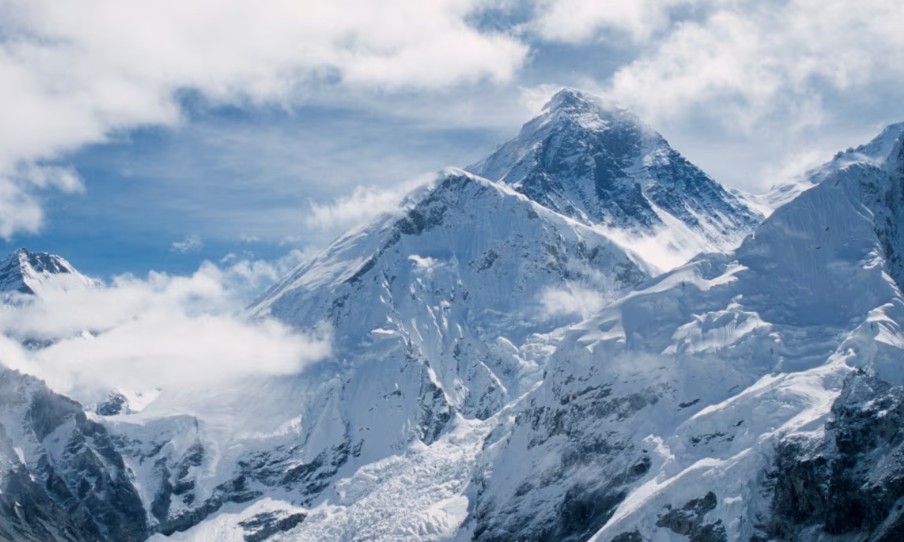
The southwest view of Mount Everest.
By Helen Regan
On May 10, 1996, more than 30 climbers became stranded high on the world’s tallest mountain by a powerful and unexpected storm. Oxygen-starved, exhausted and lost in the darkness, their story became a fight for survival against 70mph winds and -40 degree temperatures.
Eight people lost their lives in what was then the deadliest 24 hours on Everest. But it was the media attention that followed, led by Jon Krakauer’s bestselling first-hand account “Into Thin Air,” that turned the disaster into a cultural phenomenon.
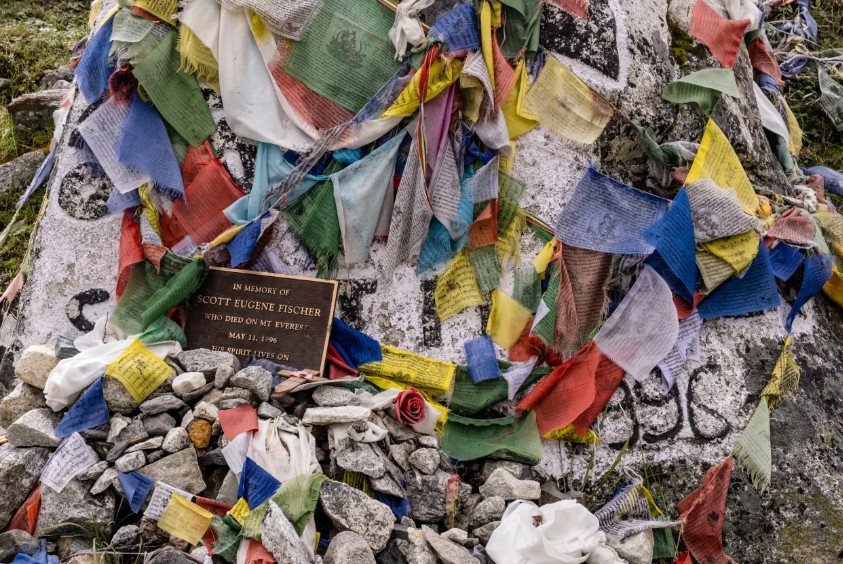
A memorial site for Scott Fischer at Dukla pass seen at Dukla, Solu Khumbu, Nepal on September 16, 2019. (Frank Bienewald/LightRocket/Getty Images)
Everest was no longer solely the domain of mountaineers. With a little training and a lot of cash, the average person could be guided every step of the way up the 8,849-meter (29,032 feet) peak to stand on top of the world.
“It was a cultural turning point,” said Will Cockrell, author of “Everest Inc.” Everest was “all of a sudden put it into the bucket list of what could be possible.”
After Tenzing Norgay and Edmund Hillary became the first people to summit in 1953, it took until 1989 for there to have been 270 summits of the mountain — known in Nepal as “Sagarmatha,” or “Goddess of the Sky.”
Last Wednesday, May 20, 274 climbers reached the summit on a single day – a record.
Thirty years after that powerful storm, advancements in technology, better equipment and a new generation of empowered Nepali operators have made the mountain safer and more lucrative than ever.
Everest Base Camp has become a high-altitude metropolis. And today, it’s not unpredictable weather that poses the greatest risk at the summit, experts say, but a mix of overcrowding, inexperienced tourists, and budget services cutting corners.
Storm in the death zone
Just a few decades ago, even the idea of guiding paying clients to the top of Everest was “so preposterous,” says Cockrell. Expeditions usually involved being part of a national or sponsored team, backed by donors.
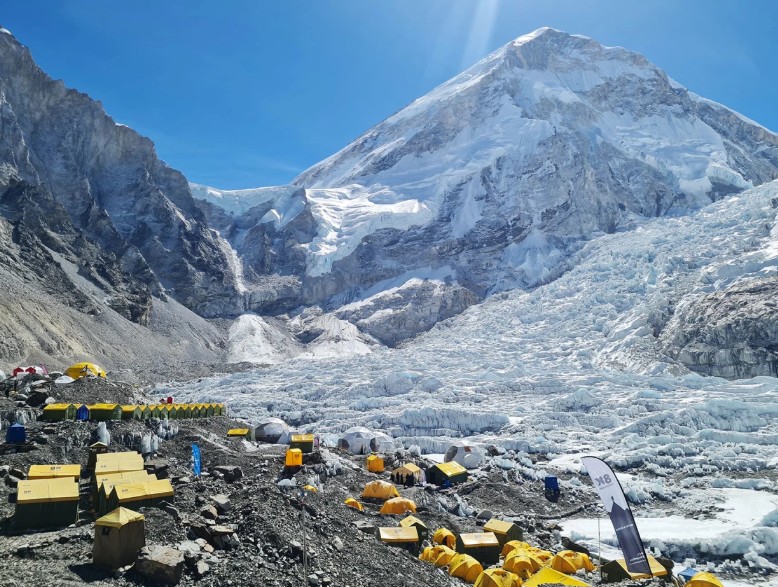
Tents of mountaineers at Everest Base Camp on April 18, 2024. (Purnima Shrestha/AFP/Getty Images)
But that changed in 1992 when New Zealand-based mountaineering company Adventure Consultants put six clients on top of Everest and, more importantly, brought them safely back down.
Others quickly followed.
“We had no idea how big the industry would become,” said Guy Cotter, CEO of Adventure Consultants, and a guide on that history-making summit. “We didn’t even look at it as an industry in those days.”
Four years later, on that fateful day in May, Adventure Consultants was one of three teams in Nepal making a summit push when the blizzard rolled in. Exhausted climbers, guides and Sherpas were left exposed on a treacherous ridge, trapped above the highest camp in the so-called “death zone,” where there isn’t enough oxygen to breathe unaided for long. Frostbite and hypothermia were setting in.
Cotter was leading an expedition on a nearby mountain at the time when he realized his friends and colleagues were in trouble.
“With binoculars, I could see them up on the summit ridge,” Cotter said. “When it looked like things had taken a turn for the worse overnight, I went over to Everest Base Camp to assist the base camp manager and the doctor.”
Cotter and the small team were the only ones in the vicinity, and it fell to them to mount a large-scale, high-altitude rescue operation and provide medical support for the many wounded.
“Virtually everybody was up on the mountain,” said Cotter. “We were all totally in shock.”
According to Everest Inc.’s Cockrell, a disastrous combination of poor guiding decisions and even worse weather led to the deaths of the eight climbers. Survivor accounts blamed ropes not being fixed in advance and a bottleneck created by slower climbers for delaying the ascent. Some climbers were also still summiting long after their cut-off — the latest time before climbers must turn back to reach camp safely before dark — of 2 p.m.
[Story continues below graphic]
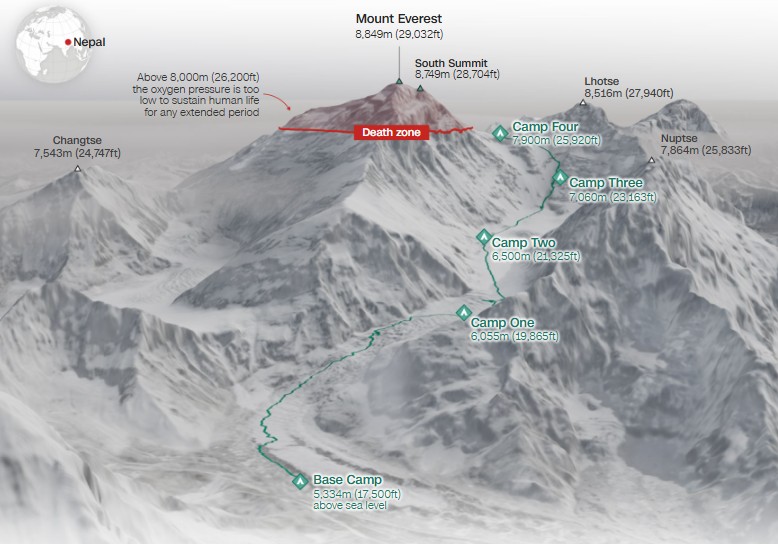 The tragedy, among the first to happen in the new age of the internet and satellite phones, became infamous because of the media storm that followed.
The stories of heroism, high-stakes rescues, costly decisions, and the sheer will to survive continue to be pored over and debated to this day, thanks to “Into Thin Air,” survivors’ memoirs, the 2015 movie “Everest” starring Jake Gyllenhaal and countless news articles.
One of the most heart-wrenching tales was that of Adventure Consultants co-founder and renowned mountaineer Rob Hall, whose decision to stay with an incapacitated client near the summit cost him his life. Stuck on the mountain with no hope of rescue, he was still able to make one last call via satellite phone to his pregnant wife.
And of Beck Weathers, who, snow-blind and frostbitten, was twice left for dead but survived against the odds. Or of Russian-Kazakh mountaineer Anatoly Boukreev, who went back out into the blizzard to rescue three climbers.
Cotter, who helped organize the first-ever helicopter airlift from Camp One to rescue some of the wounded, said many lessons were learnt from the disaster.
“It was the moment in time that the industry, as we’re now calling it, grew up,” he said.
Tech evolution
Three decades later, the climbing landscape on the mountain is vastly different, with huge improvements to safety and communications.
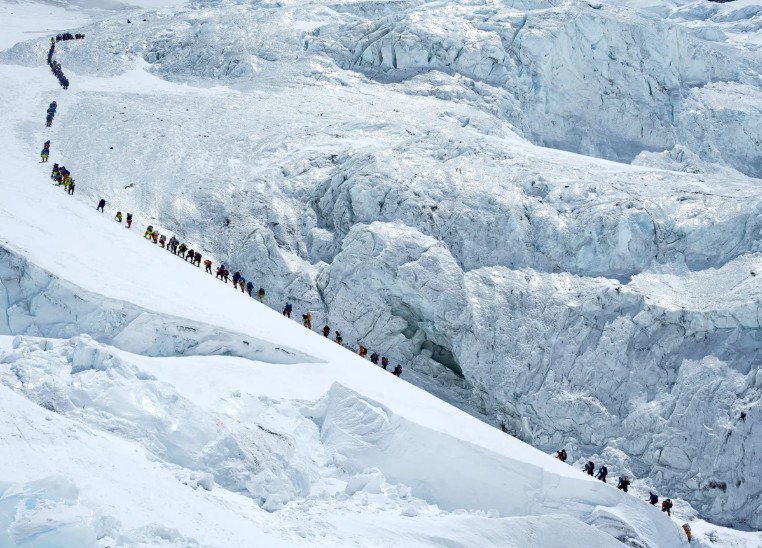
Climbers walk in a long queue as they head to summit Everest on May 18. (Purnima Shrestha/Reuters)
“I had to convince our client base that this wasn’t just going to happen every year on Everest, especially since we saw two icons of the industry — Rob Hall and Scott Fisher — lose their lives,” said Cotter, who took over Adventure Consultants after Hall’s death.
Competing guiding companies now worked together to fix ropes and organize safety caches. More bottled oxygen and medical supplies were dotted up the mountain, specialist expedition doctors were hired, and turnaround times enforced.
But it was the major advances in weather forecasting and technology that transformed how the mountain is climbed. Today, summit attempts are dictated by the weather, with operators making their push during a narrow climbing window in May when the Himalayan jet stream moves a touch north, bringing calmer conditions.
New weather forecast models tailored to Everest have become so good that a tragedy like the May 1996 storm “could really never happen again,” said Cockrell.
The latest tech evolution that could save more lives are drones capable of tracking routes and assisting in search and rescue. They can also carry heavy loads, reducing the number of trips Sherpas make ferrying supplies through the Khumbu Icefall — considered the most treacherous section of the climb.
Sherpas in charge
Gelje Sherpa grew up in Nepal’s Solukhumbu region and followed in his father’s footsteps by working in the mountains, first as a kitchen boy and porter, then as a guide.
“Now it’s my passion,” he said.
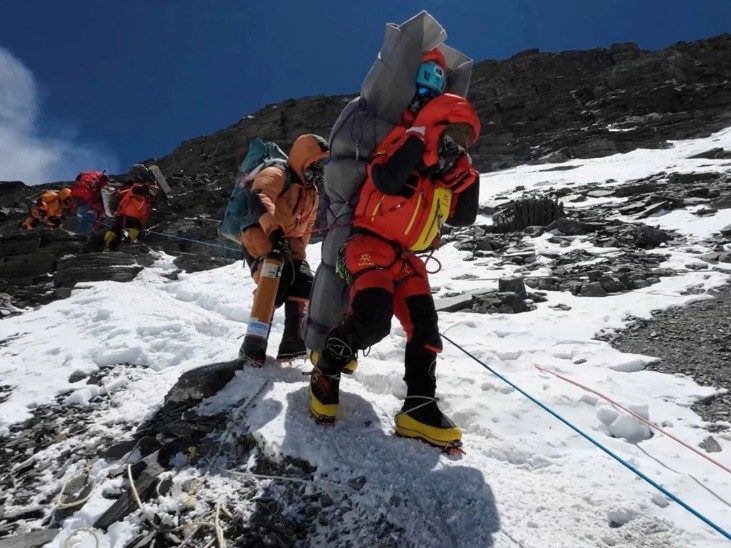
Ngima Tashi Sherpa carries a Malaysian climber during a rescue from above Camp Four on Everest, on May 18, 2023 in this screengrab obtained from a handout video. (Gelje Sherpa/Reuters)
Gelje is one the world’s most renowned mountaineers, with a high-altitude career that includes summiting all 14 of the 8,000-meter peaks. In 2021 he was the youngest member of an all-Nepali team who made history by making the first winter ascent of K2, the world’s second-highest mountain — and more technically difficult than Everest.
He’s also part of a growing cohort of Nepalis who are professional high-altitude climbers and are breaking mountaineering records, becoming certified guides and business owners.
This month, another Nepali, Kami Rita Sherpa, broke his own record, scaling Everest for the 32nd time, and legendary mountaineer Lhakpa Sherpa summited Everest for the 11th time, the most by a woman. Nepali climber and photojournalist Purnima Shrestha, who last year climbed Everest a record three times in one season, summited again.
“More Sherpas are making more records, climbing peaks, opening new routes and getting more training and more opportunity,” Gelje said. Sherpas traditionally go by their first names.
Nepali climbers are now the ones overseeing the securing of the routes up the mountain, and the fixing of the rope lines that help clients navigate the most difficult sections. These days, Nepali operators dominate the guiding industry on Everest.
“The Sherpas today who have come into the industry are those who chose it because they love the mountains,” said Cockrell, of Everest Inc. “These are the people that are running the industry now.”
Gelje says better compensation is still needed for the families of Sherpas who are injured or die in the mountains, and he wants to see better insurance for Sherpas who have long been the backbone of international mountaineering expeditions.
“For the families of those working in the mountains, they need to be (looked after) for their kids’ education etc,” he said. “Now they’re getting around $10,000 when a Sherpa passes away. This is not enough.”
Rising temperatures due to the climate crisis is adding to that risk, Gelje says, as melting ice is making navigating through the Khumbu Icefall — a shifting glacier of deep crevasses and unstable chunks of ice called seracs — even more fraught with danger. “The icefall is getting more and more dangerous,” he said.
This year’s season was delayed after a huge section of the icefall broke off and blocked the route to the summit.
The risks to Sherpas have been laid bare by a series of disasters in recent years. In 2014, an avalanche on Everest killed 16 people, all Nepali workers who were fixing ropes in the icefall, which led to a strike and the closure of the rest of the season. The following year, a devastating earthquake killed almost 9,000 people across Nepal, including more than 20 on Everest.
“Every village [in the Everest region] has lost young men to the mountain,” said Cotter, whose company established a fund that provides education for the children of mountain workers.
Kami Rita says better education and more opportunities meant younger generations of Sherpas were less interested in working in the mountains, “They do other, easy jobs,” he said.
Those who stay are pouring their education and business acumen into growing the industry, said Geljie, adding, “I like teaching what I have experienced. I’m teaching and giving training.”
Soaring popularity
Climbing Everest is a “sufferfest,” said Cockrell. From navigating the treacherous icefall to climbing the Lhotse Face, a sheer cliff of steep snow and ice, as climbers battle fierce winds and struggle for breath at altitudes humans cannot survive in. “It’ll push any human being, in any room, to their absolute limit,” he said.
Since records began in the 1920s, 344 people have died on Everest, according to The Himalayan Database, but the ratio of fatalities to climbers who venture above base camp is less than 1%.
More than 7,560 people have made it to the top in almost 14,000 total summits as of December 2025.
More people meant more supplies, more waste, and greater pressure on guides, porters and workers; issues spotlighted by viral photos of traffic jams high on the mountain.
“There are examples of some groups that have up to 60 clients,” said Cotter, who has summited Everest five times. “It’s just got a lot more pressure on people going over the mountain, and that leads to more fatalities.”
Gelje, who runs expedition company AGA Adventures with renowned British climber Adriana Brownlee, knows first-hand the dangers of high-altitude climbing. He’s conducted over 50 rescues and in 2023, at the age of 30, he performed the world’s highest solo rescue above 8,000 meters on Everest.
“More traffic is more dangerous,” he said, because it can increase the risk of frostbite and hypoxia, caused when the brain and lungs are starved of oxygen. “Five bottles (of oxygen) is more than enough but sometimes with traffic you’re going to be stuck up there, they’re going to run out of oxygen. Then they can’t come down,” he said.
Others say Everest can handle the crowds, it’s inexperienced climbers and operators that pose serious safety risks these days.
There are about 1,200 different companies all offering Everest climbs, Cotter estimates, but he says some of the budget services are cutting corners such as not using trained mountain guides, or adequately vetting clients’ experience levels.
Expeditions run from the cheapest, at about $40,000 to $100,000 depending on the company and services offered, while high-end climbs can reach $300,000.
Garmin watches with GPS trackers and satellite phones are now standard pieces of kit, but Gelje says hiring experienced guides, and a two-Sherpa-to-one-climber ratio, is vital at heights where altitude sickness, exposure and exhaustion can be frequent killers.
And newbies to Everest don’t always know what services they need until it’s too late.
“People are told you don’t need to actually even know how to climb mountains, we’ll teach you along the way, and these are being taught by people who don’t know how to teach,” said Cotter.
Kami Rita said there had been “many changes” on Everest since he first summited the mountain in 1994 — two years before the disaster. One new trend was climbers who had finished their attempt were “not doing trekking like before” to make the 40-mile, three-day journey from base camp back to Lukla, where Everest expeditions traditionally start and finish. Instead, many were opting to take a helicopter straight from base camp to the amenities of the Nepali capital Kathmandu.
“I think to make it really credible, it’s important that people who do climb Everest are qualified and experienced enough to do so, so that they feel that they have justifiably climbed to the summit, not been dragged up there just to add it to some sort of [bucket] list and a trophy to go on the shelf,” said Cotter.
Tourism is a mainstay of Nepal’s economy, employing about a million people. And Everest mania has injected much-needed cash and development into the Khumbu region, creating more opportunities and better education for those who live and work near the roof of the world.
And this season was one of the busiest ever with the Nepali government issuing a record number of permits and an estimated 900 summits.
Among them, British climber Kenton Cool whose 20th ascent is the most Everest summits by a non-Nepali; Polish climber Bartek Ziemski, who summited Everest without bottled oxygen before skiing back down to base camp; and Australian Oliver Foran, whose journey to summit with Gelje involved cycling from sea level in India — a feat he says broke the fastest “sea-to-summit” record. River Ahmed became the first Afghan woman to summit and 18-year-old Bianca Adler became the youngest Australian.
For all the negative coverage, aesthetic arguments about climbing styles, the controversies and disasters, Everest continues to be at the heart of so many dreams and ambitions — even for old hands, like Cotter.
“What I believe about Everest, even today, is that it’s one of the most amazing adventures that you could ever do, climbing up to the summit and being on the top of the world’s highest peak,” he said.
_________________
Credit: CNN



Hogar Esperanza News

The Cuenca Dispatch

Week of August 23

Ecuador’s economy grew 2% during the first half of 2026 compared with the same period a year earlier, according to new Banco Central del Ecuador data.

Cuenca gets a prime view of next week’s deep partial lunar eclipse.

Ecuador’s economy grows 2% in the first half of 2026.
Fund Grace News

Fabianos Pizzeria News

Property Manabi

Nice apartment banner