














The last almuerzo
 women now look at Cuenca in much the same way previous generations once looked at Paris, London, or perhaps California itself.
Not as paradise exactly. Nobody who has spent three consecutive rainy afternoons trying to get a visa document notarized in Ecuador would describe it as paradise. More as an alternative script or different way of arranging daily life.
A November 2025 Gallup survey found that forty percent of American women aged fifteen to forty-four say they would move abroad permanently if given the opportunity — four times higher than the ten percent who said the same thing in 2014.
 The reasons listed are familiar enough: politics, gun violence, work-life balance, healthcare costs, exhaustion, and a growing feeling that modern American life resembles a competitive eating contest held inside a shopping mall during a fire drill. Among the thirty-eight democratic OECD countries, only twenty-seven percent of women say they would move to another country permanently, making the American figure a striking outlier.
Some of those who follow through move to Europe. Some to Latin America. A few end up in Ecuador. That is the part that does not surprise me at all.
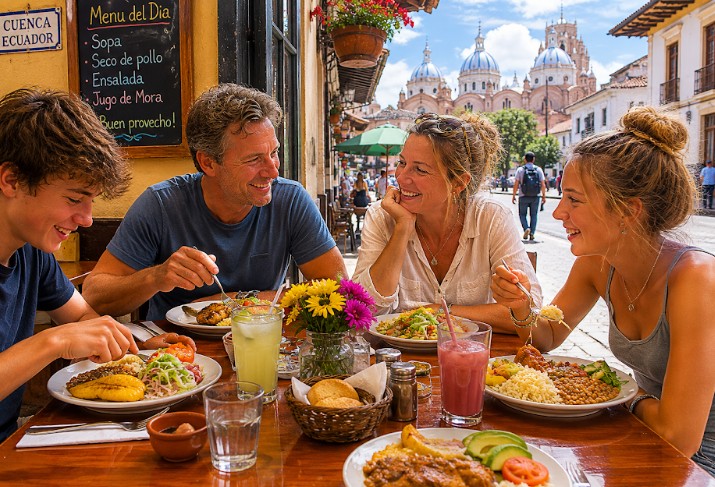
You occasionally see these younger arrivals now in Cuenca. Not the old stereotype of retired expats comparing blood pressure medications and diuretics over carrot cake in a café on Ordoñez Lasso, but younger couples with children, laptops, backpacks, yoga mats, and expressions suggesting they have escaped from an edition of civilization that had become slightly too hard to handle. They find their way to neighborhoods along the Tomebamba and Yanuncay rivers, where families walk riverside promenades in the evenings, or to quieter residential streets in Ricaurte, where the rent is lower and the university nearby gives the neighborhood a certain useful energy.
And to be fair, America does sound a bit exhausting these days. When I was young in England, schools worried mainly about whether boys might smoke behind the bicycle sheds or make catapults from rubber bands. In parts of modern America, children now practice active shooter drills before they have mastered long division.
Younger American women have not only shown the largest increase in wanting to move abroad over the past decade but have also experienced the steepest drop in institutional confidence of any age or gender group. One American who moved to Cuenca put it simply: the country she had moved to didn’t move as fast, didn’t bustle as much, and people weren’t in as much of a hurry. People smiled and said hello (o buenas dias, tal vez).
Which does sound like a reasonable summary of the average Tuesday afternoon in Parque Calderón.
The question of raising children overseas is particularly interesting. Some families have discovered that their teenagers, providentially, can continue their American schooling from an apartment in Cuenca without anyone firing a single bullet in their direction. Florida Virtual School — known as FLVS — is a fully accredited public institution serving students in grades K through twelve online, in Florida and all over the world, and it charges Florida residents nothing. Through its Flex program, students can take a full course load while enrolled as homeschool students, with year-round enrollment and the flexibility to start and finish courses at any time.
A teenager in Cuenca can complete an Advanced Placement calculus course, receive a Florida diploma by email, and then walk downstairs to buy an empanada for thirty cents without dismounting from the American educational conveyor belt that leads to college.
Of course Ecuador does have some of its own problems. One does not relocate to the Andes and suddenly start floating through life on a cloud of artisanal coffee and pan flute music while smiling children release butterflies into the sunset. The internet goes down or the light goes out. Bureaucracy mutates like a tropical fungus. Apartments advertised as “luxury condos” sometimes contain plumbing apparently designed before the Spanish hightailed it back to Europe.
And then there is the language, which is Spanish, as most people will sooner or later notice.
Many newcomers arrive in Cuenca with approximately six words of Spanish, three of which are “si” “no” and “Shakira”. Within weeks they discover that real life involves conversations about propane cylinders, banking apps, immigration forms, and whether the chicken soup contains tripe. The sidewalk itself also requires attention — Cuenca’s historic center is beautiful, but its cobbled streets and uneven sidewalks have tripped up more than one confident new arrival.
Still, there are undoubted positives here that arrivistes notice immediately.
Children walking alone to school. Public parks used by families for recreation rather than office space for drug dealers. Older people sitting on wooden benches in plazas rather than isolated in climate-controlled retirement fortresses watching cable television advertising for medications whose side effects include baldness, flatulence, and death. And perhaps most surprisingly of all, ordinary daily life that is not relentlessly monetized.
In America, increasingly, every activity seems to involve subscriptions, liability waivers, parking fees, background checks, surveillance cameras, security gates, and somebody attempting to sell you an upgraded premium experience which is what normal service used to be. Meanwhile in Cuenca, an old man may spend three hours on a bench discussing soccer and potatoes without anybody attempting to uproot him to harvest his data.
Cuenca is also, incidentally, one of those rare places where a person can buy bread, vegetables, aspirin, batteries, shoe repairs, a hot almuerzo, a SIM card, and an umbrella within walking distance of home, at prices that bear no resemblance whatsoever to prices in the United States.
A specialist doctor’s visit typically costs between thirty and sixty dollars. A one-bedroom apartment in a decent neighborhood rents for three hundred to six hundred dollars a month. These are hardly trivial considerations when the average American family is trying to calculate whether they can afford both a mortgage and health insurance in the same calendar year.
The strange thing is that many Ecuadorians themselves often dream of the opposite direction. The modernity of Miami, the magnificence of Madrid, and the joys of New Jersey. Somewhere larger, richer, shinier, better. That is the eternal human condition. Somebody is always staring wistfully over the fence at another country’s greener grass.
Social media has amplified this enormously. Young Americans watch TikTok videos about life in Portugal or Cuenca or Medellín while sitting in traffic jams on freeways near Houston. Ecuadorians watch Miami influencers driving leased sports cars while standing in line at Banco Pichincha. Everybody imagines that life elsewhere must somehow be more exciting, but usually it is not–at least not for you.
Expat life can be lonely. Visa documents can be complicated. Family is far away. You occasionally find yourself eating a scoop of imported peanut butter that costs about the same as a purse of industrial diamonds.
But what many younger Americans appear to want is not luxury, but reduction. A life where existence itself does not feel like participation in a permanent national emergency, where children can walk to a school without a rehearsed procedure for hiding under desks, and where the person sitting next to you on a park bench is not trying to sell you Oxycontin with a discount for cash.
In that sense, Cuenca may continue attracting people for reasons that have surprisingly little to do with cheap rent or eternal spring weather.
What many newcomers appear to be searching for is something harder to define–a country where the living is easy and a school desk is a writing surface, not a shield.