














The poor country with all the money
I recently noticed a below the line comment describing the United States as a poor country.
To me this seemed plainly wrong. The United States is not a poor country, but it is an extraordinarily rich country in which wealth is distributed so unevenly that millions of people, and quite a few public institutions, experience something resembling poverty.
A country that can produce a single company worth more than the entire annual economy of Britain cannot sensibly be called poor. Neither can one that maintains military bases around the world, sends machines to Mars and pays a university football coach more than the president. Yet this same country contains schools where teachers have to buy classroom supplies from their own salaries, families can be bankrupted by illness, many cities are unable to provide safe and reliable public transportation, and an alarmingly high proportion of workers live only a single paycheck from the virtual debtor’s prison of default and bankruptcy.
 The money is there alright, but the more interesting question is who owns it.
That question leads me, by one of those conversational side roads that are more interesting than the original destination, to the example of oil.
In the United States, oil beneath privately owned land may belong to the landowner, although mineral rights can be separated from ownership of the surface. A farmer like Jed Clampett of the Beverly Hillbillies may own the field, while somebody else owns whatever lies beneath it–or maybe not! This is a peculiarly American arrangement. In most countries, including Ecuador, underground oil belongs to the state.
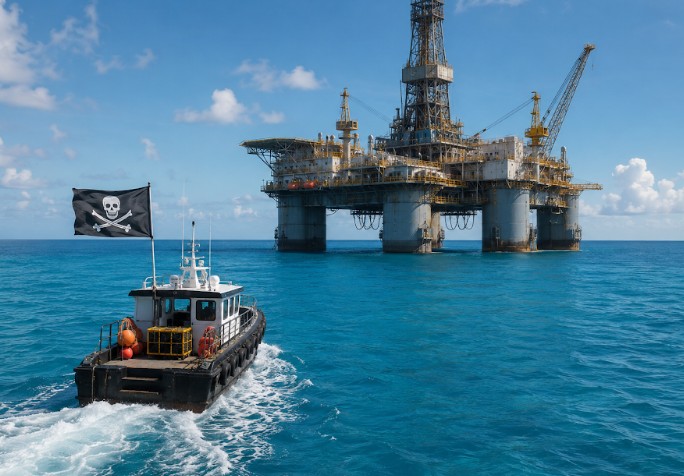
But what about oil beneath the sea, where there is no rancher standing above it and no fence post on which to hang a No Trespassing sign?
Close to the American coast, the seabed generally belongs to the individual state. Farther out, it belongs to the federal government, which means, at least in theory, that the oil belongs collectively to the American people.
The federal government does not normally drill for it. It leases blocks of the seabed to private companies. The companies bid for the right to explore, pay rent and royalties, assume the financial risk, and keep the remaining profits if they strike oil. In the 2024 fiscal year, federal offshore oil and gas produced about $7 billion in direct government revenue.
Seven billion dollars is hardly loose change, even in Washington. But spread among 340 million Americans and buried inside a federal budget measured in trillions, it does not feel much like a national inheritance. Nobody receives a note saying, “Here is your share of the oil we sold this year” unless they were born in Alaska.
Ecuador approaches the matter differently. Its petroleum legally belongs to the state, and the state-owned Petroecuador is the country’s principal producer. Oil earnings flow much more directly into government finances and have at times accounted for a very large share of public revenue and exports.
This does not mean that every Ecuadorian finds a small envelope of oil money under the door. That money disappears into fuel subsidies like cheap cooking gas, government salaries, debt payments, inefficient operations and the mysterious plumbing of public finance. Petroecuador has not always been offered as an international model of transparent and immaculate management.
Nevertheless, the principle is clear. Petroleum is treated as a national resource, not merely as something from which the government collects a fee while private owners retain the principal gain.
Then there is Norway. Norway and Britain discovered enormous petroleum resources in different parts of the same North Sea at roughly the same time. Both countries became oil producers during roughly the same period. What they did with the proceeds could hardly have been more different.
Norway decided that oil was not ordinary income. It was a finite national asset. Selling a barrel made the country richer in cash but poorer by one barrel of oil reserves. If the cash were immediately spent, the asset would eventually vanish and leave little behind. Norway therefore placed much of its petroleum income into what became the Government Pension Fund Global and invested it abroad.
By the end of 2025, the fund was worth more than 21 trillion Norwegian kroner. Remarkably, investment returns now account for considerably more of its value than the net amount deposited from petroleum revenue.
Much of that money is invested in the United States. Norway owns shares in Apple, Microsoft, Amazon, Nvidia and thousands of other companies. It owns American government and corporate bonds, property and infrastructure. Oil beneath the North Sea has been transformed into permanent Norwegian claims on profits generated around the world.
There is a pleasing circularity to this. Americans buy Norwegian energy. Norway saves part of the proceeds and invests it in American businesses. Those businesses grow, and part of their profits flows back to the people of Norway. The capital works in America, but the wealth still belongs to Norway.
Put more mischievously, the profits from Apple, Google, and Amazon are now helping to support the Norwegian welfare state. Americans buy expensive iPhones, pay for apps and subscriptions, and purchase goods advertised through Google. A not inconsiderable fraction of the resulting corporate profits returns to Norway. Meanwhile, Americans also pay some of the developed world’s fattest mobile-phone bills. The telephone in an American pocket may therefore be contributing more reliably to Norway’s collective wealth than America’s own natural resources contribute to any permanent fund for Americans.
This gives an additional comic quality to President Trump’s repeated complaint that America does not receive more immigrants from prosperous Scandinavian countries such as Norway.
But why would Norwegians be desperate to leave? They already possess universal health care, substantial social security and an indirect share in one of the largest investment portfolios in history. That portfolio includes a sizeable chunk of corporate America’s finest. Inviting them to abandon Norway for the United States is rather like asking the landlord to give up collecting rent and move into the basement.
Britain chose another route. Revenues from North Sea oil royalties went into the Treasury as general revenue and were spent alongside income tax, VAT and every other source of government money. They helped pay for public services, unemployment, tax reductions and the ordinary costs of running the country.
It is easy, decades later, to say that Britain squandered the money. That is a little too simple. Britain entered the main North Sea years with a much larger population than Norway, serious unemployment, declining industries and governments desperate for revenue. The bills were real and had to be paid.
Be that as it may, the failure to preserve any substantial part of its North Sea bounty now looks painfully shortsighted. If we look at this using the framework of New Testament parables, Britain played the prodigal son with its inheritance, while Norway behaved like the faithful servant, putting its talents to work.
The distinction reminds me of two people who each inherit a house. One sells it and uses the money for groceries, electricity and repairs to the car. These are not frivolous expenses and quality of life improves significantly for a while. The other invests the proceeds and uses part of the annual return to help meet those same expenses. Forty years later, the first person has memories of paid bills, but the second still has enough capital left to buy another house.
There was nothing inevitable about Norway’s success. A government-owned oil company can be inefficient. A sovereign wealth fund can be raided by politicians, invested badly or turned into a source of patronage. Ecuador demonstrates that declaring a resource to be public property does not automatically convert it into visible prosperity for the public.
Norway’s achievement was not simply that the government took more oil money. It created rules strong enough to prevent each generation of politicians from spending all of it.
There is another twist. President Trump has now decided that perhaps the United States should have a sovereign wealth fund too. In February 2025 he ordered the Treasury and Commerce departments to devise a plan for one, intended to invest national assets for the benefit of the American people.
At the same time, his administration began acquiring stakes in individual American companies. The federal government bought 9.9 percent of Intel, took an equity position in rare-earth producer MP Materials, obtained warrants representing 5 percent of Lithium Americas and another 5 percent of its joint venture with General Motors, and retained a special “golden share” in U.S. Steel when its sale to Japan’s Nippon Steel was approved. Other loans to strategically important mineral and technology companies have also come with warrants or profit-sharing rights.
This is not yet a Norwegian-style fund. Norway invests an accumulated national surplus across thousands of foreign companies, mostly as a passive shareholder seeking long-term returns. Trump’s holdings have been assembled through several government departments and are concentrated in domestic companies considered important to semiconductors, steel, batteries, rare earths and national security. Their immediate purpose is industrial strategy rather than saving an oil inheritance for future generations.
Is it communism? Not really. The government has not abolished private property or taken control of industry. Is it socialism? Not in any conventional sense. Intel remains a privately managed company, and the government’s stake is non-voting. The better description is state capitalism: public money is used to acquire a financial interest in selected private businesses because the government wants both strategic influence and a possible return for taxpayers.
This is not entirely new. American governments temporarily acquired large stakes in General Motors and AIG during the 2008 financial crisis, while Alaska has operated an oil-financed public investment fund for decades. What is unusual is hearing a Republican president who celebrates private enterprise argue that grants to corporations should sometimes buy the taxpayers a piece of the company. His reasoning is not absurd. If the public assumes part of the risk, why should shareholders receive all of the reward? This could be called the What Would Warren Buffet Do? philosophy of government.
The danger, though, is that a national investment fund becomes a presidential collection of favoured companies. Norway’s fund succeeds partly because it is enormous, diversified, professionally managed and constrained by rules. A government that buys one company because it is strategically vital may later be tempted to buy another because it is politically useful. State capitalism can build national wealth, but it can also produce expensive pets.
This returns us to the description of America as a poor country. America possesses abundant natural resources, immensely productive companies, sophisticated technology and vast private fortunes. Its problem is not an absence of wealth. It is that so much wealth is privately held, while so many common needs depend on local and state governments that are treated as though they were penniless.
Norway made a different choice. It allowed private enterprise to help extract the oil but insisted that a substantial part of the value become a collective asset. Every Norwegian is, indirectly, the beneficiary of a vast global investment portfolio.
The United States is not poor. Britain was not poor when North Sea oil was flowing. Ecuador is not without valuable resources. But a nation’s wealth and the wealth of its individual citizens are not necessarily the same thing.