













The Cuenca calefón chronicles: How to tame the beast and finally take a hot shower
By Ross Roberts
If you are moving to Cuenca from North America, you will quickly fall in love with the cobblestone streets, the $3 almuerzos, and the spring-like weather. You will not, however, fall in love with your shower on day one.
In fact, after six months of stubborn experimentation, freezing shivers, and near-third-degree burns, I finally unlocked the secret to mastering an older, basic-model Ecuadorian calefón (tankless gas water heater).
To spare you the half-year learning curve, here is the golden three-part rule upfront:
- Set your calefón’s flame to a comfortable dishwashing temperature. Do not set it to maximum inferno.
- Turn the shower handle to 100% hot—and leave it there.Forget everything you know about blending hot and cold water.
- Use the faucet handle purely as a volume control. The flow rate itself becomes your thermostat. Less water volume means hotter water; more water volume means cooler water.
Do not set it to maximum inferno.
 Turn the shower handle to 100% hot—and leave it there. Forget everything you know about blending hot and cold water.
Use the faucet handle purely as a volume control. The flow rate itself becomes your thermostat. Less water volume means hotter water; more water volume means cooler water.
The Anatomy of the Struggle: Tanks vs. Calefones
Back in the States, most of us grew up with giant, 50-gallon insulated metal tanks in the basement or garage. That tank holds a massive reservoir of water constantly kept at 120°F to 140°F. When you shower, you blast the hot water and blend in cold water to dial in your preferred blend. The tank doesn’t care how much cold water you mix in; it just keeps feeding hot water until the tank runs empty.
An older, basic calefón is an entirely different beast. It has zero storage. Cold mountain water enters copper coils, passes over a wall of roaring gas burners, and exits instantly into your pipes.
To fire up those burners, the calefón relies on a mechanical pressure diaphragm. If enough water flows through the hot-water pipe, the gas valve opens, the igniter clicks, and you get fire. If water flow drops below a specific threshold, the valve snaps shut and the flame goes dead.
The 6-Month Journey of Discovery
Understanding how that little mechanical box thinks took months of trial, error, and goosebumps.
Phase 1: The Traditional Mixer Trap
Like any sensible newcomer, I stepped into the shower, turned on the hot, felt it getting uncomfortably warm, and nudged the handle slightly toward cold.
Disaster. The shower immediately turned into a glacial mountain stream. So, I shoved the handle back toward hot. Ten seconds later: liquid magma.
What was actually happening? By opening the cold water line, the cold water stole the plumbing pressure. The flow through the hot line dropped below the calefón’s activation threshold, extinguishing the gas flame instantly. By the time you notice and crank it back to hot, the burner relights at full blast, superheating a tiny volume of stationary water.
Phase 2: Lowering the Flame
My first adjustment was turning down the gas knob on the calefón unit itself. This solved the volcanic third-degree burns, but whenever I tried to mix in cold water, the heater still clicked off, plunging me back into arctic misery.
Phase 3: The “All-Hot” Compromise
Once I realized that introducing any cold water choked the heater’s flame, I committed to keeping the faucet strictly at 100% hot. No blending allowed.
This stopped the violent hot-and-cold oscillations, but the water hovered around the upper 80s°F—passable on a warm afternoon, but distinctly brisk on a chilly 50°F Andean morning. For a while, I resigned myself to the idea that lukewarm showers were simply the price of expatriation.
Phase 4: The Kitchen Sink Epiphany
One morning after a mediocre shower, I walked over to the kitchen sink and turned on the tap. Within seconds, steam was billowing off the stainless-steel basin.
Wait a minute. If the kitchen sink gets scalding hot water every single time, why is the shower barely warm?
The answer came down to water volume vs. heat exchange. The kitchen faucet had a modest aerator that restricted flow, meaning water traveled slowly through the calefón’s heating coils, absorbing tons of heat. In the shower, I had been opening the valve wide open. The torrential rush of high-altitude water was flying past the burner so fast that the flame didn’t have time to heat it up.
The final breakthrough was simple: keep the shower faucet at full hot, but turn down the volume. By backing the handle off to a medium stream, the water lingered over the flame just long enough to reach the perfect, steamy shower temperature.
Upgrading or Apartment Hunting? Look for This
If you are currently touring rental apartments in Cuenca or looking to replace an aging unit, keep these features in mind:
- Modulating/Digital Models: Modern calefones feature electronic thermostats and flow sensors. You simply punch in your target temperature (say, 40°C / 104°F) on a digital keypad, and the unit automatically adjusts the flame and water flow internally to keep it steady, even if someone flushes a toilet.
- The Golden Spec: Dual Knobs + Battery Ignition: If you want absolute reliability in Cuenca, choose a unit with independent manual knobs for Gas Flame and Water Flow, powered by standard D-cell batteries (not a 110V wall plug).
Modulating/Digital Models: Modern calefones feature electronic thermostats and flow sensors. You simply punch in your target temperature (say, 40°C / 104°F) on a digital keypad, and the unit automatically adjusts the flame and water flow internally to keep it steady, even if someone flushes a toilet.
The Golden Spec: Dual Knobs + Battery Ignition: If you want absolute reliability in Cuenca, choose a unit with independent manual knobs for Gas Flame and Water Flow, powered by standard D-cell batteries (not a 110V wall plug).
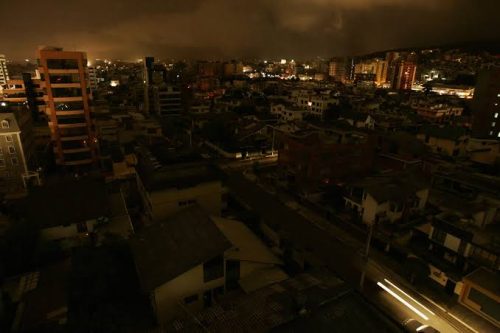
Ecuador occasionally experiences scheduled power rationing and unexpected blackouts (cortes de luz). If your water heater relies on a 110V electrical wall outlet to fire the ignition, a blackout means ice-cold showers. A battery-powered gas calefón runs completely independent of the electrical grid, ensuring that even when the lights go dark across the neighborhood, your morning shower stays warm.
________________
Ross Roberts is a retired sheet music seller and singer who recently swapped Albuquerque, NM, for Cuenca, Ecuador, alongside his wife of 44 years. When he isn’t getting to know his new home, he is often locked in an ongoing battle with modern technology. Sometimes he wins.



Hogar Esperanza News

The Cuenca Dispatch

Week of September 20
Ecuador turns to industrial power cuts to protect Mazar and keep homes from going dark.

Ecuador raises its 2026 growth forecast, but El Niño could spoil the outlook next year.
Cuenca retirees challenge medical and therapy changes at IESS senior center.
Fund Grace News

Fabianos Pizzeria News