













Why China is embracing AI while America isn’t
By Vivian Wang
When the A.I. video-generation tool Seedance 2.0 debuted earlier this year, it prompted drastically different reactions on opposite sides of the world.
In the United States, many in the movie industry responded with fear. After a shockingly realistic Seedance-generated video purporting to show a fight scene between Brad Pitt and Tom Cruise spread widely online, Hollywood filmmakers and writers said their jobs were becoming obsolete.
 But in China — home to Seedance’s parent company, ByteDance — many were excited. Stocks in short-video companies surged. One of China’s most famous directors, Jia Zhangke, shared a short film he made using Seedance, in which his real self and an A.I. version of himself discussed moviemaking.
“I’m not worried about technology replacing movies,” Jia wrote on social media. “From the very beginning, movies have coexisted with new technology. What really matters is how people use technology.”
The different reactions reflect a broader split between China and much of the West: Chinese people seem way more eager for the A.I. future.
People in China are among the most optimistic in the world about A.I., according to a survey of 47 countries last year. While 69 percent of people in China said the technology’s benefits outweighed its risks, only 35 percent of Americans agreed. Other polls have shown similar disparities.
What’s driving this difference? The answer may be related to how the technology has been deployed in each country.
A.I. everything, everywhere
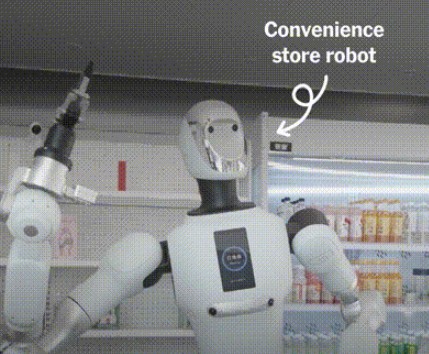
Driverless taxis roam more than a dozen Chinese cities, and service robots putter through hotels and restaurants. Chinese tech companies have rolled out medical chatbots to help users avoid long lines at hospitals. A.I. assistants are embedded in popular apps, so users can ask their mapping apps to help them decide where to eat or ask their shopping apps to help them choose between pairs of shoes.
The ubiquity of the technology is hard to envision unless you see it for yourself. We recently published an interactive piece to allow readers to feel as if they were walking through the A.I.-filled streets of Beijing; to judge by the reader comments, many people outside of China found both the amount of A.I., and people’s attitudes toward it, surprising.
The widespread deployment of A.I. in everyday life has been an explicit focus for the Chinese government and for Chinese tech companies.
Xi Jinping has said that China’s A.I. industry should “prioritize practical application.” Officials say A.I. could help solve China’s thorniest problems, such as inequalities in health care or an aging work force.
By contrast, many leading American tech companies have been focused on more abstract goals, like developing the most cutting-edge model or achieving artificial general intelligence.
One result of all this is that Chinese consumers are feeling the benefits of A.I. more than those in the West, one professor who studies the digital economy told me.
“A lot of things can already be helped by A.I., and people find that interesting,” said Bai Guo, a professor at China Europe International Business School in Shanghai. “So there are quite a lot of positive and active feelings toward it.”
A few notes of caution
There have been signs, though, in recent months of growing concerns about A.I., even in China.
Several workers have sued their employers in Chinese courts after they said they were replaced by A.I. Judges sided with the workers, saying that introducing A.I. does not justify mass layoffs.
The government doesn’t want mass job loss, because that could lead to protests. It also doesn’t want A.I. to generate content that challenges censorship, or to empower hackers. In a recent speech, Xi warned that there would need to be measures to avoid “loss of control.”
It’s also possible that there are more critics of A.I. in China than we see. Chinese officials have censored information about crashes involving autonomous driving, for example. And China also does not permit independent labor unions, which have been some of the most vocal critics of A.I. in the West.
But the prevailing sentiment remains enthusiasm. Maybe it’s because of how much A.I. has already been integrated into daily life. But some of the scholars, investors and entrepreneurs I spoke with also cited a more abstract reason for the optimism that I found worth considering.
Simply put, China has modernized so quickly in recent decades that many Chinese are used to groundbreaking change. Technology has been key to that change, and it still stands as proof of how far China has come.
Afra Wang, a technology writer from China, wrote in a newsletter this year about her grandmother, who once walked five hours to buy a clock so that her children could get to school on time.
“Today her Xiaomi phone has given her an online shopping addiction, and delivery drones fly above her apartment,” Wang wrote. “A.I. simply looks like the next turn of a wheel that has only ever spun forward.”
_________________
Credit: New York Times



Hogar Esperanza News

Property Kuralt

Fund Grace News

The Cuenca Dispatch

Week of August 23

Ecuador’s economy grew 2% during the first half of 2026 compared with the same period a year earlier, according to new Banco Central del Ecuador data.

Cuenca gets a prime view of next week’s deep partial lunar eclipse.

Ecuador’s economy grows 2% in the first half of 2026.
Property Manabi

Fabianos Pizzeria News

Nice apartment banner

Property Amazon
