
















Ecuador’s electricity crisis: Mazar water level continues to fall as country races to avoid blackouts
Although Ecuador’s national electricity system continues to power households, the country has entered a period of high operational risk. To prevent the system from reaching critical levels by mid-October and forcing residential blackouts, the government has adopted a contingency plan that disconnects 185 of the country’s largest industrial electricity consumers one day a week.
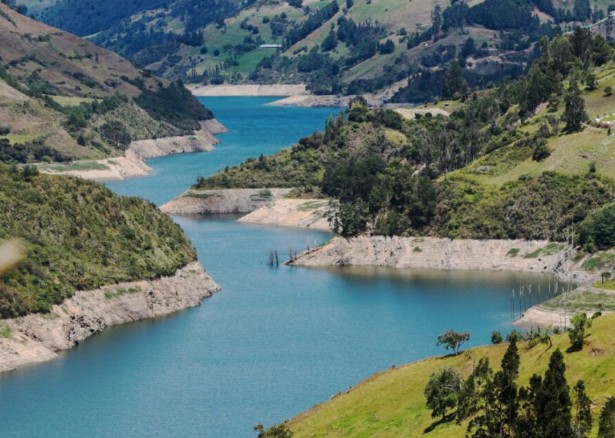
All eyes are on the Mazar hydroelectric reservoir in eastern Azuay Province.
The question is whether the industrial sacrifice will be enough.
Ecuador’s electricity system is operating under intense pressure. About 75% of the country’s energy depends on hydropower, leaving electric generation highly vulnerable to rainfall and water levels. With the dry season tightening its grip and new generation capacity still being discussed, authorities are turning to emergency measures to conserve water and maintain enough generating capacity to meet demand.
Adding the crisis, the effects of a very strong El Niño system are beginning to be felt throughout the country.
At the center of the crisis is the Mazar reservoir at the Paute hydroelectric complex, which powers three generation stations.
Mazar reservoir level falls rapidly
As of 9 a.m. on September 24, 2026, data from the Corporación Eléctrica del Ecuador (Celec) placed the reservoir at 2,136.53 meters above sea level (m a.s.l.), or 16.47 meters below its maximum operating level.
The rate of decline is an even greater concern. Since September 1, as the dry season intensified, Mazar’s level has fallen by approximately 11 meters. Without significant rainfall, which the national weather service says in unlikely, the reservoir level will continue to fall.
The government’s immediate objective is to conserve the remaining reserves and keep the reservoir above the critical level of 2,115 m a.s.l., at least until December. Complicating the plan is the impact of El Niño, which forecasters say could prolong dry conditions into 2027.
Falling below the critical 2,115 m a.s.l. level would reduce and even shut down the Paute complex, which currently supplies approximately 1,800 MW, or almost 40% of the national demand. Even a loss of 50% of generation capacity at Paute could trigger blackouts.

The government is counting on reductions in industrial power consumption to avoid nationwide blackouts similar to those of 2024.
The government’s plan: industries take the first hit
To reduce the risk of residential blackouts in October, Energy Minister Juan Carlos Blum has ordered the country’s largest manufacturing firms disconnected from the power grid on Mondays. The order followed meetings with corporate leaders in which Blum claimed there was no other option given the severity of the crisis. Most of the companies affected are in Pichincha and Guayas Provinces, but two are in Azuay Province.
Blum said the government’s strategy has two stages.
Phase 1: Scheduled industrial disconnections
The first measure affects 185 large companies, which the Energy Ministry describes as AV1 and AV2 power consumers.
Under the plan, these companies are disconnected from the National Interconnected System for 24 hours once a week, on Monday. The government estimates the measure will save approximately 3,100 MWh per day, freeing between 600 MW and 1,000 MW during periods of peak demand. Several independent energy experts question the estimate, saying savings could be much less.
Phase 2: Deeper cuts for the largest consumers
A second, more drastic phase would target the country’s most electricity-intensive operations, focusing on large-scale mining projects and major cement plants. The government estimates that suspending the electric supply to these firms entirely would save as much as 2,100 MW.
“These measures will definitely slow the water level decline at Mazar, the question is will it be enough,” says César Aguilar, executive director of the National Electricity Operator (Cenace).
Electrical engineer Andrés López calculates that the 3,100 MWh saved each day is equivalent to an average continuous reduction of approximately 129.2 MW. According to his calculation, that represents about 38% of the country’s current deficit and only 2.9% of national electricity demand.
The bigger problem: Ecuador lacks reserve generating capacity
Water conservation is only part of the problem. Ecuador is also confronting a shortage of total available generating capacity at a time when electricity demand can approach 5,700 MW on hot weekdays.
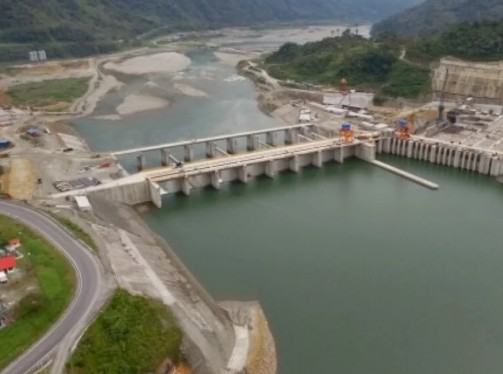
Flow levels of the Coca River at the Coca Codo Sinclair hydroelectric plant have been dropping in recent weeks.
Energy-project specialist Alejandro Montalvo Jaya warns that the system is already operating beyond its limits. “A healthy energy system in Ecuador would have a cushion of 1,200 to 1,300MW and we have almost none,” he says.
The government’s hope is that industrial disconnections will not only conserve water but also create a reserve margin that can help protect the grid against unexpected failures. Several factors have reduced that margin, however.
Some thermal generating units at key facilities, including the Esmeraldas and Paute reserve plants, are currently down for repairs. At the same time, Colombia has reduced electricity exports to Ecuador by 98%, leaving the country without as much as 450MW outside support.
Another concern is the Coca Codo Sinclair facility, whose generation depends on river flow that is currently declining and is expected to continue to drop. In addition, technical problems at Coca Codo mean the power generation operates at less than 60% capacity. The current Rio Coca flow-rate at the facility is 247 cubic meters per second, seven cubic meters above the operational level.
According to energy experts, the big question is whether taking large industrial consumers offline provides the system with sufficient buffer to avoid widespread residential blackouts in the coming months
Why industrial self-generation is difficult
The government has also turned to industrial self-generation as a longer-term emergency solution. Under Executive Decree 32, issued earlier this year, large electricity consumers in the AV1 and AV2 classes are required to have self-generation systems in place by December 15, 2026, reducing their dependence on the National Interconnected System.
For many industries, however, meeting that deadline presents major technical and logistical obstacles. Most industrial facilities that have generators use them as emergency backup systems. These units are designed to operate for limited periods during unexpected outages, primarily to keep essential equipment and safety systems functioning. Most of these systems are for limited use and are unable to serve as a primary source of electricity.
Fuel is another challenge. Most of these generators run on diesel, and Ecuador imports 80% of its diesel supply. Companies would therefore need to arrange additional fuel transportation, storage and distribution capacity.
Another major issue is that heavy industry cannot simply switch off its power. For many industrial facilities, disconnecting electricity is considerably more complicated than turning off the lights in an office and can lead to equipment damage and other economic losses.
In addition, industries with continuous thermal or mechanical processes — including cement, steel, ceramics and glass — can suffer significant operational and financial consequences from an abrupt shutdown. A cement mill, for example, may require controlled cooling, cleaning and recalibration procedures before it can return to normal operation. Those processes take 48 to 72 hours.
As a result, a scheduled 24-hour electricity interruption can translate into several days of lost production.
New generators cannot be installed overnight
Installing new prime-generation equipment is also expensive and time-consuming. The estimated cost is between $500,000 and $600,000 per megawatt. A medium-sized factory requiring 3 MW or 4 MW of capacity could therefore need to make an investment of more than $2 million to power up.
Even companies willing and able to make that investment face another obstacle: global demand for generation equipment. Demand from sectors such as mining and data centers has increased pressure on international supply chains, with equipment procurement, engineering and installation commonly taking six to 18 months.
For many companies, that makes meeting the government’s December deadline with newly purchased equipment extremely difficult if not impossible.
Floating generation: an emergency solution racing against time
With industries facing difficulties in acquiring their own generation capacity, the government has proposed another emergency measure to increase generation capcity: floating power barges. The plan has three key components.
The government has announced its intention to incorporate two thermal power barges with a combined capacity of approximately 200 MW. Under the proposal, the electricity would be directed primarily to large AV1 industrial consumers. This would allow the government to avoid placing the full cost of the rental on the state while giving companies an alternative source of electricity to meet their self-generation obligations.
The electricity generated by the barges would also be considerably more expensive than what Industries currently pay approximately, $0.12 per kilowatt-hour, while the government estimates that electricity from the power barges could cost between $0.24 and $0.44 per kWh. For companies with continuous production processes, however, paying a higher electricity rate would still be preferable to shutting down operations and absorbing the much larger losses associated with prolonged production stoppages.
Procurement could become the bottleneck
The most immediate concern is timing. The two procurement processes for the barges, managed by the public company ElecAustro and valued at a combined $82 million, are still moving through the public procurement system. One process remains in the negotiation stage, while the other is awaiting an award. Current schedules place key milestones in the first weeks of October.
After contracts are signed, the barges would still have to be transported, anchored and connected to the electricity system That creates a significant gap between the urgency of the electricity crisis and the timetable for the proposed solution. “The problem is that there is a worrying disconnect between the urgency of the crisis and the government’s schedule,” López said. “While the Mazar reservoir is losing centimeters every hour and low water is affecting the country today, the solution involving the barges does not even have the contracts signed,” he says, adding that actual power generation may not begin until November.
For now, Ecuador’s electricity system remains dependent on a delicate balance: conserving the water at the Mazar reservoir, reducing industrial demand, maintaining every available megawatt of generation and bringing new emergency capacity online before the dry season pushes the system beyond its limits.
The coming weeks will determine whether the government’s measures are enough to avert a blackout scenario similar to 2024.



Hogar Esperanza News

The Cuenca Dispatch

Week of September 20

Ecuador turns to industrial power cuts to protect Mazar and keep homes from going dark.

Ecuador raises its 2026 growth forecast, but El Niño could spoil the outlook next year.

Cuenca retirees challenge medical and therapy changes at IESS senior center.
Fund Grace News

Fabianos Pizzeria News