














Blackouts hit Quito, Guayaquil and areas near Cuenca as ‘low water’ reduces hydro generation
Ecuador’s National Electricity Operator (Cenace) ordered blackouts in several regions of the country Tuesday night and Wednesday morning. In a message to electricity distributors, Cenace blamed power interruptions on “low water conditions” at hydroelectric plants, especially at the Mazar complex in Azuay Province.
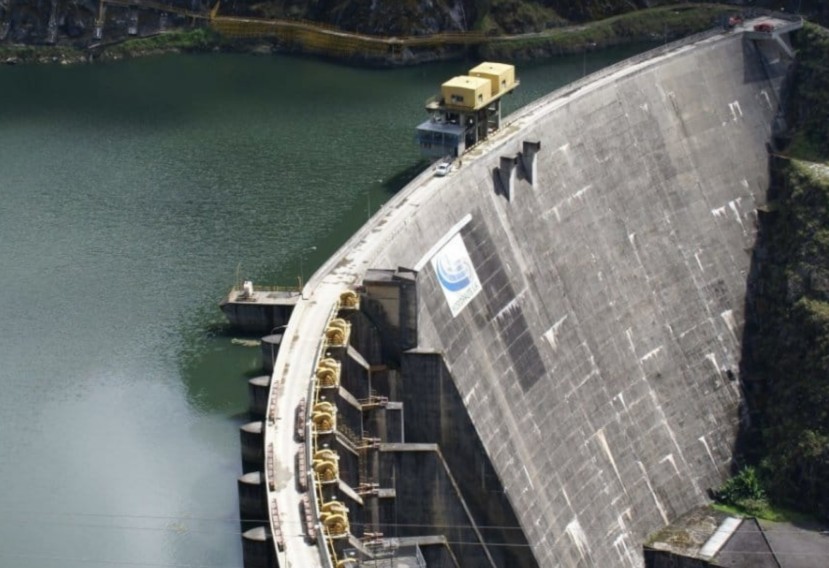
The dam at the Mazar hydroelectric generation station.
Diego Morales, president of the Central South Regional Electric Company (Centrosur) said the outages are affecting “a number of rural communities near Cuenca” although only two sectors of Cuenca were reporting loss of power. “The decision at Cenace was to distribute disconnections in way that equalizes their impact throughout the country,” he said. “We are responding to low flow rates on the rivers that power our hydroelectric generators.”
Traffic jams were reported in Quito and Guayaquil Wednesday morning as streetlights on major roadways went dark. In Guayaquil, Juan Ortiz, assistant municipal transportation director, said his office was dealing “total chaos” in some parts of the city. “We had no warning this was coming — there was no announced schedule,” he said. “Blackouts also occurred yesterday but the distributor told us it was for maintenance and to replace old equipment. They said they would not affect morning and afternoon commute traffic.”
In a Wednesday morning interview, President Daniel Noboa blamed the power disruptions on weather conditions that require maintenance work “related to improving power transmission and distribution” networks. He also said that “efforts are underway” to incorporate up to 400MW of additional thermal-generated electricity into the power grid.
In an interview on Cuenca’s Radio Tomebamba, Morales said that “extraordinary efforts” are being made to conserve the water level at the Mazar reservoir, which has led to power suspensions. “Mazar is the country’s primary source of electricity, and the reservoir provides water to three generation plants,” he said. “Unfortunately, the water flowing in from the Rio Paute is very low, which means generation must be reduced,” he said.
Morales added that the flow rate of Rio Paute into the reservoir Wednesday morning was 20 cubic meters per second while the optimal rate is 124.