











Constitutional conflicts could derail U.S. trade deal
As the Constitutional Court begins its review of the proposed trade agreement between the U.S. and Ecuador, legal experts say some provisions of the deal violate Ecuador’s constitution. The agreement, signed by representatives of the two governments in March, is also undergoing legal and legislative reviews in the U.S.
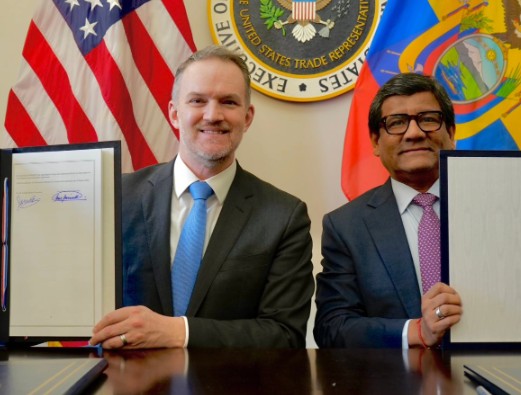
Ecuador and the U.S. signed a trade agreement in March that is currently being reviewed by the Constituional Court.
Besides its own review, the Ecuador court must also consider more than 50 amicus curiae briefs, many of them claiming constitutional conflicts with the agreement.
According to Quito constitutional lawyer Gonzalo Muñoz, there are four “sensitive provisions” in the agreement that challenge constitutional integrity. “Besides the constitutional questions, many of the objections filed with the court claim the plan represents a surrender of sovereignty by Ecuador,” he says.
The first involves food sovereignty and price controls set by the Andean Community (CAN) and agreed to by Ecuador. The controls and CAN rules “coordinate” with the Ecuadorian constitution for the protection of the agricultural sector, including smaller farmers, Muñoz says. Washington is demanding the elimination of these controls and rules.
A second provision requires Ecuador to accept all pharmaceutical products approved by the U.S. Food and Drug Administration (FDA) and that it follow rules adopted by the FDA, Muñoz says. This would override many of Ecuador’s drug and medical rules and could limit the country’s ability to negotiate with drug producers in other countries for the best prices.
The third provision of the agreement would require Ecuador to scuttle constitutional provisions for its public enterprises containing social and environmental requirements. The draft trade agreement demands that all state entities operate under purely business and commercial standards that don’t include social requirements.
The fourth U.S. demand is that Ecuador adopt U.S. immigration guidelines, including visa restrictions on certain countries, including Cuba and Haiti. Due to language in the constitution, Muñoz believes the court will reject this provision.
Following the Constitutional Court review of the trade agreement and consideration of amicus curiae briefs, it goes to the National Assembly for a final vote.
“It is possible that the conflicts can be resolved through negotiation, as they were three years ago with the Chinese trade deal,” Muñoz said. “In that case, China was agreeable to abide by the agricultural rules of the Andean Community. After the court completes it work, we will see if the U.S. is also agreeable to changes.”