










Plan a visit to Cuenca’s historic cemetery
By Frances Hogg Lochow
Monday, November second is Día de los Difuntos, Ecuador’s Day of the Dead. If you are expecting to see parades of people dressed like skeletons wearing fancy dress and sugar-skull makeup like in Mexico City, you’ll be disappointed. (Fun fact: The centerpiece of Mexico City’s Day of the Dead festivities never existed until it was inspired by a scene in the 2015 James Bond movie, Spectre.) In Cuenca, this day is respectful, moving, and quiet, and an excellent time to learn more about this country’s history and traditions, and to explore Cuenca’s historic Cementerio Municipal de Cuenca.
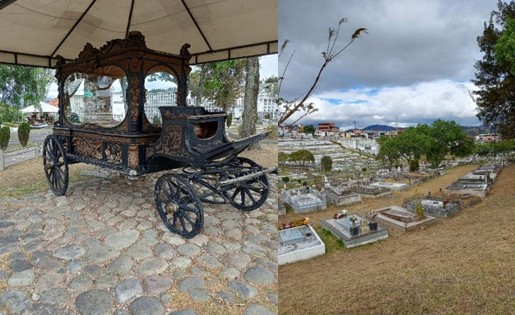 Originally, a division existed between the wealthy who were buried in churches or private cemeteries, and the rest of society. The municipal cemetery was established in 1843 for people of more limited means. In the oldest section, called the patrimonial cemetery, most of the gravestones here are illegible, but a marker reads “Here greatness and pride end. Equality begins. Here we all decay.” In 1930, the Cementerio Municipal was declared as the only burial place allowed in Cuenca. It was made a National Heritage site in 2002.
The cemetery, which takes up nearly 18 acres, is an intriguing place to visit anytime, with pleasant walkways and directional markers. In addition to the interesting tombs and crypts, there are exhibits of elegant antique horsedrawn hearses, a pet crematorium and mausoleum, a Jewish cemetery and a Grecian-style ossuary where bones removed from crypts when grave taxes are not paid are eventually deposited. (This is common in Latin-American cemeteries.) The mausoleum of the influential Eljuri family resembles a tiny cathedral with beautiful stained glass and a mosaic tile interior. In an area called “the basin,” in-ground tombs tell the stories of the families buried there.
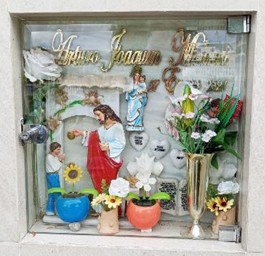
Most of the tombs are in above-ground structures of several stories with memorial plaques in the crypt niches that sometimes contain images of the deceased and other mementos. Some of the individual structures belong to families, neighborhoods, or guilds and unions such as for taxi and bus drivers and firemen.
 The cemetery is beautiful to visit at night, especially on El Día de los Difuntos. The streets around the cemetery are crammed with vendors selling flowers and candles as well as colada morada and guaguas de pan. In the weeks before El Día, these treats are offered for sale in restaurants and bakeries all over Cuenca. The colada is a warm, thick, purple drink made from tiny Andean blueberries called mortiñas, fruit pulp, and purple corn flour. Guagua (pronounce wah-wah for good reason) is the Kichwa word for a baby. Decorated with colorful icing designs and made from bread shaped like babies, the rolls can be sweet or savory.
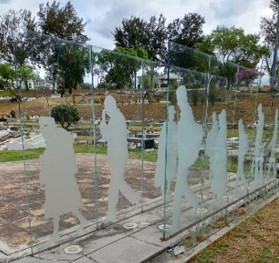
The quiet of the families who gather to clean and decorate the graves feels contagious. The scent of flowers, the candles burning, and sometimes gadgets softly playing music add to the feeling of reverence. Night is the best time to experience what I find to be the most moving memorial, called the Monumento de los Migrantes, made of etched glass panels lit from below. The transparent panels depict people endlessly walking, and honor Cuencanos who left to find better lives and never returned. At the base of the panels smaller markers honor the names of some of them.
A poem inscribed on the monument, translated, describes the loss:
Your journey without a destination.
Words are left unspoken.
Dreams that will never see the dawn.
I await your return; please, come back.
If I am here, you are present also.
Near yet distant.
So far and yet so close—like a shadow, light and swift as a sigh.
As you walk, you are that silhouette—blurred in my dreams—seeking the way back.
You will keep traveling while I wait for you.
I will go out to meet you, painting the walls of my city with memories;
and everyone will know our story.
They would discover you, share in your absence.
They would come to know our tragedy.
But how many walls would be needed to remember those who are not?
 There are several entrances to the Cementerio, but not all of them are always open. The main entrance is on is Avenida Gonzales Suarez near Calle Octavio Diaz. There is a helpful guard who can answer your questions but may ask to inspect any packages you are carrying to help prevent possible vandalism. It is open every day, generally from 8am to 6pm, but longer on El Día de los Difuntos.
_________________
Frances Hogg Lochow is a 14-year resident of Cuenca and the founder of the Cuenca Writers Collective