











The Ecuadorian toad is fighting for its survival — and it has a lawyer
By Bethany Brookshire
High in the Andes, a winding road clings to the mountainside, linking the roughly 7,000 people who live in the rural Angamarca River Basin, to the coast — and the rest of Ecuador. It’s a landscape of steep mountainsides and narrow valleys. Farms are interspersed with páramo, a type of high tundra. The current motorway is too narrow for heavy trucks transporting goods or for patients to speed toward the nearest city for medical care at night. But progress is coming. An expansion project has started to widen the road to two lanes. Access to markets, universities, tourism, and medical care beckon.
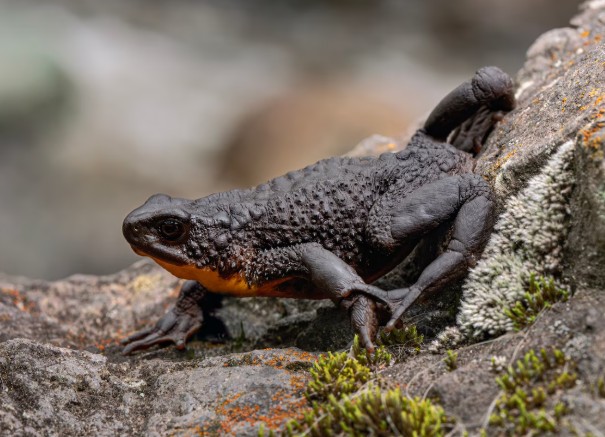
Ecuador’s Angamarca River Valley is home to the last population of the endangered Jambato harlequin toad (Atelopus ignescens). A road project that the region desperately needs now threatens the toad’s survival, in a complicated test of the rights of nature.
But the construction brings road crews, dirt, and dynamite, and humans aren’t the only creatures that call Angamarca home. The road cuts directly through the only existing habitat of the Jambato harlequin toad (Atelopus ignescens). A bit smaller than a human thumb, the toad is dark — almost black — on top. The surprise is on the bottom, where its tummy flashes a lively orange yellow. Its call is a soft, squeaky peep, like a very small dog toy. With only a few hundred toads left, the expansion could spell doom for the species, which was once thought to be lost entirely.
However, the toad is not defenseless. The Ecuadorian constitution is unique in that, since 2008, it has included the “rights of nature”—the legal premise that nature, from a mountain to a river to a toad, has rights to exist, to persist, and to thrive. The legal distinction goes beyond how species and ecosystems are protected in the United States, under the Endangered Species Act (ESA) or Environmental Protection Act. Legally speaking, the U.S. and most other countries consider nature as a resource for human use. In Ecuador, the national government has a mandate to prevent activities that “might lead to the extinction of species, the destruction of ecosystems and the permanent alteration of natural cycles.” Here, nature has rights, just like a person. And yes, this toad has lawyers.
A legal team has sued the local government on the toad’s behalf to stop road construction, stating that the road expansion lacked environmental safeguards, and impedes the toads’ right to exist as a species. Construction has been paused, until the government can provide correct environmental safeguards. The decision could set new precedents for the rights of species all over the country. Outside of Ecuador, other communities and even countries, such as Aruba and Ireland, are considering adding rights of nature to their constitution. The toad’s victory adds to legal precedent in Ecuador, which could shape when and how such laws are implemented and enforced.
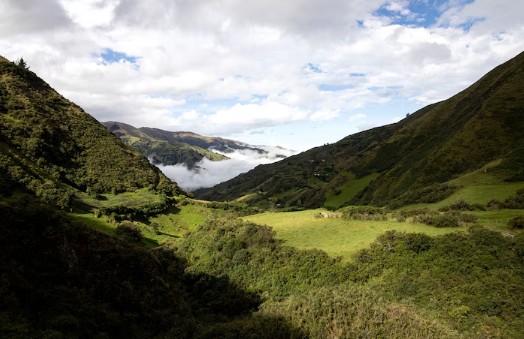
single road links the rural mountain community of Angamarca to the coast and the rest of Ecuador.
But what about the community, which still needs a road? The Jambato offers a pivotal test of the constitutional mandate, and the philosophy it stands on. In the past, cases that ruled in the favor of species also typically had an upside for some humans: like preventing a mine that would ruin a habitat and perhaps contaminate human drinking water. Here, the road clearly benefits the local farming community, and without correct environmental safeguards, it will destroy the toad’s habitat.
Can the modern infrastructure rights of a rural, underserved community truly coexist with the rights of an individual species to not go extinct? Giving nature rights, it turns out, isn’t so simple.
The Jambato harlequin toad gets its name from the word “hampatu,” which means “toad” in the Indigenous Kichwa language and is technically ex-extinct. It used to be a common sight, says Juan Guayasamín, a herpetologist at the Universidad San Francisco de Quito in Ecuador and a National Geographic Explorer. Everyone from Spanish explorers in the 1800s to herpetologists in the 1970s, he says, “talk[ed] about this species in the hundreds and thousands.”
But a decade later, the Jambato was gone. Scientists suspect a combination of hot, dry weather and a nasty fungal infection called Batrachchytrium dendrobatidis, or Bd, doomed the toad. By the 90s, it was considered extinct in the wild, with the last known sighting in 1988.
Then, in 2016, a 12-year-old boy from Angamarca found a Jambato. “The Jambato became now this symbol of hope,” Guayasamín says.
The Angamarca River Valley is the toad’s last stronghold. In a 2021-22 survey of the valley, Guayasamin and his colleagues found 71 Jambato toads. Today, activists estimate that there are between 92 and 359 individuals left in the world.
The survey was part of the work of Alianza Jambato, a group of scientists, ecotourism leaders, and local Indigenous leaders and volunteers who want to conserve the Jambato, formed in 2021. Maria del Carmen Vizcaíno, co-founder and CEO of the nonprofit, immediately set out to involve the community. At first, all was well. The nonprofit worked with the parish government and volunteers to set aside land as a sanctuary for the toad and held “toad day” celebrations where local kids dressed as toads in black outfits with large orange bowties.
But soon local government officials and Vizcaíno’s nonprofit found themselves on opposite sides of the road.
Friction between the toad’s supporters and the community began in 2024 when the Cotopaxi provincial government approved the construction project to widen the only road into the river valley. (The provincial government did not respond to requests for comment.)
For many locals, it was long overdue. “We have carried our products on animals, walked long distances, and, in the most critical moments — when someone from the highland communities gets sick at night or in the early morning — we haven’t had a road that allows for timely transport to a health center or hospital,” says Romeo Vichicela, the president of the Angamarca Parish Government.
Expansion means blasting through rock. When construction began, debris began to rain down the side of the road and into the river. The Alianza Jambato and local volunteers, including Nayerli Canizares, a university student from Angamarca, were horrified. While the community needs a road, “I want a road planned well with technical studies,” she says.
But moving the road elsewhere would be a difficult and expensive proposition. “From a technical, territorial, and public investment efficiency perspective, it is not reasonable to modify the route or propose an alternative in another area,” Vichicela says.
Alianza Jambato decided to take matters into their own hands. In September of 2024, the group worked with CEDENMA, an organization that represents conservation groups across Ecuador, to file a measure with a local judge to stop the construction, stating the toad was in imminent danger. CEDENMA did not object on behalf of the Alianza Jambato, but on behalf of the toad itself. “I’m the toad’s lawyer,” Gustavo Redín, the vice president of CEDENMA, told National Geographic earlier this year. “The toad is my client.”
His client has a case in part because, the national government’s constitutional mandate to protect all species. “Whenever there is an impact on nature, you actually have the duty to complain, and the state has the duty to respond,” explains Kelly Swing, a zoologist at the Universidad San Francisco de Quito who is not involved in the toad’s case.
It’s rare for an amphibian to be so well-represented. As of 2022, 24 countries have passed rights of nature laws, or affirmed rights of nature through court cases. Some are sweeping, others focus on specific ecosystems or rivers. In the U.S., the rights-of-nature movement has not seen many large victories. While local communities in the U.S., from the city of Santa Monica to Indigenous groups, have incorporated the rights of nature into their laws, there is no federal legal principle that ecosystems or species have rights — but that hasn’t stopped the courts from considering it.
In a well-known 1972 Supreme Court case, the Sierra Club sued the Department of the Interior attempted to block the construction of a ski resort in California’s Mineral King Valley because it, would harm the local ecosystem. Ultimately, the court declared that the Club’s members did not have the standing to sue because the resort would not be harm them enough. U.S. law prioritizes human concerns. Species should exist because we enjoy them, canyons so we can hike them. Under that framework, the mountains and forests in question had no rights in the discussion. Still, in a famous dissent, Justice William Douglas argued against the court’s majority that nature didn’t deserve rights, and that ecosystems, rivers, and more should be granted legal personhood for their protection.
________________
Credit: National Geographic