









Noboa says Ecuador needs more energy from Colombia but transfers so far have been ‘minimal’
President Daniel Noboa said Wednesday that Ecuador will continue to buy electricity from Colombia and hopes the daily transfers will increase. According to the National Electricity Corporation (CNEL), the transfers during the last 30 days have provided less than 1% of the Ecuador’s power usage.
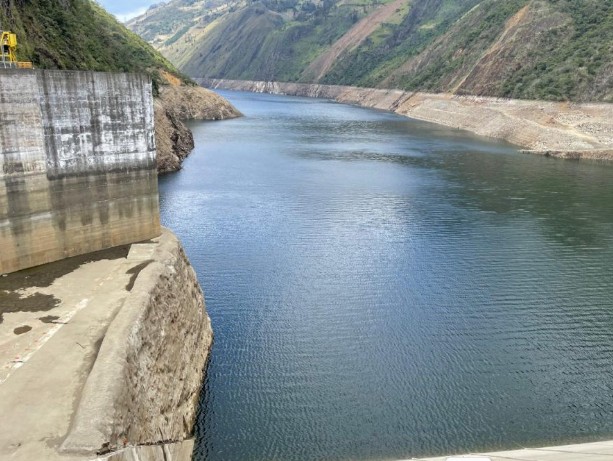
Following a recovery from late-October rain, the water level at the Mazar reservoir is dropping again.
“We need to continue the purchases for three or four weeks, until mid-December, to preserve the water level in our reservoirs until the dry season ends,” he told a Guayaquil Radio Centro interviewer.
The president’s comments came as the government asked large business power users in parts of the country to disconnect from the power grid. Managers of shrimp farms, feed mills, agricultural exporters and printing companies in Guayas Province said their power was turned off for several hours on Sunday, Monday and Tuesday.
The new power cuts come as reservoir and river flow levels drop at the country’s largest hydroelectric facilities, including the Mazar reservoir and its three generating plants.
Nivaldo Sánchez, member of the College of Electrical Engineers advisory council, says it is unlikely that Colombia will transfer greater amounts electricity. “Despite high hopes that we would receive 7% or 8% of our power from Colombia, the transfers have been minimal, less than 1% a day with three or four exceptions,” he said. “They are in a similar situation as we are, trying to maintain water in their reservoirs, and they don’t have much power to spare.”
Sánchez also claimed the price CNEL pays private Colombian companies providing the electricity is “exorbitant,” as much as 10 times higher than residential rates. “On Friday, one of the few days Ecuador received a larger transfer, CNEL paid as much as $1.40 per kWh when Ecuadorian households pay 10 cents per kWh,” he said. “We know that they sell to the Colombian government for a fraction of this.”
Former CNEL engineer Juan Pablo Serrano questions Noboa’s comment that the dry season will end in December. “We are at the beginning of a very powerful El Niño and we know from experience that this will extend dry conditions in the sierra, possibly to February and March,” he said. “I think it is very dangerous for the government to assume normal weather conditions will return in December. What’s happening on the coast should dispel this idea.”
Although rain bolstered hydro production in late October, water levels are falling again at the Mazar complex and at Minas San Francisco and Agoyàn plants, the country’s fifth and sixth largest producers.
On Thursday morning, the Mazar reservoir was at 2,225 meters above sea level, a drop of three meters from a week ago while the water level the Minas San Francisco plant was within a meter of minimum operational level. The flow rate of the Rio Coca at the Coca Codo Sinclair plant, the country’s large hydro plant, was reported in the “low” range.
The National Meteorology Institute’s five-day weather forecast calls for heavy rain on the coast and light to moderate showers in the Amazon and sierra foothills.