














Galapagos and Guayaquil battered by El Niño floods
For the second time in three weeks, areas of Santa Cruz Island in the Galapagos suffered severe flooding over the weekend. The National Risk office reported that more than 220 people were relocated to temporary shelters as a result of floods.
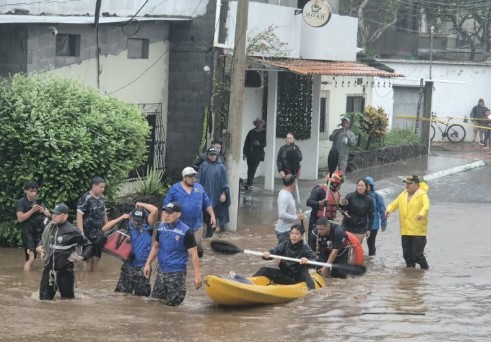
More than 200 residents were relocated due to flooding on Santa Cruz Island on Saturday and Sunday.
Flights were temporarily suspended Saturday and Sunday at the airport on Baltra Island, adjacent to Santa Cruz, as water accumulated in the runway. The road connecting the airport to Puerto Ayora, the Galapagos’ largest town, were washed out in several locations.
On the mainland, large areas of Guayaquil were underwater during the weekend following heavy rain. A Risk Management spokesman said that thousands of families in low-lying neighborhoods are living in flooded houses. “We do not have space to relocate all of them and are concentrating on areas with the deepest water,” he said, describing the practice of residents placing cement blocks on the floors of flooded houses to walk from room to room.
The spokesman said his office is worried about the spread of mosquito-borne diseases. “We have experienced a large increase of dengue and malaria cases and the standing water is breeding more mosquitos.”
Risk Management said that floods were also reported in Santa Elena, Manabi and Esmeraldas Provinces, with some locations receiving as much as a meter and a half of rains since early October. As of noon Sunday, 36 rivers in the coastal region were above flood stage, 22 of them in Guayas Province.
Former director of the National Meteorology Institute (Inamhi) Roberto Sanchez says there is “no relief in sight” for the coastal flooding. “I hate to say it, but this pattern will continue until February or even March next year,” he said. “This is a very strong El Niño and the sea water temperatures are the highest ever recorded and they are generating massive amounts of moisture in the atmosphere.”
Sanchez said there are “hopeful signs” of greater rainfall in the southern sierra, where four of the country’s largest hydroelectric plants are located. “It is ironic that we have too much rain on the coast and not enough in the mountains where we need it to keep our lights on,” he said. “We had an increase in showers in the region last week but most of these were localized and provided only short-term relief for the rivers and reservoirs. The forecast is for heavier rain Monday and Tuesday.”