











A favorite in Samborondon, Mantraa now offers its Indian specialties in Cuenca’s Puertas del Sol
It is difficult to exclaim which ethnic foods are the most favorite in the world. The most popular ethnic foods vary by region, but analysis of Google Trends data showed five favorites.
Chinese, Mexican, Italian, Thai, and Indian cuisines consistently rank among the world’s favorites. Chinese food is the most searched for cuisine on Google. The popularity of Indian food has transcended its traditional boundaries to emerge as a global culinary favorite.
The number of Indian restaurants has grown by 25 percent in the last five years, outpacing the restaurant industry, according to a 2023 report by the National Restaurant Association, which represents more than 380,000 restaurants in the United States.
“There are over 4,000 Indian restaurants in London,” said Shailendra Seth, the owner of Mantraa, Cuenca’s newest Indian restaurant.

Small copper pots await to be filled for the table.
That is more than the combined total of Indian restaurants in Delhi and Mumbai.
“This large number highlights Indian cuisine’s popularity,” said Shailendra.
But it has been slow to take foot in Ecuador.
“In 2018, there was no authentic Indian restaurants in the country,” said Shailendra. “My wife, Neetu, made really good Indian food. When the Ecuadorians tasted her food, they did not think it was too spicy.”
Based on their Ecuadorian friends liking Neetu’s food, the couple opened Mantraa in May 2018 with Indian friends of theirs, Anand and Shri Somani.
It was quite the change for Shailendra, who had worked in the pharmaceutical industry for a quarter century. His work was mainly in native India before working in Venezuela and Ecuador.
The couple found a great location on the outskirts of Guayaquil, in Samborondón.
“On a lighter note, Samborondon is often referred to as Miami in Guayaquil. It is a relatively safe area in Guayas province,” said Shailendra. “We started with 40 dishes as an Indian menus is so extensive. There are thousands of dishes!”

A Kalamkari painting, a traditional Indian art form known for its intricate details and use of natural dyes, hangs on the wall at one of the tables.
Mantraa is consistently in the top three restaurants in the Guayaquil-Samborondon area. Families and couples are always returning to the restaurant, the named Mantraa, which refers to sacred chants commonly used in Hindu temples and households.
“These chants are known to have benefits for the human body, similarly good and healthy food, cooked with love and caring when eaten in the company of friends and family, in a good ambience,” said Shailendra. “It has benefits for the human body, hence the name Mantraa for the restaurant.”
Currently, it is listed as #1 restaurant in Samborondón, on Tripadvisor, with an average score of 4.9 out of 5, with 374 reviews. Google’s aggregate score is very similar with 4.7 stars for Mantraa.
The success in Samborondón had Shailendra and Neetu wanting to expand into Cuenca.
“Cuenca was long planned, but the Covid pandemic delayed it for several years,” said Shailendra.
On top of that, finding the ideal location slowed things down.
“We thought El Centro would be good for us,” said Shailendra. “But we found two problems: Too much vehicular traffic, too little parking, and a lot of restaurants close down in the evening in El Centro.”

A pitcher of Mango Lassi, a creamy, frothy, yogurt-based drink originating from the Punjab region of India.
They looked at a lot of properties in the city before settling on a renovated historic casa in the Puertas del Sol neighborhood.
“This is an up-and-coming area,” said Shailendra.
All of the cooks at Mantraa are Indian, bringing an authenticity to everything they prepare. The spiciness is adapted to the Ecuadorian palate, but the intensity can be increased if requested.
“What differentiates us are our spice levels and ingredients,” said Shailendra. “We get one or two people every week who want it very spicy.”
Many Indian restaurants with their intense spices have given Indian food a bad reputation according to Shailendra.
“Spices should not overwhelm the food,” said Shailendra. “You need to taste the chicken.”

Mantraa is one of three restaurants in a renovated historic casa, in Puertas del Sol.
Almost everything is made from scratch, and that includes yogurt, a foundational ingredient in Indian cuisine. Yogurt is used to tenderize meat, thicken sauces, and provide a creamy, tangy base for dishes like curries, raitas, and lassis (a popular yogurt drink in north India).
“As long as we can get fresh mangoes, we will be serving mango lassis,” said Shailendra.
Every house in India makes their own special mango lassi according to Shailendra. The same goes for Masala Chai, a popular beverage made by brewing black tea with a combination of fragrant spices, sugar, and milk.
“We have a generic chai recipe,” said Shailendra. “It is 1/2 cup milk, 1/2 cup water; add some mashed fresh ginger, fresh ground cardamom, and boil it for a couple of minutes. Then add sugar.”
In India, according to Shailendra, a good chai is “good for a hundred miles.” Truckers stop at roadside stands for some chai to keep awake and continue their drive.

One of the cooks is preparing Naan by putting it into a clay oven.
In just four months, customers have already chosen their favorite dishes: Butter Chicken Masala, Chicken Tikka Masala, and Paneer.
Butter Chicken Masala and Chicken Tikka Masala are similar. The biggest difference is butter chicken has cream and butter, and tikka masala does not.
Legend has it that Kundan Lal Gujral, the owner of Moti Mahal, a small restaurant at that time, in the 1930s, faced a challenge of repurposing Tandoori Chicken, another popular dish he had created. His new dish made his restaurant an iconic presence in Delhi and a multinational corporation.
Meanwhile, Chicken Tikka Masala, on the other hand, is believed to have been created 4,200 miles away by Indian chefs in the UK. It’s a spicy, tomato-based dish that is made with marinated chicken cooked in a tandoor oven, a large vase-shaped oven.
Paneer is a fresh cheese that is sometimes known as “Indian Cottage Cheese.” Typically, in India, buffalo milk is used to make paneer due to its higher fat content than cow’s milk, giving it a richer flavor. Mantraa uses ricotta cheese to replicate the popular cheese. The Paneer dishes at Mantraa use different gravies, giving the cheese a wide variety tastes.
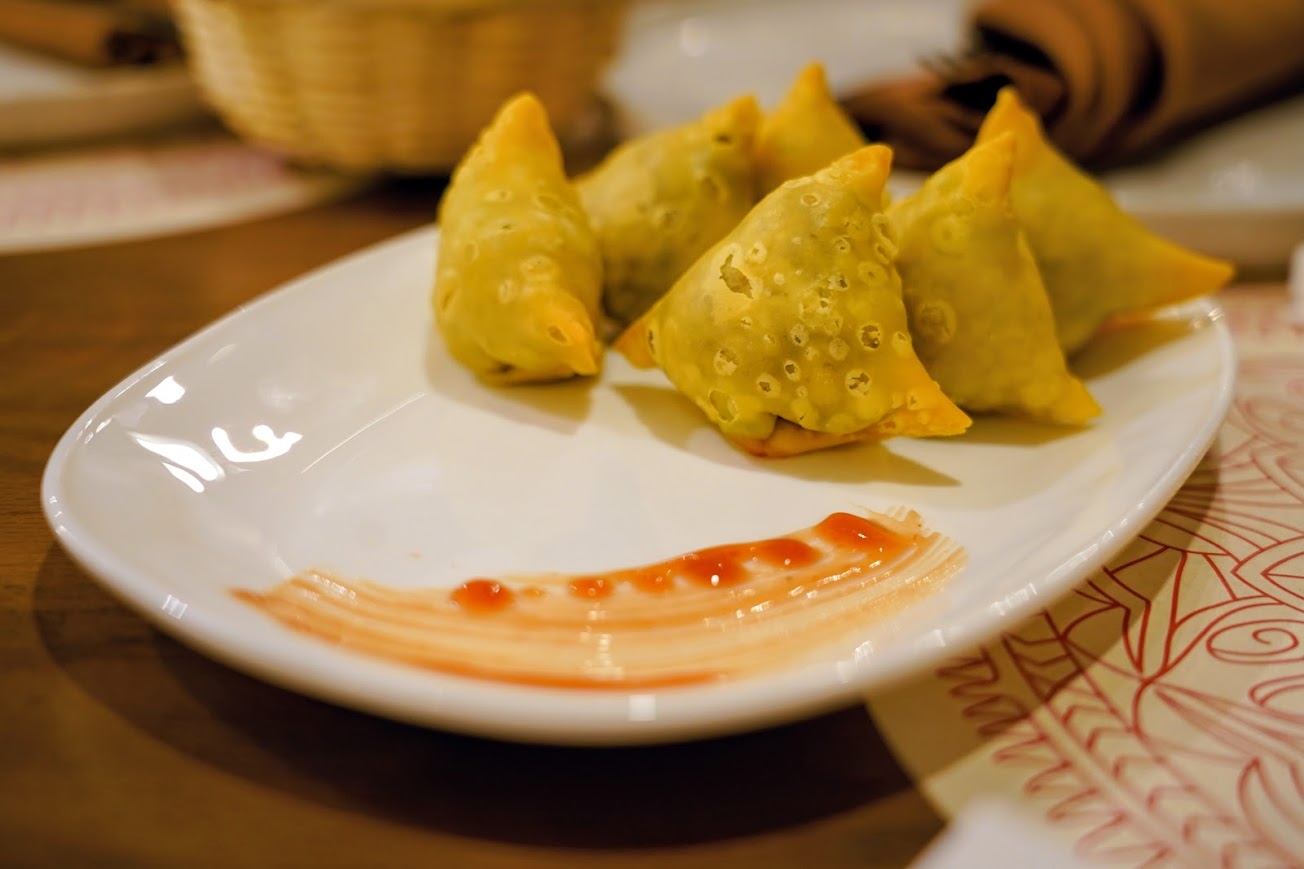
It’s hard to resist a crispy and flaky Samosa filled with delicious, spiced potatoes.
Then there are the traditional lentils.
“In India there are more than 10 different varieties of lentils, that help as a source of healthy protein for the vegetarian population,” said Shailendra.
They are so popular in India that the country has to import them from Myanmar, Canada, and Brazil.
“Only two of them are used at our restaurant: Dal Makhani and Dal Tadka,” said Shailendra.
Dal Makhani is a popular north Indian dish. It is slowly cooked black Dal (lentils) with garlic, tomato, butter, and garam masala.
Dal Tadka is the most eaten in India. It is a classic dish made with yellow Dal, spices, and a tempering of aromatics.
When it comes to bread, Roti is the most common in India. It is unleavened flatbread made with just a handful of ingredients. Roti is great served hot with butter or homemade ghee.
Mantraa is now serving new bread that is similar to sourdough.
“Everyone loves it,” said Shailendra.
Mantraa serves eight different types of Naans. Made from fine flour and made in a clay oven, Naan typically includes yogurt or milk in the dough, giving it a richer taste and a softer texture. Long before forks, Naan was the table tool for scooping curries, lentils, and sauces.
“We do the authentic Naan,” said Shailendra. “I challenge you to compare our Naan to others.”
That challenge may be all you need to experience some excellent north Indian food, on the west side of Cuenca.
_________________
Mantraa, Casa del Río, C. Victor Manuel Albornoz y Los Cedros, Cuenca, 099-331-3507, https://www.instagram.com/mantraaecuador/?hl=en, Hours: Tuesday-Thursday: 12-4 p.m. and 6-10 p.m., Friday: 12-4 p.m. and 6-11 p.m., Saturday: 12-11 p.m., and Sunday: 12-9 p.m., Credit cards accepted.
Photos by Stephen Vargha
Stephen Vargha’s second edition of his book about Cuenca, “Una Nueva Vida – A New Life” is available at Amazon in digital and hardback formats. His award-winning blog, “Becoming Cuenca,” supplements his book with the latest information and hundreds of professional photos by him.