













A retirement journey from sheep town to basin city
I have lived long enough to watch two different towns, one in North Yorkshire, England, and one in the Ecuadorian Andes, win the same prize for the same crime. 
They both insist on being pleasant places to live, despite the fact that their street plans were drawn up by people who never imagined delivery vans, ride-hailing apps, or retirees with opinions about sidewalk maintenance.
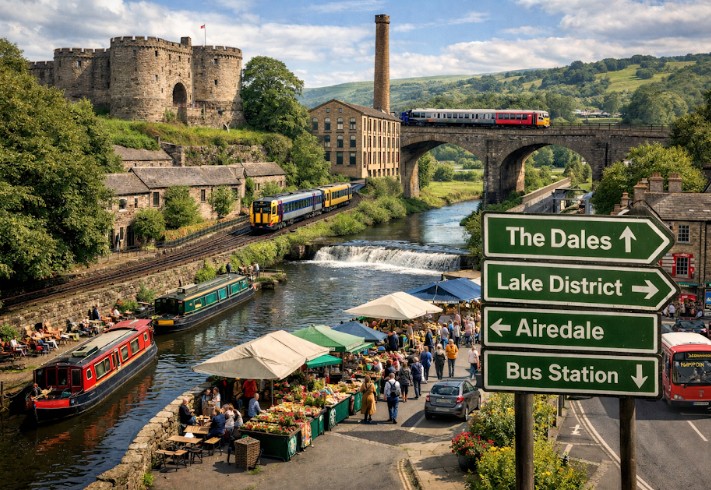 Skipton, for readers who have never wandered north of London except by accident, is a market town in North Yorkshire, England, resting at the edge of the Yorkshire Dales National Park. Although well-known it is also often described as a hidden gem, But more importantly, it is where Charlie Larga’s life began and his first memories of it were of cold gritty winter days when toes, fingers, and ears froze and developed chilblains, and the freezing fog mixed into a recipe with just the right proportions of leaded gasoline and coal smoke that stung your face as you walked down the High Street towards the bus station.
Cuenca, Ecuador, where he now resides, is where it appears increasingly likely to end, a basin city whose name describes what geography intended rather than what marketing departments later improved upon.
Skipton’s origins grew from sheep, not strategy. Its name, rooted in Old English for sheep town, reflects a wool-trade ancestry that left behind more than etymology. From those pastoral beginnings came a convergence that, viewed coldly, should have produced permanent gridlock. A medieval castle anchors the town center. Six roads once pushed inward from Leeds, Bradford, Harrogate, Grassington, Burnley, and the Settle direction, all behaving as though Market Street were the obvious place where you wanted to arrive. Add multiple railway lines, the Leeds and Liverpool Canal sliding calmly along its engineered logic, the River Aire doing what rivers do regardless of civic convenience, and a bus terminal injecting its own pulses of arrival and departure, and you have the ingredients for an urban mess.
Yet Skipton functions and despite its generally miserable winter weather, was in fact recently named as the Happiest Place in England, which is not exactly how Charlie Larga remembers it, but never mind.
It functions not flawlessly, not silently, but without the daily collapse one might reasonably predict. The construction of a beltway soon after Charlie left the country must have cheered people up. Through traffic learned to flow past the sheep on the edges of the town rather than through the historic street market that has opened weekly in front of the castle since King John granted it a charter in 1204. Chaos was not eliminated, merely rerouted.
Memory edits selectively. I recall the cattle market not so much as an economic institution but as a sensory education: the smell of livestock, dung underfoot, mud that respected no shoe, the puddles, and the strange fact that it was nearly always raining on market day. That cattle market of pens, men shouting, cows mooing, sheep baaing, and pigs snorting has since been replaced by a supermarket with a vast parking lot, an arrangement suggesting that the modern British equivalent of cattle is the automobile. Where once rude farmers negotiated over beasts, equally rude shoppers now haggle and shake fists over parking spaces and wire carts.
The town’s former canalside cotton mills also tell a story of adaptation. Built not of brick but of stern, durable millstone grit stone from nearby quarries, they once projected the immutable permanence of industrial cathedrals, but today they have mutated into condos with tasteful lighting and foam cavity insulation, a combination implying that heritage is all very well, but Christmas is best appreciated at a stable indoor temperature rather than the temperature of a biblical outdoor stable.
Skipton even acquired a small indoor shopping arcade with a wrought iron and glass ceiling, once ceremonially praised by the then Prince Charles, a royal nod that briefly elevated retail roofing into an event of national significance. One suspects the future king saw in it what planners always hope for: modern conveniences into old structures.
Cuenca’s identity is declared upfront. The city delivers what it says on the tin. A basin. Rivers collect, merge, then flow on their way towards the distant ocean throwing off electrical power in exchange for altitude. The historic center follows the Spanish colonial grid pattern with admirable stubbornness. No railroad arrived during the age of rail, an absence that shaped growth for generations, until the Tranvía glided into service five or six years ago.
Cuenca’s rivers, unlike Skipton’s canalised industrial corridors, have been transformed into linear parks. Paths, trees, benches, joggers, dogs, conversations. Water, once something to build around cautiously in case bridges broke, is now something to stroll beside deliberately. It is difficult to overstate how civilising this feels.
Most residents of Cuenca will never have heard of Skipton. Skipton residents might also need to consult Google maps before locating Cuenca. Yet both places collect awards for livability, that modern civic pageant in which judges reward towns for achieving what they were never designed to achieve: balancing heritage, mobility, commerce, housing, tourism, nostalgia, and the unstoppable mathematics of traffic.
Skipton’s High Street serves its rural hinterland with steady competence. For what Britons consider serious mall shopping, one boards a train for Leeds, about thirty-five minutes away. Leeds, with roughly 800,000 inhabitants and three universities, performs metropolitan scale with confidence. Cuenca, comparable in population and similarly university-anchored, plays a parallel role within its Andean geography.
Climate intrudes with its own editorial authority. Summers in Skipton can feel uncannily like Cuenca: mild, agreeable, faintly optimistic. Winter corrects that illusion as ice takes over sidewalks and puddles in parking lots freeze over. Walking becomes tactical and broken ankles, arms, and hips are all too common. Cuenca’s cooler months lack this particular hostility, and altitude lends the air a clarity that makes even an ordinary walk seem more bracing than exhausting.
Why compare the town of my beginning with the city of my probable ending? Because retirement, like town planning, is an encounter with accumulated consequences. Skipton shaped my assumptions about independence, weather, and movement through constrained space. Cuenca accommodates my present priorities: walkability, affordability, climate, and the quiet pleasure of living in a city where rivers have been promoted from drainage channels to public companions.
Town planning, viewed from a comfortable distance, appears a matter of diagrams and authority. Up close it is compromise, resistance, unintended effects, and citizens convinced the obvious solution has been perversely ignored. Skipton absorbed centuries of converging movement of cattle drives, canals, railroads, roads and internal combustion engines before conceding to bypass logic. Cuenca negotiates modern growth while defending a UNESCO-protected centre and nurturing riverside parks. Neither solution was simple. Neither is finished.
Both towns are widely considered to be some of the most desirable places to live in 2026 not because planners achieved perfection, but because perfection is incompatible with real places inhabited by real people driving real vehicles while insisting they prefer tranquility.
And if there is a lesson in beginning life in Skipton and ending it in Cuenca, it is this: The comforting fiction is that towns are designed; the observable truth is that they simply survive us.



Hogar Esperanza News

San Clemente Banner News

The Cuenca Dispatch

Week of March 01
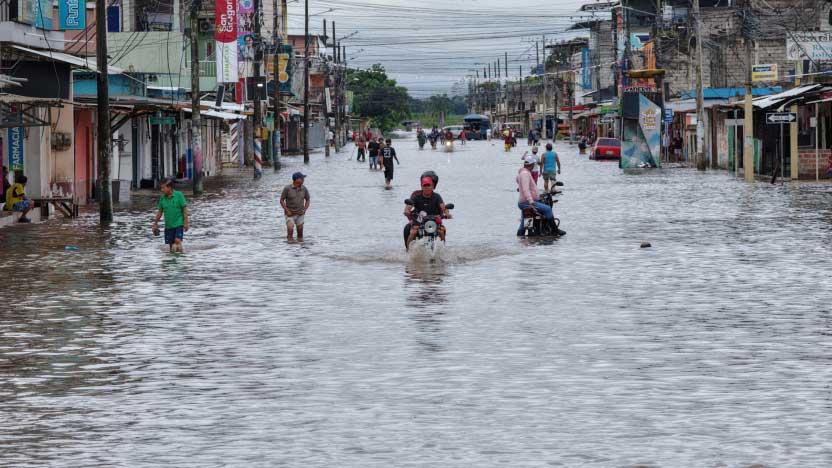
Emergency declared as winter rains batter Ecuador, damaging homes, schools and critical infrastructure.

Goleada fuel subsidy probe puts Guayaquil mayor and business network under judicial scrutiny.
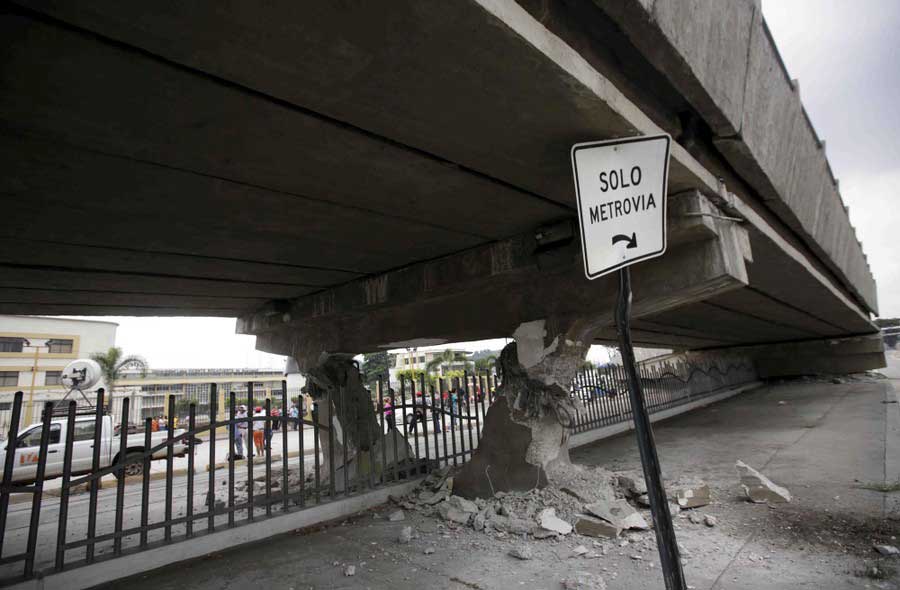
Noboa tightens spending rules on local governments amid claims of bloated payrolls.
Fabianos Pizzeria News

Quinta Maria Banner News
Anubis Restaurant News

Amazon Banner News

Fund Grace News

Property Manabi Banner News