











An expat becomes a celebrity — for a few minutes
By Jeremiah Reardon
A year ago, I rehearsed on guitar the songs I’d play for a live appearance on GM 7 Digital Radio in Azogues. The station broadcasts exclusively on its internet Facebook platform, where listeners can watch both live and recorded events.
 What led to my celebrity turn resulted from a chance encounter I had with actor/director/internet radio host Rommel Martinez out front of an ice cream shop where my wife Belinda and I dug into our bowls. “Hey! Rommel!”, I shouted as he strolled past.
Theater friends for over ten years, we have collaborated on a variety of artistic projects. We hugged on the sidewalk, and he waved back at Belinda. “Jeremiah, I have good news! I started work last year at an Azogues radio station. I have my own show. It’s called Mosaico De Voces (Mosaic of Voices).”
“Felicidades, amigo!” I cheered. “You’ve made it to the big time!”
“I’d like to interview you. You can play your guitar, too,” my energetic friend offered. He stood a few inches shorter than me and his curly dark hair shone in the afternoon sunlight.

Rommel Martinez (left) interviews Jeremiah.
“Thanks, Rommel, I’d love to. I’ll put together songs to play.”
“I have a show next Wednesday,” he said. “Come over to my home at 6 p.m. and you can ride with me.”
At that moment, my fellow guitar-student, Andy Kim, walked up to us. After introducing her to Rommel, I told her about his generous invitation. “Why, Jeremiah, you’re becoming a celebrity,” she said, making us all laugh.
In recent years, as a hobby based on my interest in music, I’ve crafted three acoustic guitars while serving as an apprentice to Cuenca artisans. Desiring to make one herself, Andy accompanied me to two workshops to learn about the process and the cost.
Owning a guitar required that I learn to play so that I can appraise a guitar’s quality. Cuenca’s recreation department offers free guitar classes at city cultural centers. For a year and a half before playing on Rommel’s show, I had attended both afternoon and morning classes a couple of days a week.
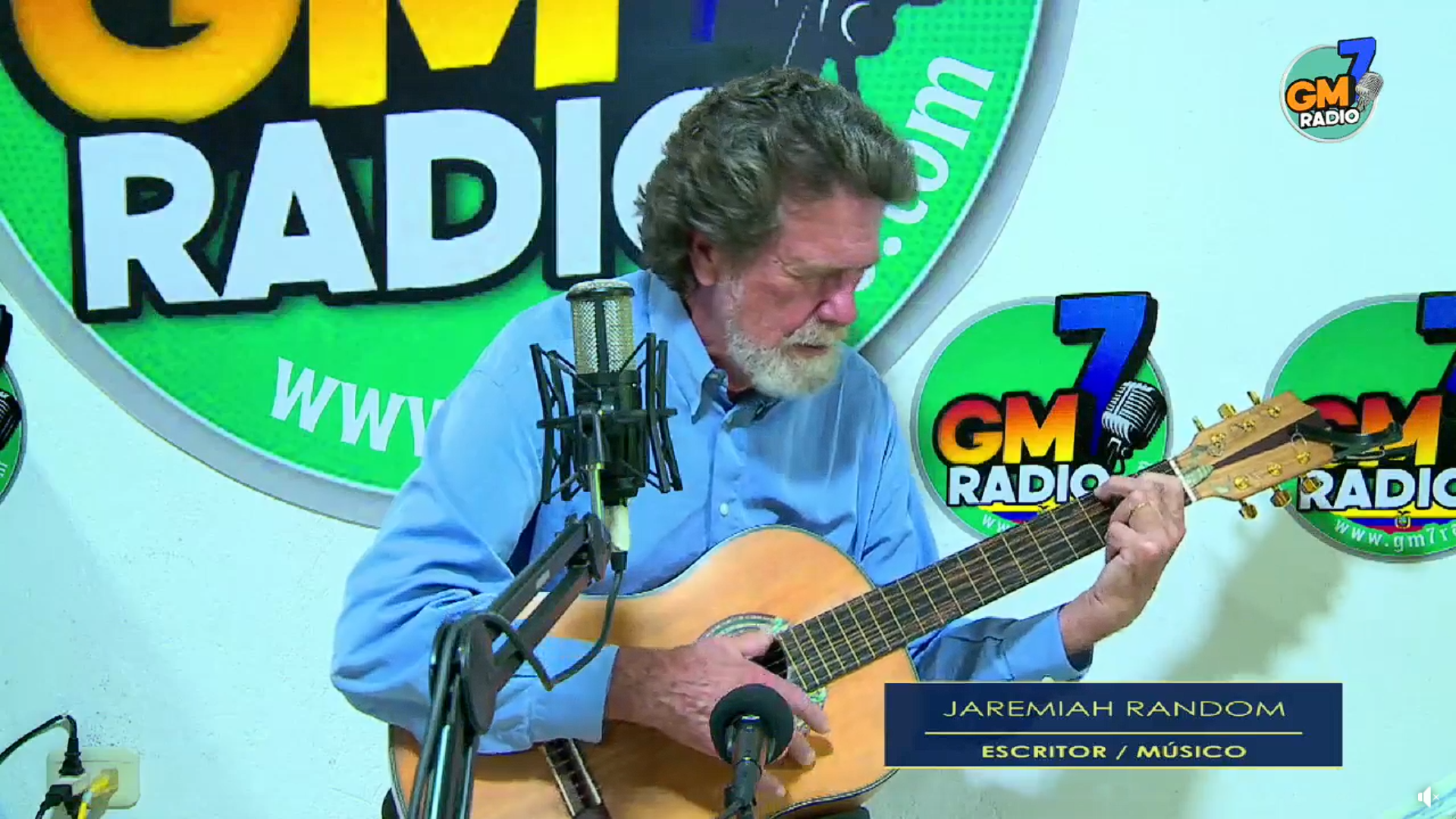
Jeremiah plays live on air at GM 7.
Joining Rommel a week later, our half hour northerly drive to Azogues led us through a convoy of military vehicles halted on the Pan American Highway’s outside lane and its shoulder within sight of the Andean city 20 kilometers north of Cuenca. We parked across the street from GM 7’s home on Calle Simon Bolivar. It occupies the second floor of a large block building. To the left of its two store fronts, stood a garage.
Rommel unlocked a metal door leading into a vast space with wooden steps to the right. Upstairs a door opened into a sparse interior of halls and doorways dominated by GM 7’s orange and blue logo featuring a shiny microphone.
An office with curtained windows overlooked the street. Similarly sized, the room next to it contained only cardboard boxes stacked on the floor. The station’s technical workspace dominated the rear of the floor. Off from the tech area, glass walls fronted interview rooms. With its remove from the street and its state-of-the-art equipment, the well-lit space felt calm and professional.
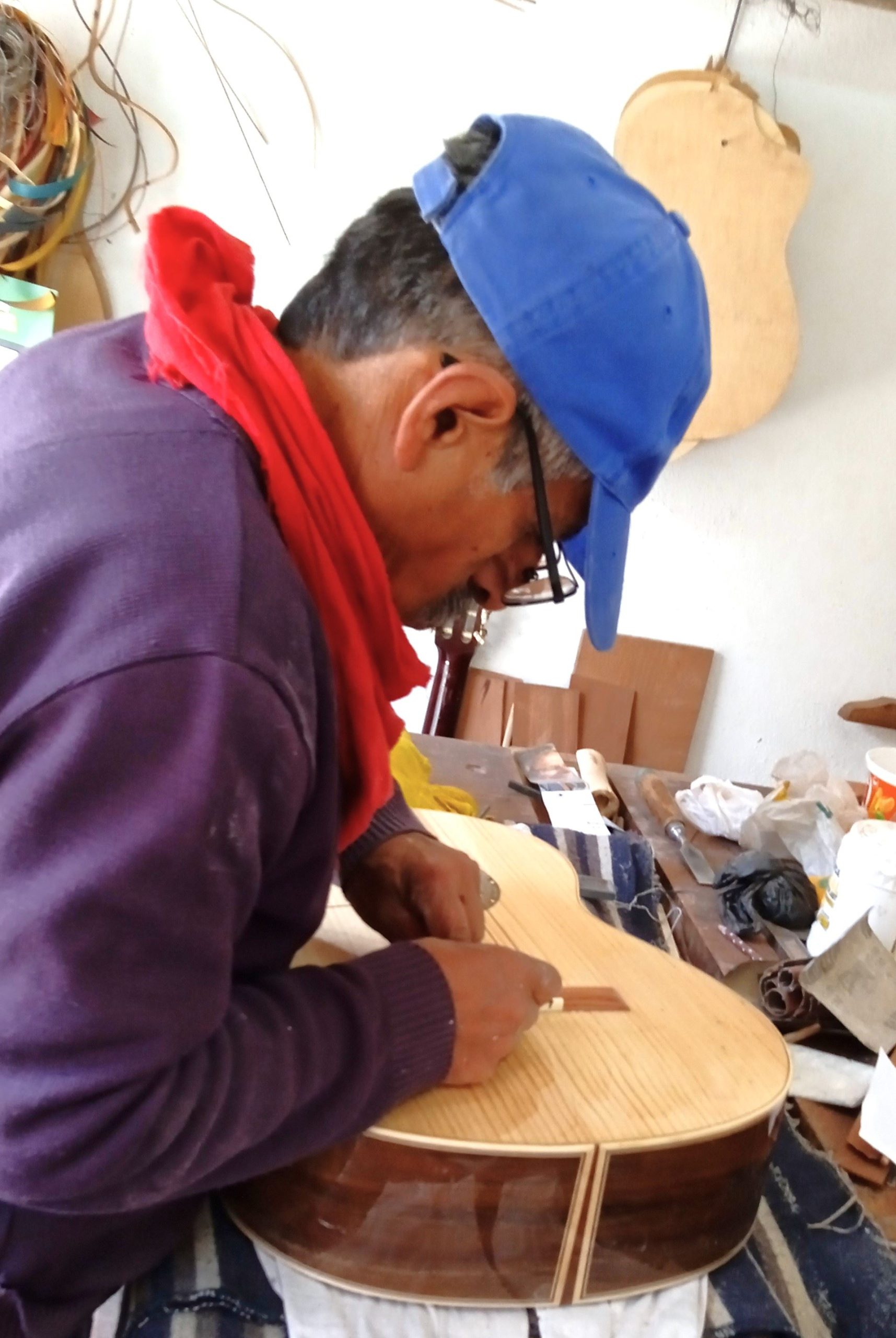
Maestro Juan Uyaguari ties strings on Jeremiah’s second guitar.
Rommel and I chatted with the tech awaiting that evening’s guest. The pediatrician of Rommel’s three-year-old son soon joined us. The gray-haired man wore a dark brown suit and an open collar tan shirt. Rommel led him into a room furnished with a desk and chairs. They sat beside each other, facing a couple of cameras. A green-screen wall used by the tech for video projections stood behind them.
From my chair in the studio, through its glass wall I watched the interview progress. Occasionally, I’d check a monitor displaying several camera angles of the two men. I liked seeing my friend ask questions which the doctor answered at length.
Afterwards, we headed home and discussed the show. Then, Rommel asked if I’d be his guest for the coming week. “Okay, Rommel. Fine with me. Thanks!” I replied.

Maestro Luis Pugo Jimbo and Jeremiah with restored first guitar.
Unexpectedly, later in the week Belinda asked me to accompany her to our Peruvian friend’s art show opening at a downtown gallery that same evening. I texted Rommel a heads-up, asking him to postpone our interview.
What soon developed was a colossal blowup, potentially damaging our friendship. He texted me back, “The station’s already promoting your appearance on the show.” Slowly, it sunk in after these exchanges that GM 7 broadcast his show live! I felt ashamed for taking the invitation so lightly.
Unable to reach him by phone, I rushed a few blocks over to his home. Why didn’t I call him or go by his house sooner? What an idiot! I thought.
In the after-dinner hour, his sister Ruth greeted me at their parents’ home on a crowded block across from a public school. Rommel, his wife and their son live in an apartment attached to one side of the house.
Ruth’s expression conveyed sympathy as my confusion spilt out. In reply, she said, “He’s at the station but will be here tomorrow afternoon.”
“Thanks, Ruth. And have a good evening.” Back home, Belinda and I discussed how to accomplish being together at the art show and with me leaving once Rommel arrived.

Jeremiah (right) practicing in Museum of Modern Art adult class.
Returning the following afternoon, a sense of calm came over me as Rommel warmly greeted me at the gate. “Jeremiah, how are you?”
“Much better, Rommel, now that we can talk,” I replied.
We entered his parents’ home and sat at the dining table drinking coffee. “Rommel, please. Let’s do the show tomorrow. Belinda and I just need a few minutes together at the opening to greet our friends. Then, you and I can leave for Azogues.”
“Jeremiah, can you do it next week on Tuesday?” he asked. I agreed.
“Good, but this time you must be sure to come. We can’t have another cancellation.”

Technician at work in GM 7 station.
“I apologize for screwing up our plans. I’ll be sure to mark it on our calendar. Thank you, Rommel!”
Arriving the following week at his home, we left a little behind schedule in his small sedan. I cringed in its low seat as Rommel unaccustomedly raced through intersections and traffic circles to reach the limited access highway.
Once beyond Cuenca, I relaxed. Rommel asked questions in preparation for the interview. I filled him in on my Irish American family’s love of music and how I played violin in school bands and a Washington, D. C. junior orchestra.
Arriving In downtown just after sunset, we parked in the same spot across from the station. Most storefronts had metal shutters drawn down to the sidewalk. Bright lights of fast-food restaurants lit up the street around us.

Technician at work in GM 7 station.
Arriving on the second-floor, Rommel first interviewed the coach of Azogues’ Apache Football Club. The young man had a beard and dressed in casual clothes and a backward turned ballcap.
I joined Rommel at his desk once this interview concluded. We both wore open collar blue shirts. He said, “Jeremiah, for our interview you speak in English. I’ll translate what you say in Spanish for the audience.”
“Sure, Rommel,” I felt relieved as my Spanish isn’t so good.
Rommel started the interview with introductory remarks. We appeared on the screen of a monitor mounted to the ceiling in front of the glass wall. On the bottom read: Romel Martinez, Presentador and Jaeremiah Random, Escritor/Musico (Writer/Musician). He had only two questions. First, he asked about my musical interests. In answering, I repeated much of what I had shared with him earlier.
Then, he asked me what songs I’d play. I listed four, including the Christmas carol Noche de Paz (Silent Night), Hallelujah by Leonard Cohen, an arpeggio triplet exercise and El Condor Pasa, an Andean folk song.
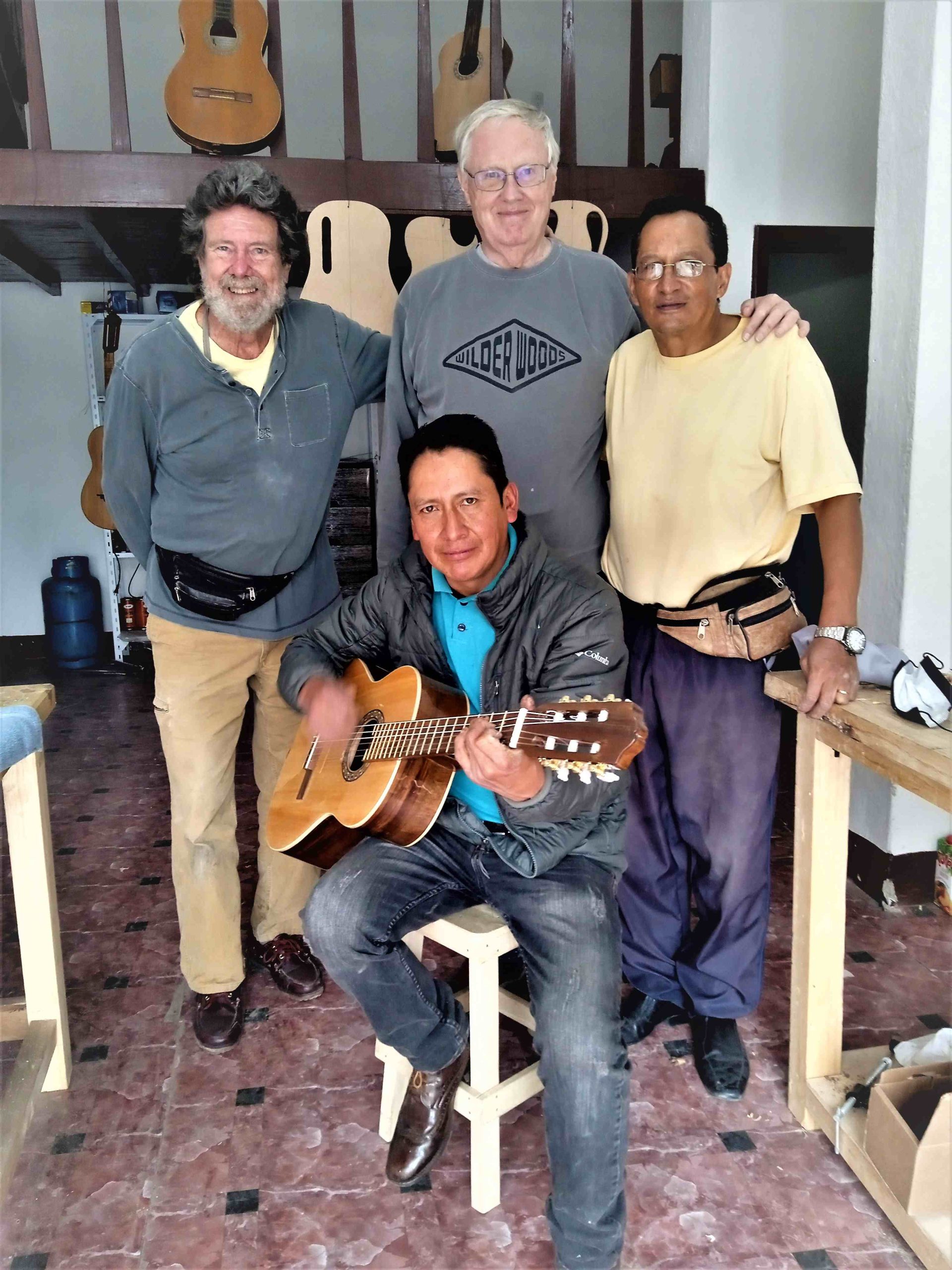
Maestro Oswaldo Landi with Jeremiah’s first guitar. Back row, left to right: workshop students Jeremiah, Mark O’Donnell and Guillermo Rosero.
At the interview’s conclusion, ads and public service messages played over loudspeakers. Rommel showed me into the studio. “Jeremiah, you sit here in front of the camera. The technician will let you know when to play.”
I sat on a wooden stool and placed several song pages on my music stand from home. I’d only play chords and not sing. In my guitar class I love hearing my fellow students sing these songs accompanied on guitar. They grew up hearing them on the radio and at fiestas.
The tech soon approached and said, “Jeremiah, we are ready for you to play!” I stretched my fingers by playing musical scales. Before I knew it, he gave my cue.
Speaking in Spanish into a microphone, I introduced the popular Hallelujah and played into another one positioned at the guitar’s sound hole. Twenty minutes had passed, and I played the Peruvian waltz Odiame (Hate Me), when Rommel knelt before me and waved frantically. Go to 47:00 on the video for that abrupt halt.
Damn, they must be tired of my playing, I thought. I glanced above him to see through the glass three uniformed police officers in the hallway. Oh, it’s a raid! Maybe the station hadn’t paid its taxes.
With the camera turned off my surprised looking friend got up and pointed. “The Mayor of Azogues is here! I need to set up your mics in the other room.” A wave of relief surged through me. So, it’s not my fault, I thought.
Dressed in a blue suit, the handsome mayor entered the station and shook hands all around with its staff. I introduced myself and asked his name. “Javier,” he replied in a friendly fashion.
He soon joined three other officials including one of the policemen. They sat around the table of a glassed-in room. Looking on from the hall, the staff and I saw Javier dominate a lively discussion. Dealing with the invasion of drug cartels from the coast had the officials’ undivided attention.
Turning to me, a staff member spoke in English, “Until a couple of years ago, I lived in New York City. I loved living in the States! Ecuador has too much corruption,” he remarked as a scowl contorted his handsome features. The irony of this moment struck me as Azogues officials worked in earnest a few steps away.
Rommel soon wrapped up his chores at the station and it felt good to relax with my friend as he drove home at a more leisurely pace. He had an idea, “You can be in the movie I’m making with a couple of friends. It’s a drama revolving around the life of a young woman. We’re filming the pilot to shop around for investors. I liked hearing you play Amigo, tonight. Your character can play it in the movie.”
“Sure, Rommel. Sounds exciting. My class played it for our Museum of Modern Art Christmas show. I’ll keep practicing for the movie.”
Amigo praises friendship and Roberto Carlos, The Latin Music King, recorded it in 1977. I felt proud of my friend for having his own show at GM7. And grateful to him for putting me on the air after my screw up. “Muchisimas gracias, amigo!”