














Border crossing between Colombia and Ecuador reopens after a 19-day protest
Traders and transport operators have suspended a 19-day blockade at the Rumichaca International Bridge, the primary land crossing between Colombia and Ecuador. The protest, prompted by a 50% tax imposed by the Ecuadorian government on Colombian goods, was lifted to accommodate travel and commerce during the Semana Santa holiday period. Despite the suspension of the strike, the regional business community reports that significant economic damage and diplomatic tensions persist.
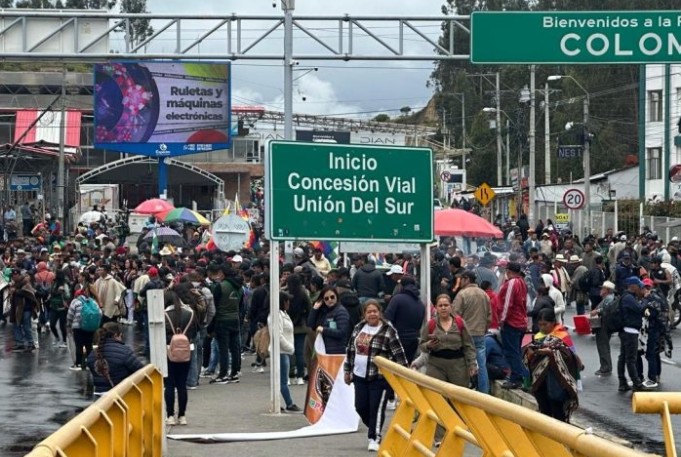
The Ecuador-Colombia border crossing at the Rumichaca International Bridge.
The closure of the border crossing created a substantial disruption in binational economic activity. Estimates from the Cámara de Comercio de Ipiales in Nariño, Colombia indicate that losses reached approximately $5 million USD per day due to freight remaining stationary in the border zone. The Comité Gremial de Trabajadores de la Frontera de Ipiales stated that while the reopening is a responsible gesture for the high-traffic holiday season, current tariff policies continue to threaten hundreds of direct and indirect jobs linked to foreign trade.
The Governor of Nariño, Luis Alfonso Escobar, criticized the trade barriers implemented by the administration of Ecuadorian President Daniel Noboa. Governor Escobar argued that such measures inadvertently encourage illicit activities in the region. He emphasized that instead of facilitating formal commerce, high tariffs drive trade toward illegality, undermining regional security efforts. To mitigate the conflict, the Comunidad Andina de Naciones (CAN) has initiated high-level dialogues. Diplomatic delegations led by Colombian Deputy Minister of Foreign Affairs Juana Castro and her Ecuadorian counterpart, Alejandro Dávalos, held a virtual working group to address pending issues in trade, transport, energy, and hydrocarbons.
Diplomatic friction has extended into the energy sector. President Noboa claimed that in 2017, Ecuador assisted Colombia during a potential blackout by charging 1.6 cents USD per kWh, whereas in 2024, Colombia charged an average of 28 cents USD per kWh during Ecuador’s hydroelectric crisis. In response, the Colombian Minister of Mines and Energy, Edwin Palma, clarified that prices during the 2023-2024 El Niño phenomenon reflected the actual costs of production and distribution, particularly when fossil fuel-powered thermoelectric plants using fuel oil and diesel were activated.
The ongoing trade dispute has impacted more than 5,500 companies over the past two months. Diana Marcela Morales, the Colombian Minister of Commerce, Industry, and Tourism, confirmed scheduled meetings with Ecuadorian officials to de-escalate the conflict and establish fair, transparent rules. Concurrently, the Ministerio de Comercio, Industria y Turismo has moved to protect domestic industries by implementing new tariffs on steel and ceramics from countries without existing free trade agreements. These measures aim to counter market distortions and protect a sector that employs more than 50,000 people while promoting circular economy practices and reducing CO2 emissions.
_________________
Credit: Finance Colombia