













Cuenca and the road not taken
Traffic, like cholesterol, causes blockages and is rarely discussed thoughtfully, being treated instead as a sudden affliction brought on by strangers or too many recent arrivals. We complain about it as if it arrived yesterday, when in fact traffic is a long-term civic decision, something cities invite, encourage, and then act surprised to discover unpacking itself at every intersection.
Urban historians have a phrase for this condition, the automotive city, describing a place built not around people but around private vehicles, with streets redefined as corridors for machines rather than shared public space.
 This outcome was not inevitable, having been engineered, legislated, advertised, and enforced, as streets that once belonged equally to pedestrians, bicycles, horses, carts, and trams were steadily reassigned to cars, accompanied by laws, signs, symbols, and the moral assumption that anyone moving too slowly was simply in the way.
North American cities embraced this hygienic model with enthusiasm, adopting low density housing, detached homes with garages, freeways slicing through neighborhoods, and the gradual disappearance of streetcars. Congestion, when it arrived, was not a failure of the system but its logical conclusion, the predictable result of prioritizing private movement at scale, long before the costs became obvious in lost time, wasted fuel, injuries, and the endless ritual of road widening.
Cuenca, almost by accident, chose differently.
This is not to say Cuenca has no traffic, since anyone who has waited behind a bus on Gran Colombia or watched a delivery truck block half of El Centro at noon knows otherwise. What Cuenca avoided was full surrender to the automotive city logic, instead hedging its bets, compromising early, and leaving itself escape routes.
Avenida de las Américas is one of them, functioning in practice as a beltway, not elevated or celebrated as a beltway or ring road, but effective, allowing a lot of traffic to move around the historic center rather than through it and allowing passengers to transfer to both ends of the Tranvia line. Many cities never made this distinction, funneling everything inward and then spending decades blaming drivers for the result.
The one-way systems provoke similar misunderstandings, irritating visitors while serving residents who understand their purpose. One-way streets are not an attack on freedom but an admission of geometry, acknowledging that in a city of narrow streets and fixed buildings, you either manage flow or surrender to chaos, a choice Cuenca made deliberately.
The tramline was the real heresy, reasserting the idea that streets are shared civic infrastructure rather than car storage lots with aspirations. Predictably controversial, it disrupted habits and forced decisions, but it also achieved something subtler, by reminding the city that movement does not require ownership, fuel, parking, or noise, and that people can be moved efficiently without multiplying vehicles.
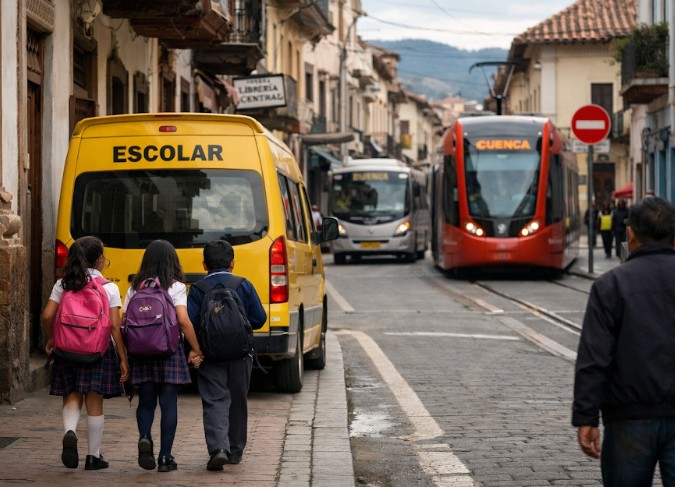
One small detail reveals how different the assumptions still are here. In Cuenca, many children are collected each morning from their front gates and delivered to school in yellow minibuses, returning home the same way in the afternoon, a system that removes thousands of individual car trips before they ever begin. Others walk hand in hand with friends or siblings, backpacks bouncing, while some ride ordinary city buses or the Tranvía with the confidence of young people for whom public transport is not a fallback but a normal part of growing up. A city that allows children to move through it safely, without requiring a private vehicle and a supervising adult for every short journey, is quietly declaring what it thinks streets are for.
What Cuenca largely avoided was the suburban exodus logic that reshaped North American cities after World War II, the belief that density is a problem, that distance equals freedom, and that every adult must own a car to participate fully in society. Daily life here still happens locally, with shops, schools, buses, taxis, walking, and cars coexisting without pretending that one mode deserves total dominance.
This matters because traffic is not solved by adding lanes but shaped by choices about density, rights of way, and what a street is for. Engineers learned long ago about induced demand, the phenomenon by which new roads create more congestion rather than less, and Cuenca, perhaps unintentionally, never fully bought into the fantasy that more asphalt would save it.
The city still argues about buses, parking, delivery hours, and the tram, and those arguments are healthy, because they mean the street remains a political space rather than a surrendered one. Once a city stops arguing about traffic, it has usually already surrendered.
For further reading, try Fighting Traffic by Peter Norton.