












Demand for ‘super grain’ quinoa taxes Bolivian farmlands; Production increases in Ecuador
The growing global demand for quinoa by health food enthusiasts isn’t just raising prices for the Andean “super grain” and living standards among Bolivian farmers. Quinoa fever is running up against physical limits.
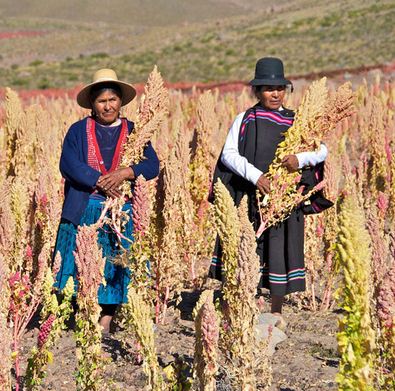
Quinoa harvest in Bolivia.
The scramble to grow more is prompting Bolivian farmers to abandon traditional land husbandry practices, endangering the fragile ecosystem of the arid highlands, agronomists say.
Although most quinoa is grown in Bolivia, it is also native to the Andean regions of Ecuador and Peru, where it is grown mostly for local consumption.
Quinoa currently fetches as much as $3,300 a ton, up nearly threefold from five years ago, a surge fed by “foodies” making quinoa a hot health-food product based on its high content of protein and amino acids. It’s also gluten free, because though used like a grain, quinoa is actually an edible seed.
Enthusiasts in the U.S. and Europe, as well as some research, suggest that the grain is the single most nutritious food source in the world.
Quinoa has been cultivated in the Andean highlands since at least 3,000 B.C., growing natively from Chile north to Colombia. It grows best at high altitudes in climates with cool days and even cooler nights. Bolivia is the largest producer of quinoa, followed by Peru, Ecuador, and Colombia.
In Ecuador, quinoa is grown primarily in the higher elevations of Azuay Province, near Cuenca, and in Cañar Province, to the north. It is sold primarily in local mercados, but efforts are underway to develop an export market.
In December, Bolivian officials began a campaign of public announcements to grow more quinoa as sowing season got under way. Townspeople sacrificed a llama to ask Pachamama, or Mother Earth, for a good harvest. Four months later, however, the campaign ended abruptly amidst complaints that that the crop was being planted on land where llamas traditionally graze. Without the llama manure, little grows in the arid highlands where the most prized variety of quinoa originates.
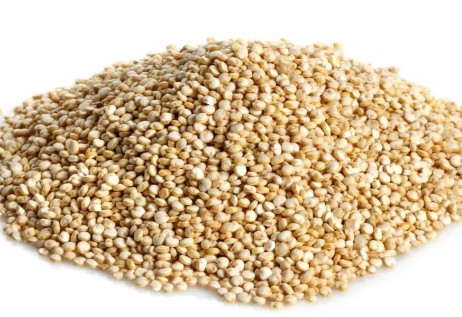
Refined quinoa
“Quinoa goes hand in hand with the natural fertilizer that llamas produce and there must be a nutritional crossing between the two,” said Rossmary Jaldin, an expert in the crop.
Bolivia’s deputy minister of rural development, Victor Hugo Vasquez, said 30 percent of his country’s 70,000 quinoa producers are now children of peasants who left the farm but have been drawn back by high quinoa prices. He and the president of Bolivia’s National Association of Quinoa Producers, Juan Crispin, say many of the growers don’t follow traditional farming methods and are depleting soils because they don’t rotate crops.
“We’re not going to work with them,” said Vasquez. “We are not going to help them.”
Bolivia declared quinoa a “strategic” priority in 2017 and has since disbursed $27 million in credits for increasing yields to cash in on the boom.
The country’s quinoa crop expanded from 240 square miles (63,000 hectares) in 2009 to 400 square miles (104,000 hectares) in 2023, when it produced a total of 58,000 metric tons, according to the Rural Development Ministry. That is more than 40 times the production in 2000.
Agronomists say that there is room for expanded production in Ecuador without environmental damage. A project at the University of Cuenca works with highland farmers, providing training planting and harvesting procedures to increase production.
The United States imports 52 percent of quinoa produced in the Andes while 24 percent goes to Europe, where France and the Netherlands are big buyers.