
















Ecuador drops its claim against Coca Codo Sinclair’s Chinese contractor but details of the deal are murky
By Allen Panchana
Nineteen years after construction first began, and following investments of more than $3.2 billion, Ecuador’s giant Coca
Codo Sinclair hydroelectric plant remains an unfulfilled promise. Operational since 2016, it has never met its 1,500-megawatt potential and is part of the reason Ecuadorians suffered power cuts of up to 14 hours a day in late 2024.
The most recent twist in the Coca Codo Sinclair story has political and diplomatic overtones, resulting from President Daniel Noboa’s official visit to Beijing at the end of June, where he met with his Chinese counterpart Xi Jinping.
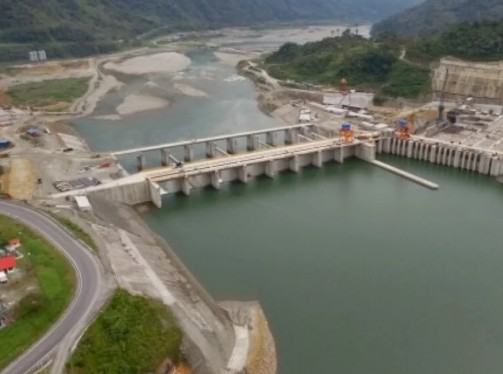
Aerial view of the Coca Codo Sinclair hydroelectric plant in northern Ecuador. The project was supposed to transform Ecuador’s energy mix and put an end to blackouts, but has struggled to consistently meet its full potential.
Upon the Ecuadorian delegation’s return from Beijing, Foreign Minister Gabriela Sommerfeld announced Ecuador had reached an agreement with PowerChina – the parent company of Sinohydro, Coca Codo Sinclair’s builder – to take over operations of the hydroelectric plant.
As part of the agreement, the Chinese state-owned enterprise will pay $400 million in compensation. In return, the Ecuadorian government will end the international arbitration it initiated in 2021 to pursue $580 million in damages. The case had been brought due to structural defects in the hydroelectric plant, including more than 17,000 cracks detected since operations began, as well as defective valves and poorly installed components.
Located between the Amazonian provinces of Napo and Sucumbíos, the megaproject was supposed to transform Ecuador’s energy mix, ending blackouts and complementing the country’s largest hydro generation complex at Mazar in Azuay Province. But after nearly a decade of fluctuating output and frustrations, the future of Coca Codo Sinclair remains uncertain. Some political figures are questioning the new deal with PowerChina, while ecological factors continue to pose challenges for the plant.
A concession to PowerChina?
From construction to operation, the saga of the Coca Codo Sinclair hydroelectric project has spanned the terms of four Ecuadorian presidents: three terms of Rafael Correa (2007–2017), Lenín Moreno (2017–2021), Guillermo Lasso (2021–2023) and Daniel Noboa (2023-2029).
For the Noboa government, the new agreement with PowerChina does not represent a concession or privatisation of the plant, “but a temporary management model to ensure the technical functioning of the system,” Energy Minister Inés Manzano says.
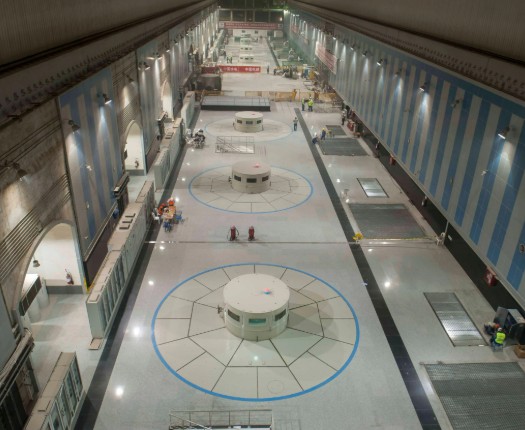
Designed to supply a third of Ecuadorian national demand, the Coca Codo Sinclair plant does not operate consistently and is located in a valley prone to natural disasters.
However, Manzano does not specify when the maintenance and operation of the hydroelectric plant will be transferred to PowerChina. It is currently run by the state through the Ecuadorian Electricity Corporation (Celec).
“This is only the first step in a broader process; there are still several legal procedures to be completed before the arbitration is finally closed,” the minister explains. “Among the next steps, three additional legal documents must be drafted and signed, and the attorney general’s office must issue its opinion. As part of the amicable solution, Sinohydro is expected to take over the maintenance and administration of the hydroelectric plant.”
At least four ministries (energy, finance, foreign affairs, and government) are reported to have participated in the negotiations with the Chinese company. Ecuador’s Economy and Finance Minister Sariha Moya, emphasises that PowerChina will be paying compensation instead of a guarantee for the failures at the plant.
“PowerChina initially proposed to provide a guarantee that would be repaid as improvements were made to Coca Codo Sinclair,” explains Moya. “The Ministry of Economy clearly explained that the problem at the hydroelectric plant not only generated losses for the company, but also losses for the state. Therefore, we did not accept the guarantee, but rather compensation to the Ecuadorian state.”
The decision to hand over plant operation to the same company responsible for its construction problems has, however, met with criticism from political figures outside the government. Ana Galarza, a former National Assembly member says: “In other words, PowerChina is paying $400 million for the Coca Codo Sinclair concession and is not paying for the damage it caused. Don’t try to fool us or treat like we’re naïve.”
“This new agreement raises questions about energy sovereignty, transparency and state capacity,” Galarza suggests. “The paradox is clear: the flagship project for changing Ecuador’s energy mix ends up being operated by the same company blamed for the failures that prevented it from doing so. Meanwhile, blackouts could return and the erosion of the Coca River continues.”
Galarza is citing allegations that Coca Codo Sinclair has contributed to the erosion of the Coca River – which, most dramatically, became a topic of debate when the San Rafael waterfall, downstream of the plant, stopped flowing in 2020. However, researchers have cast doubt on the facility’s impact on the waterfall, while the capacity of the plant itself has been hampered by it.
Having PowerChina take charge of the hydroelectric plant is the best possible solution, according to Inty Grønneberg, a mechanical engineer and scientist from Ecuador who has studied the evolution of Coca Codo Sinclair across two decades.
“It’s not about ideologising the project, but about solving problems,” Grønneberg says. “It doesn’t matter if it’s administration, concession, or whatever you want to call it. Ecuador needs electricity, especially with a low water period knocking on the door again.” In fact, even though Coca Codo Sinclair was only partially operational during the low water period of 2024, almost a third of the country’s hydro-generated electricity came from it.
Nature working against Coca Codo Sinclair
Coca Codo Sinclair does not operate consistently due in part to its status as a run-of-river plant (its intake is from a river diversion channel, rather than a reservoir) and its dependence on the flow of the Coca River.
In October 2024, the plant operated at only 39% of capacity; in July 2025, it was temporarily out of service due to sediment accumulation after heavy rains. In total, in the first seven months of 2025, it has been out of operation 19 times, according to Celec.
Furthermore, it is located in an area with high seismic activity as well as in an area known for erosion. In other words, it is a valley prone to natural disasters.
Above-average rainfall during the past winter in the Amazon increased the river’s flow, destroyed the containment works and deepened the riverbed, exacerbating the risk to hydro plant infrastructure.
The regressive erosion of the Coca River has destroyed nearby infrastructure and is close to reaching the hydroelectric plant’s water intake. Celec reported in the first week of July 2025 that the erosion was 4.7 kilometers from the intake but four weeks later, following more heavy rain, said it was only four kilometres away.
According to Celec, the flooding also destroyed key structures such as rockfill walls, channel armouring and fill, which served to reinforce riverbanks. It also washed away the beach that previously allowed people to walk along the riverbank, and deepened the undercut on the left bank, which now exceeds four metres.
From 2020 to the present, Celec has allocated more than $150 million to studies, design, consulting and engineering works related to the erosion of the Coca River. To date, all efforts have failed to stop its advance toward the power plant. Some experts warn that the erosion could put the power plant out of service completely in as little as six or seven years.
Sinohydro was in charge of the project’s construction, backed by a $1.7 billion loan from the Export-Import Bank of China, but it ended up costing more than double that amount. The loan came with conditions, such as the hiring of a Chinese construction company to carry out the project – the same company that will now be responsible for operating an energy project that has brought constant headaches to Ecuador.
________________
Allen Panchana is an Ecuadorian journalist and professor at the Universidad Católica de Santiago de Guayaquil.
Hogar Esperanza News

Dani News

The Cuenca Dispatch

Week of November 30

Noboa doubles down on constitutional changes despite voters’ clear rejection.
Assembly approves Ecuador’s 2026 budget after tense debate over spending priorities.
Ecuador: between 2020 and 2024, an area equivalent to the size of Luxembourg was deforested.
Fabianos Pizzeria News

Fund Grace News

Anubis Restaurant News

Hotel Oro Verde News

Property Manabi News