
















Ecuador’s violence-hit coastal region is the focus of candidates in the closing days of the campaign
By Alexandra Valencia and Yury Garcia
The two candidates battling it out to win Ecuador’s presidency in this Sunday’s run-off have focused their energies on the populous coastal provinces, where voters are pleading for action to tackle spiraling drug-related violence.
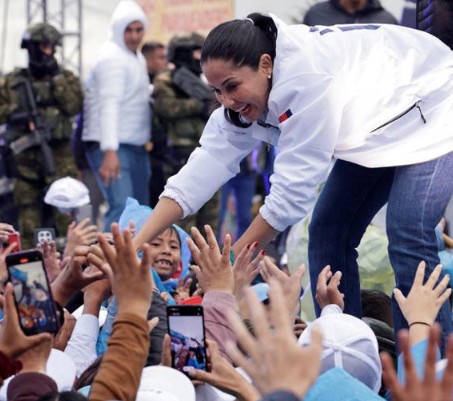
Ecuadorean presidential candidate Luisa Gonzalez of the Revolucion Ciudadana party greets supporters during a closing campaign rally in Quito April 9.
Incumbent President Daniel Noboa has intensified security operations and economic hand-outs after he lost the seven provinces — including Guayas, home to Ecuador’s largest city, Guayaquil — to leftist rival Luisa Gonzalez in February’s first round.
Noboa’s strongest support comes in the Andean region of the country where crimes rates remain relatively low.
Gonzalez has promised ambitious social programs as well as security improvements.
Noboa, a 37-year-old business heir, was elected in 2023 to serve out the remainder of his predecessor’s term on promises to combat drug gangs that have roiled the once-placid South American country. He says he and U.S. President Donald Trump discussed security when they met informally last month.
In February, Noboa nationally came just 16,746 votes ahead of Gonzalez, an unexpectedly tight result as voters voiced frustration with his lack of progress on security issues.
“On the coast we’re voting for Luisa (Gonzalez) because Noboa supposedly had many plans to combat crime and he hasn’t achieved them,” said Guayaquil student Gabriela Pogyo, who said her family was shaken down by a gang demanding $5,000.
At the same time, he has sought to promote his social bona fides, distributing payouts to people affected by an oil spill, small businesses hit by flooding, as well as students, police and the military.
He has said he needs more time to implement his “Phoenix” security plan and that military deployments, harsher sentencing and arrests of gang leaders reduced violent deaths by 15% last year.
“We will not lose the country, we will defend it to the death, until the last second,” Noboa told supporters on Sunday in the city of Balzar in Guayas. “For the incredulous who don’t believe we can do things well, we need to show them action, public works and progress.”
Gonzalez has said she will fight crime by adding 20,000 police officers, deploying anti-money laundering technology and sending thousands of peace-focused social workers to violent neighborhoods to help create jobs and keep kids, often recruited by gangs, in school.
“They told us the Phoenix Plan would fix everything, they lied. Today Ecuador is among the most dangerous countries in the world, we go out into the street and feel the danger,” Gonzalez said in a video posted on social media. “But we know how to change it: when dignity goes up, crime goes down.”
Tackling the widening reach of the drug trade and insecurity has been a key issue for Latin American politicians in recent years, from Chile to Argentina, El Salvador to Costa Rica.
Noboa’s struggles may be a sign that a focus on purely hardline policies may not always be a winning strategy.
Violent deaths in Ecuador in January and February nearly doubled to 1,529 compared to the same two months in 2024.
Gonzalez cites that as evidence that Noboa’s policies are failing, while the government has attributed the increase to violence between rival gangs.
_________________
Credit: Reuters



Hogar Esperanza News

The Cuenca Dispatch

Week of September 20

Ecuador turns to industrial power cuts to protect Mazar and keep homes from going dark.

Ecuador raises its 2026 growth forecast, but El Niño could spoil the outlook next year.
Cuenca retirees challenge medical and therapy changes at IESS senior center.
Fund Grace News

Fabianos Pizzeria News