









El Vado is Cuenca’s latest food scene; Ecuador agrees to accept U.S. asylum seekers; End of the penny; Sanitary violations at mercados; New bus terminal
Hungry? –
(de El Mercurio del domingo, 16/11) El nuevo epicentro gastronómico en Cuenca (The new gastronomic epicenter in Cuenca) – New food businesses in the El Vado sector have succeeded in conquering the palates of diners. Aji Dulce is located on Calle de la Cruz y Juan Montalvo and their Venezuelan owners, Mayra Alejandra Peña and Jhonathan Camacho, offer homemade almuerzos <As opposed to giant food distributors who can sell you 500 lunches that have been sitting in a freezer somewhere since 2021 and the only fresh thing on the plate is the 1/4 cent sprig of parsley.>. The almuerzos cost $3.00 and are balanced and prepared with fresh products from the Mercado 10 de Agosto. <Maybe you shouldn’t read the hygiene article below.> Some of the popular offerings are the ‘Bandeja Paisa,’ a traditional Colombian dish, and the ‘Pabellón Criollo,’ a specialty typical of Venezuela. Every 2 months, they make food from completely different places which have included Spain, France, Arabia, Mexico, Italy, Greece, and Brazil. Currently they are getting ready for a Thanksgiving dinner on viernes, 28/11 <I know, not Thanksgiving. So go figure.> which includes traditional turkey, stuffing with homemade bread, mashed potatoes and gravy, and sauteed green beans and carrots for $10 per person. <The price is right.>
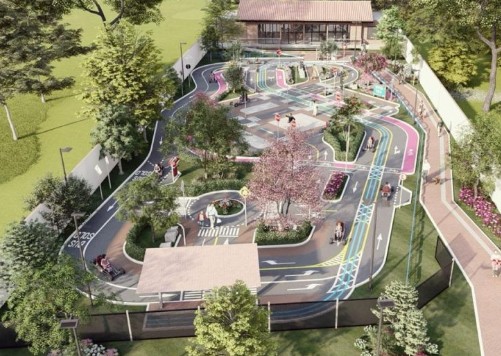
The new traffic interactive park in Ricaurte will have a driving track and a classroom for training,
Niro Panadería is on Juan Montalvo y Pres. Córdova where tradition and passion for baking and pastry are fused thanks to the creativity of the owner, Elsa Campoverde, who graduated from the Instituto San Isidro. Her specialties are artisanal breads and pastries made with fresh ingredients, selected fruits, high quality flour, and natural butter. She has created modern versions of traditional breads, incorporating ingredients such as red fruits and soy while maintaining the authentic artisanal flavor. Her customers’ favorites include fig bread, carrot bread, and her cookies.
Clandestino is on Pres. Córdova 14.63 y Coronel Talbot and specializes in artisanal pastas with a fusion of Italian and Asian. <Makes sense when you remember noodles got to Italy from China – Marco Polo/Gary Cooper and all that.> The specialties of owner Víctor Rivero are filled pastas such as raviolis, sorrentinos, and tortelinis as well as pizzas. The pizza toppings include pork and egg, and asparagus with Parmesan, mozzarella and pesto. He has raviolis with smoked trout in a sauce of rosemary with lemongrass, butter, garlic, and white wine with almonds. Other popular dishes are his tortellinis with smoked pork in a red wine sauce, and pelmeni (dumplings) with beef ribs in a dried mushroom sauce
Curious? –
(de El Mercurio del sábado, 15/11) Pacto para recibir a solicitantes de asilo (Agreement to receive asylum seekers) – The US Department of Homeland Security publicized an agreement with the Government of Ecuador for Ecuador to receive people from 3d countries who have applied for refuge in the US. The agreement seeks to guarantee dignified, safe, and timely transfer from the US to Ecuador for citizens of 3d countries who have asked for international protection against return to their countries of origin or their country of previous residence. The agreement says the Ecuadorian Government decides whether or not to take the people seeking refuge, but it will not take people with criminal histories. Ecuador will not return anyone to his country of origin or previous habitual residence until a final decision has been made on the application for asylum. The US will not commit to sending funds for Ecuador to receive asylum seekers. The agreement will take effect after Ecuador sends a response to this proposal made by the US. <I wonder how many of these refugees might just want to stay in Ecuador if their applications are rejected — or even if they’re accepted.>
(de El Mercurio del domingo, 16/11) Fin al centavo de dólar (End of the penny) – Last Wednesday, the US minted its last one cent coin because it costs 3.69 cents to make one. Since Ecuador is dollarized, there has been worry about how this will affect the Ecuadorian economy, especially if it also decides to stop making pennies. The concern is that not minting pennies could unchain a process of rounding, which people fear will make products and services more expensive. Verónica Artola, former manager of the Banco Central del Ecuador (BCE), said that if the country still keeps minting pennies, it must take into account that Ecuador can no longer buy pennies from the US, and if it continues to make them, there will be an uncompensated cost so a cost-benefit analysis should be done. According to the BCE, in 2022, $1,292,400 worth of pennies was shipped to Ecuador. Another reason the US stopped minting pennies was the increase in electronic transactions and the reduced use of physical money. This trend is also growing in Ecuador. It’s hoped that if there are no more pennies that businesses and banks will round to the closest nickel.
(de El Mercurio del domingo, 16/11) Higiene y salud público (Hygiene and public health) – Food safety is one of the essential pillars to protect public health. In Ecuador, the mercados are vital for supplies, but they are also where factors for sanitary risk converge. These include inadequate food handling, absence of refrigeration, and lack of cleaning the surfaces in contact with food products. These recurring causes of contamination can cause food borne illnesses. The Universidad Católica is promoting interdisciplinary projects integrating health sciences, bio-technology, environmental engineering and social sciences for a single integrated vision of food safety. Two mercados were studied, one in Cuenca and the other in Gualaceo. In Cuenca, researchers analyzed 120 samples of ground beef from 15 stalls and found bacteria conforming to INEN 1338. Variables included the type of storage, hour, day of taking the sample, and environmental conditions in the mercado. 75% of the samples were contaminated with Escherichia coli, and 16.67% by total coliform bacteria. In Gualaceo, 120 samples were taken from metal and wood surfaces, both inside and outside the mercado. E. coli was present in 31.7% of the samples and total coliforms in 69.2% of the samples. <Those of you with sensitive stomachs might want to stick with supermarket meat until you get digestively acclimated.>
The results of both studies, developed in different scenarios, but socially similar, agreed that the mercados in Azuay do not guarantee optimum conditions for food safety. For meat products, contamination came mainly from the lack of a refrigeration chain and food handling directly without gloves or adequate utensils. On inert surfaces, micro-organisms persisted because of deficiencies in disinfection. Specific recommendations were made with the main goal of establishing a culture of hygiene/sanitation based in education, control and co-responsibility.
(de El Mercurio del lunes, 17/11) Ricaurte tendrá el primer parque vial de ruralidad (Ricaurte will have the first rural traffic park) – The traffic park will have a track for driving and teaching road education in an interactive manner, a community room for training, and a municipal tax collection office so local residents won’t have to go all the way downtown. The $241,000 project will be built in the Buena Esperanza barrio and will start at the end of octubre with a 4 month (120 days) construction period. The park layout has redondeles (round-abouts), different intersections, pedestrian crossings and horizontal and vertical traffic signs. The goal is to orient school kids about traffic laws. <The rendering shows little Formula 1 cars on the track. I hope that doesn’t give the kids the wrong idea about the proper speed on city roads. And will the teachers tell the kids it’s OK to go through red lights if there’s no traffic?>
(de El Mercurio del lunes, 17/11) La nueva terminal sur se construye en 2 semanas (The new south terminal will be built in two weeks) – <The headline is more than a little misleading.> After signing the construction contract, the south terminal terrestre will start in 2 weeks. The work will take place where the itinerant Narancay market was until the end of octubre. The merchants were moved to a new area in the Carmen de Guzho sector. Construction should last 12 months with the inauguration in noviembre 2026. <Hopefully that’s not a deadline like the Tranvía deadlines.> It is hoped that it will decongest the traffic on av. De las Américas and Héroes de Verdeloma. <It will take some of the load off the current terminal terrestre?> Included will be a system of electric buses that will connect the south terminal with the first Tranvía station at Control Sur. <That sounds kind of cool. Hop off the bus from Loja or Vilcabamba, jump onto an electric bus, and wind up on the Tranvía.>