















From the river to the rinse cycle: Cuenca’s laundry evolution welcomes the machine
If you want to take the pulse of a city, don’t bother with opinion polls or traffic counts. Just count how many homes have washing machines.
Here in Cuenca, about two-thirds of homes now have one. That’s roughly where Britain stood in 1967, when half the population was still wrestling with twin tubs and hand wringers. Back then, washing was noisy, steamy work involving rubber gloves and pouring kettles of near-boiling water. Today in Cuenca it’s mostly quiet and cold, which rather suits the climate and the temperament of the place.
Cold water is standard here. Even the machines that have a “hot” setting rarely see it connected, because laundry areas don’t always have a hot water line. (Actually mine does, but I still don’t use it.)
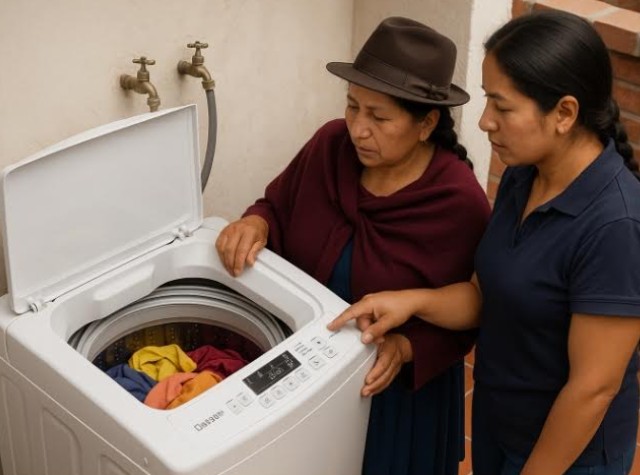 Electricity is 110 volts, not the 220 or 240 used in Europe, so few washers try to heat their own water. Detergents are blended for cold use, and most of us prefer not to pay extra for heating the water when clothes will come out clean enough with soap and spin that you don’t get thrown out of Common Grounds. Only a few imported models have internal heaters, and these are usually bought by people who remember their mothers washing whites at sixty degrees with detergents that claimed “Tide’s in—dirt’s out!” or that they used special scientific enzymes to defeat those nasty biological stains on the underpants of teenage boys. Of course they are also much more expensive.
Infrastructure tells half the story. Cuenca’s near-universal electricity and piped water with decent pressure make machine ownership possible, but the economics finish the job. A local lavandería may charge eight to ten dollars for a week’s wash, which could add up to four or five hundred dollars a year to the budget, depending on the size of your household (and the amount of biological stains it produces.)
My own spinny Electrolux machine with a ten year warranty cost three hundred and twenty-five dollars from Tia after the IVA rebate for seniors. Even with detergent and the occasional hose replacement, it more than pays for itself in twelve months, and I can wash bedding whenever I like without counting kilos.
Machine design itself reflects the plumbing of continents. In North America, washers have two hoses and depend on the house water heater to supply the hot fill.
In Europe, most have only one hose and heat the water inside with a heating element. That means a European front loader hums quietly for an hour or more, sipping power and using perhaps fifty litres of water. A big American top loader guzzles twice that but finishes in forty minutes, proudly using the house’s cheap gas-heated water. Latin America went a third way: small drums, cold water, and sometimes semi-automatic twin tubs that survive wherever water pressure falters and can be used with river water.
Voltage explains much of this geography. At 110 volts, an internal heater would take forever to warm a load of water. At 230 volts, it’s simple and efficient. So Europe got clever thermostats and scalding cycles for white shirts, while Ecuador got energy-saving cold water as a default way of life.
Laundry habits follow suit. Europeans worry about hygiene and temperature. Americans trust their detergent and their dryer. Cuencanos often line-dry on the roof in the sun, which does both jobs at once.
The social dimension is visible on washing day. In poorer barrios, a few families still hand-scrub at concrete basins, in plastic baths on the floor, or even carry baskets to the river, echoing the city’s not-so-distant past.
In the historic centre on quiet streets, you still hear the whine of a spin cycle echoing off a courtyard wall, though rarely at night because water pressure drops after ten. Among expats, fully automatic front loaders have become a mark of status and domestic arrival, up there with gas water heaters, proper sheets and curtains, and custom-made sofa covers.
Measured purely by ownership statistics, Cuenca 2025 is about where the UK was in the Summer of Love (1967). But the machines are quieter, the soaps less harsh, the process far more civilized. But the rhythm is familiar. Wherever human beings live, the sound of washing machines is the hum of progress itself, a sound that says the water runs, the power’s steady, and there’s enough spare cash for a machine that does the work of two maids at the touch of a membrane switch using an eco-cycle inteligente–whatever that may be.