











How the Noboa government manages and controls communication and its relationship with the media
By la Fundación Periodistas Sin Cadenas
President Daniel Noboa’s government has developed a communication strategy designed to minimize the president’s exposure to the public, protect the government’s narrative, and limit the chances for journalists to question public officials.
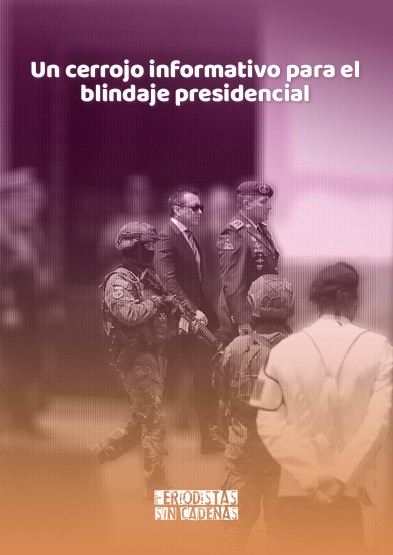
That is the conclusion of An Information Lock for the Presidential Shield, a report published on June 1, by the Journalists Without Chains Foundation with support from Reporters Without Borders (RSF), in partnership with the media outlets Plan V, La Barra Espaciadora, Tierra de Nadie, and Indómita.
Within the presidency, the rules are clear: some issues are handled directly by the president, while others are delegated to other government officials.
 “Based on these guidelines, it is determined which issues are communicated directly by the presidential office and which are channeled through ministers and spokespersons, as well as the format in which the information is presented — whether through statements by the president himself, social media posts, or interventions by other authorities,” the report says.
According to sources who spoke confidentially to the investigative team, the strategy is intended to prevent Noboa’s image from becoming associated with negative events, reduce the visibility of conflicts, and quickly dilute controversies in public debate. The approach depends on when the president appears publicly, which issues he addresses personally, and which are delegated to ministers or other spokespersons.
The report cites several examples of this strategy in practice, including the case of the four boys from Las Malvinas who were intercepted by a military patrol, disappeared, and later murdered, as well as corruption scandals involving electricity-generation contracts awarded to the company Progen and the failed agreement with the U.S. firm Healthbird to develop an appointment-management system for Ecuador’s Social Security Institute (IESS).
In the latter two controversies, the principal government spokespersons were former Energy Minister Inés Manzano and Integrity Secretary José Julio Neira. That changed only on May 21, when Noboa referred publicly to the Progen case for the first time in a statement posted on his X account. The message came three days after he delivered his annual Report to the Nation amid growing criticism over the judicial handling of the case.
“Let those responsible go to prison based on the findings of the Prosecutor’s Office and the reports of the Comptroller General — not those whom the desperate opposition wants to blame,” Noboa said. “We will fight until the very end to recover every last dollar.”
What he did not address was the fact that almost all those indicted in the Progen scandal were minor figures within the Energy Ministry and other government agencies. There was no mention of those who played the biggest roles in the negotiation and decision-making leading to the signing of the contract with the Florida vendor: former energy ministers Inés Manzano and Roberto Luque, and the president himself.
In addition to on- and off-the-record interviews, the report draws on public records and official documents, analyses by organizations specializing in freedom of expression, reporting by Ecuadorian media outlets, and testimonies from affected journalists.
According to the Foundation, the goal of the investigation is to provide a structured analysis of a phenomenon that is affecting the daily work of journalists in Ecuador and creating a risk environment for those who investigate those in power.
Selective media platforms and closed communication channels
One of the strategies identified by the report is the use of small, carefully selected media outlets to announce issues of public importance before amplifying those messages through larger news organizations.
As an example, the investigation points to events on September 17, 2025, during a massive protest against the proposed Loma Larga gold mine south of Cuenca and rising fuel prices in the country.
In that context, “President Noboa chose an unexpected setting: a radio station in Machala belonging to a media outlet with only 456 YouTube subscribers and just over 21,000 Facebook followers. He spoke for 46 minutes, defending the elimination of fuel subsidies, arguing that the measure targeted the finances of criminal organizations, and presenting the decision as irreversible. The interview avoided more difficult questions. Hours later, those statements were being reported by national news outlets. The strategy had worked,” the report states.
According to the investigation, the president frequently chooses provincial media outlets where interviews tend to be less confrontational and where the topics discussed often align more closely with the Executive Branch’s agenda. Ecuavisa, which also examined the issue, found that Noboa participated in 46 interviews between November 2023 and September 2025, including 19 on radio stations in Quevedo, Machala, Esmeraldas, Cuenca, and Guayaquil.
Why focus so heavily on local media? The investigative team posed that question to one of its confidential sources.
“Because they usually don’t challenge the government,” the source said. “And, pragmatically speaking, they are media outlets with very limited resources. They face significant financial constraints, are less likely to challenge the president but have considerable reach within their communities.”
The report also highlights the closure or reduction of several channels of communication with the press. According to the investigation, the General Secretariat of Communication discontinued the institutional messaging groups that had previously been used to distribute official information and respond to urgent inquiries.
At the same time, agencies such as the Ministry of the Interior, the National Service for the Comprehensive Care of Persons Deprived of Liberty (SNAI), and the National Police became less responsive to requests for information. In the case of the Armed Forces, no permanent spokesperson was appointed despite their central role in security operations.
Decline of press freedom and danger for journalists
Artur Romeu, director of the Reporters Without Borders office for Latin America and author of the report’s foreword, notes that Ecuador is among the three countries that have experienced the sharpest decline in press freedom worldwide.
One of the principal reasons, he argues, is the deterioration of security conditions for journalists, which has worsened significantly in recent years. According to figures from the Ecuadorian Journalists’ Protection Coordination Platform (MAPP), six journalists were murdered in 2025 alone.
For Romeu, these killings are “the most visible expression of a deeper phenomenon: the normalization of various forms of daily violence against the press in several provinces of the country.”
“This scenario is closely linked to the expansion of organized crime and its growing capacity to control coastal territories and influence local dynamics,” he writes. “Existing protection policies for reporters, meanwhile, fall far short of addressing the magnitude of the problem and are hindered by bureaucratic procedures that reveal a lack of political will and programmatic priority.”
Romeu adds that Ecuador’s sharp decline in the World Press Freedom Index — falling 31 places — cannot be explained solely by increased violence against journalists. The drop also reflects setbacks in economic conditions, the regulatory framework, the socio-cultural environment, and the broader political context.
“The Ecuadorian case illustrates one of the defining characteristics of contemporary threats to press freedom,” Romeu concludes. “They do not always take the classic form of direct state censorship. More often, they operate through diffuse pressures, strategies of delegitimization, institutional opacity, economic precarity, and selective control of public information.”