















In political gamble, Noboa invites other countries to post military troops in Ecuador
By James Bosworth
In the midst of campaigning for reelection, Ecuadorian President Daniel Noboa last week offered a shocking policy proposal: He said he will invite foreign troops to the country to combat criminal gangs. Although Noboa had earlier proposed allowing the re-establishment of a U.S. military base on Ecuadorian soil for same purpose, the new proposal opens the door to other countries.
Noboa did not provide key details, only indicating that the foreign forces would have a limited mandate but be operational and working alongside Ecuador’s military and police to take down criminal groups.
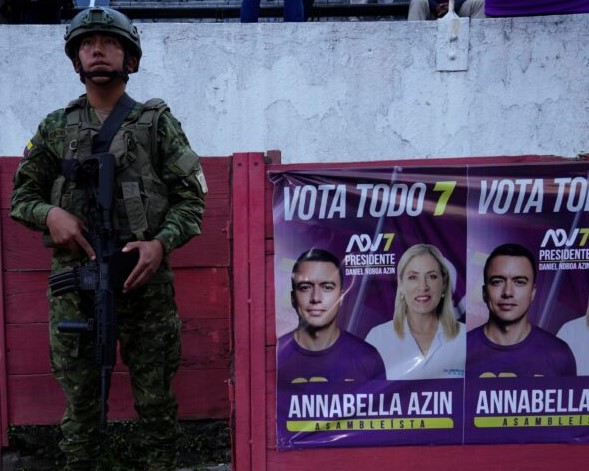
A soldier stands guard in late January at political rally.
Inviting foreign forces could be a winning idea if the public’s security fears override the sovereignty concerns that often dominate debate in Latin American politics. At the same time, by being so open about the policy Noboa is ensuring that voters who enter the polling station less than two months from today will understand that they may be voting in favor of foreign troops entering their country. It’s a big gamble to believe that voters will decide in the president’s favor.
Noboa’s proposal for foreign troops goes against conventional political wisdom in Latin America. In a region where U.S. intervention has been all too common, most countries’ political leaders have rejected the presence of foreign troops. Beyond their historical context, Noboa’s comments also strike at a very current debate in Latin America. U.S. President Donald Trump’s rhetoric about territorial expansion and the need to fight against an “invasion” of migrants has included threats to use military force in Mexico and Panama. Recent Trump statements about potentially using troops or drones against drug cartels led Mexican President Claudia Sheinbaum to reject the possibility of any U.S. forces operating unilaterally in Mexico.
Panamanian President Jose Raul Mulino has said his country will defend every inch of the sovereignty of the Panama Canal.
While it seems likely that Noboa would turn to the United States for military assistance given his recent visit to Washington for Trump’s presidential inauguration, Noboa did not specifically say that U.S. troops are the forces he has in mind. That leaves open the possibility that he would seek a regional partner like Brazil or a different foreign partner from Europe or Asia. Noboa does not seem likely to invite the Chinese to help, although he championed improve trade relations between the two countries. However, even the hint of such an invitation could create a dynamic that gives him leverage in negotiations with the United States.
Noboa’s proposal also pushes against Ecuador’s recent history, though it’s unclear whether that helps or hurts him politically.
Back in 2009, then-president Correa kicked a U.S. Air Force mission out of a forward operating location at the Air Force base in Manta. That U.S. presence was critical to combatting drug trafficking in the Pacific. Some have argued that the U.S. withdrawal played a role in the rising crime and violence that has plagued Ecuador’s coast in recent years as drug cartels have moved into Ecuador’s ports to export cocaine to the U.S. and Europe.
When U.S. military was forced out, the move played well politically for Correa and his leftwing base. Now, with Gonzalez representing Correa’s party in the presidential election, it seems clear that she would oppose any effort to undo Correa’s move, which was viewed by his supporters as a restoration of Ecuador’s sovereignty.
At the same time, polls show that Latin America’s citizens may be less reluctant about foreign forces than their political leaders. A recent AtlasIntel poll for Bloomberg found that a majority of citizens in Argentina, Brazil, Chile, and Colombia would support the U.S. using its military to combat drug cartels in Latin America. Even in Mexico, long resistant to that sort of U.S. influence, 37 percent said they support the U.S. military targeting cartels. (In notable contrast, an enormous majority of Latin Americans in all five countries reject Trump’s proposal to retake the Panama Canal.) Those numbers indicate much stronger public support for foreign troops than the typical rhetoric of nationalistic politicians would ever countenance. Assuming that the numbers in Ecuador look similar to those in Colombia and Brazil, perhaps Noboa is on to something with this campaign proposal.
However, advocates of his proposed approach to combating crime in the country should be cautious. Even if Noboa wins reelection, setting up the legal and operational framework for partnering with foreign forces would take months. Meanwhile, criminal organizations would have advance notice and time to adapt their operations. The proposal’s effectiveness would depend on which foreign partners are involved and how their capabilities match Ecuador’s specific security challenges.
Support for hypothetical military operations could quickly sour once the painful realities and second-order consequences of those armed actions become apparent. Even if this proposal helps push Noboa across the finish line to reelection, its implementation may not be politically popular in the long run.
_______________
James Bosworth is the founder of Hxagon, a firm that does political risk analysis and bespoke research in emerging and frontier markets, as well as a global fellow at the Wilson Center’s Latin America Program.



Hogar Esperanza News

Fabianos Pizzeria News

Fund Grace News

The Cuenca Dispatch

Week of September 06

U.S. sinkings of Ecuadorian fishing vessels trigger court scrutiny after 28 crew members are released.

Cuenca targets a November launch for its first new international link to Chiclayo.
Exports hit a quarterly record, but Ecuador’s import bill is rising even faster.
Property Manabi
