













Jumping General Lee
There was a moment around 1980 when the world seemed to run on two channels of reality at once. On the evening news the announcer spoke in grave tones about the American hostages held in Tehran after the seizure of the U.S. embassy in the Iran hostage crisis. The camera would linger on yellow ribbons and worried families while commentators explained that the crisis might last months or even years.
Then the news would end, the music would change, and suddenly the television screen filled with an orange car flying through the air over a creek somewhere in rural Georgia.
That car was the General Lee, a bright orange Dodge Charger belonging to the cousins in The Dukes of Hazzard, although I am not sure whose name the insurance was under.
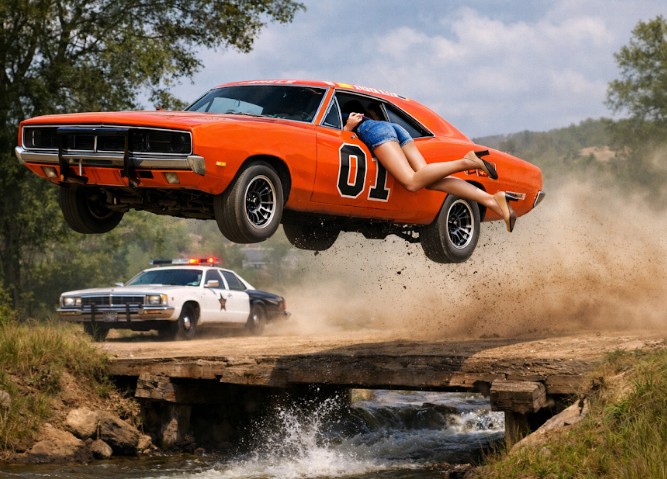 When I first encountered The Dukes of Hazzard I had never set foot in the United States. Like millions of viewers around the world, I absorbed it with the trusting curiosity usually reserved for documentaries. If television showed two cousins driving an orange car across creeks while a county sheriff bounced along behind them in a patrol car, then I assumed that somewhere in America this must be how things worked.
Hazzard County seemed to operate with its own legal system, its own automotive aviation program, and an economy in which young men could spend the entire day fighting local corruption without ever appearing to go to work. At the time it did not strike me as absurd. Television had shown it to me, and therefore, in the way that television often did in those days, it felt like a glimpse of contemporary America.
The contrast between those two realities of 1979 never seemed strange at the time. Television was simply like that. One moment it was Walter Cronkite or Dan Rather on geopolitics, the next moment two young men sliding across the hood of a car and climbing in through the windows because the doors apparently did not exist or were welded shut.
The Dukes themselves were not exactly criminals, although they had once been caught running moonshine and were therefore on probation. The terms of that probation were rather particular. They were not allowed to carry guns and they were not allowed to leave Hazzard County. In eight seasons they also managed never to come within sight of an interstate highway, which was probably just as well, because the General Lee might have caused havoc on I-75.
Instead they spent their time thwarting the schemes of the local political boss and his sheriff, who together ran the county with a level of corruption that would have impressed any central American banana republic.
Oddly enough, the Dukes never appeared to have regular employment. Their uncle had a farm, and that seemed to settle the matter. They drove around all day performing acts of civic virtue while their female cousin Daisy kept cool by running about in shorts so brief that an entire category of clothing eventually took its name from her.
In those days nobody worried too much about symbolism. The roof of the General Lee carried a Confederate flag, which was treated by the show as a piece of Southern decoration rather than a political statement. The debates about that would come decades later.
The show itself had begun life as something much rougher. It grew out of a 1975 film called Moonrunners,in which the cousins were genuine moonshine runners rather than probationary folk heroes. Television cleaned them up, took away their guns, and gave them a moral code suitable for family viewing.
The moonshine connection was not entirely fictional. During the Prohibition era real bootleggers in the American South modified their cars so they could outrun the police on narrow back roads. Those drivers eventually began racing each other for sport, and from that unlikely origin emerged NASCAR.
So the General Lee was really a descendant of the bootlegger cars of the 1930s, except that the TV version spent much more time airborne when escaping from clumsy pursuing law enforcement vehicles. (This was all presumably in the days before police helicopters reached Georgia.)
That airborne quality created an unexpected problem for the producers. The Charger was chosen because it looked magnificent on camera, with its long fastback shape and wide stance. Unfortunately, every time the General Lee leaped across a ravine the suspension collapsed when it landed, and the car usually died on the spot, which meant that hundreds of Chargers were sacrificed during filming. At first they were cheap used cars, but as the show became popular fans began buying them and restoring them as replicas. By the later seasons the producers in California were running out of used Chargers to destroy.
The stunt drivers paid the price as well. The jumps looked cheerful on television but they were brutal in reality, and several drivers were injured when the cars landed badly.
None of this diminished the show’s optimism. Each week the Dukes launched themselves through the air, outwitted the sheriff, exposed a crooked scheme, and slid through the windows of the General Lee without castrating themselves on the gear shift.
Meanwhile the news continued to report on the hostages in Tehran, the Cold War, and the other anxieties of the age.
Looking back, the appeal of the Dukes may have been precisely that contrast. In a complicated world they offered a county where the problems were simple, the villains were comically rustic, the shorts were short, and the fastest car in Georgia could solve almost anything.
It was not many years later that the dream was destroyed and by the time Dukes of Hazzard had ended its run, many states had already introduced mandatory seat belt laws.