














Major drug traffickers have left Colombia and relocated in Ecuador, says Colombia President Petro
The cocaine is flowing south, out of Colombia and into Ecuador, and so are the biggest traffickers. “The action has moved to Ecuador because that’s where the transport routes have been established and the big traffickers have followed,” Colombian President Gustavo Petro said in a Washington, D.C. press conference following his meeting Tuesday with President Donald Trump.
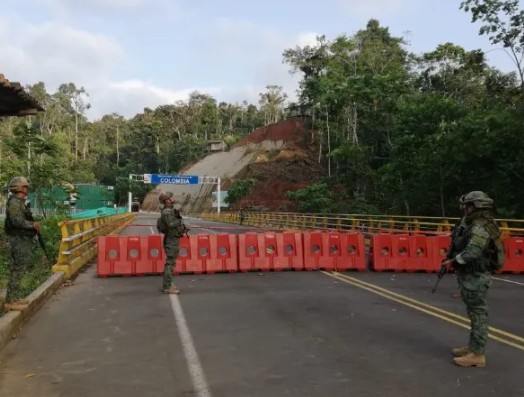
A border crossing in Esmeraldas Province is barricaded and guarded by soldiers.
Petro said he provided Trump with a list of major trafficking bosses, most of them living in Ecuador.
Petro claimed Colombia has been effective in keeping cocaine shipments out of its ports, especially at Buenaventura, the country’s only Pacific port. “Some drugs still get through, as they do at our Caribbean ports, but the amounts have been reduced over the years,” he said. “The drug lords have been forced to find new outlets and Ecuador was the obvious choice.”
Petro conceded that Colombia is exporting massive amounts of cocaine to Ecuador. “Yes, this is where the coca is grown and the cocaine is processed, and we have armed groups in the mountains and rural flatlands who protect and oversee the process,” he said. “Every day, we carry out raids on the fields and the processing facilities, but these quickly replicate.”
Regarding the new tariffs President Daniel Noboa imposed on Colombian imports, and to which Colombia has reciprocated, for lack of cooperation in fighting trafficking, Petro said there have been many joint operations by the armed forces of the two countries against the drug trade and he supports increasing those operations. “Confronting this is a massive and very complicated challenge, requiring cooperation on many levels including judicial and intelligence. Army raids are part of the answer but only part of it.”
Although the Ecuadorian government has not commented on Petro’s claims, several current and former police and military bosses have. Colonel Mario Pazmiño, regional director of the Latin America Security College, agrees that major drug traffickers live near the port areas of Ecuador, but he says they “move freely and frequently between the two countries.”
He also says the drug traffickers Petro refers to are “second tier” bosses. “The head honchos, the cartel bosses and their top lieutenants live in Miami, Madrid and Dubai.” He adds that the Mexican cartels play a major role in the Colombian cocaine market.
Colonel Fausto Cobo, former director of the Ecuador Center for Strategic Intelligence (CIES), agrees with Petro that military missions are only part of the solution to drug trafficking. “Noboa has a preference for brute force, the iron hand, but we have seen the limits of this approach in the past two years. What is needed is much stronger intelligence gathering as well as the use of technology to assist the military.”
Cobo also says that too little emphasis has been placed on controlling the roads and trails that drug traffickers use to move cocaine into Ecuador from Colombia. “There have been many missions on these routes but then the army retreats,” he says. “There must be constant presence for this approach to be effective.”
Both Cobo and Pazmiño say it will be impossible to defeat drug traffickers entirely. “They are well financed and well-armed and they adapt quickly to government tactics,” says Cobo. The objective is to reduce the flow of drugs and to make Ecuador a less attractive option for shipping them. The ports must be secured.”