By Elias Aboujaoude
Birthrates are collapsing across the developed world, and the numbers are stark enough to unsettle most demographers. Nearly three‑quarters of humanity already live in countries with fertility at sub-replacement levels, according to the United Nations. A 2024 Lancet forecast goes further: 97 percent of countries are projected to fall below replacement fertility by 2100, a demographic inversion without historical precedent.
These declines imply shrinking workforces, depleted pension funds, increasingly isolated older adults and a worsening of the politics around immigration, often seen as the only realistic remedy in Western societies. Familiar forces have been blamed — delayed parenthood, wider access to contraception, the rising cost of childrearing and existential angst that spans climate change, war resurgence, and how AI will transform the future.
 But something more intimate is also contributing, rooted less in macroeconomics and anxiety than how digital life is rechanneling libido. Its consequences may be civilizational.
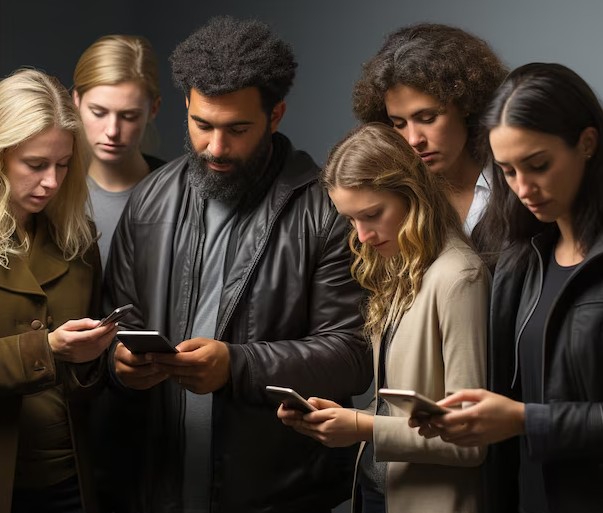
The smartphone is now the closest relationship many people have. It is the last thing they touch before falling asleep and the first thing they reach for upon waking up. According to a survey by the American Academy of Sleep Medicine, 87 percent of Americans regularly sleep with their smartphones in the bedroom.
The device has colonized that most personal of spaces, turning the bed into a workstation and turning notifications, likes, shares and algorithmically curated content into a preferred source of dopamine hits. As a result, many couples spend their time side by side in distinct digital bubbles. More than distraction, this is a kind of fetishistic displacement that redirects desire. As the device becomes the primary source of stimulation, the partner is “phubbed” (for phone snubbed), with reproductive sequelae.
The smartphone is the portal to many potentially problematic behaviors, from social media overuse to those related to gaming, shopping, gambling and pornography. Among them, the latter is particularly relevant here. Data suggest pervasive use: In one survey of adults under 40, 16 percent of men reported viewing pornography at least once daily. But what they are consuming is not simply sexual content. It is a hyper‑stimulating simulation thereof, designed to maximize arousal through exaggeration and novelty.
Real intimacy — negotiation, vulnerability, emotional and physical effort — cannot compete with the frictionless gratification of unrealistic content. In a study that analyzed 3,419 men aged 18 to 35, 21 percent had some level of erectile dysfunction during partnered sex, and higher pornography consumption was significantly correlated with erectile dysfunction, even after adjusting for confounders.
The proposed mechanism seems straight-forward: As the brain becomes accustomed to a certain intensity of stimulus, expectations are distorted, and bodies and practices that are not representative of typical human anatomy or sexuality become normative. The result is a growing cohort of individuals who prefer virtual arousal to actual intimacy because the digital alternative is easier, more reliably available and more exciting.
One might expect online dating platforms to counteract these trends. By dramatically extending the pool of eligible people one can connect with, dating apps should make it easier than ever to find partners. But research suggests otherwise.
Our study of Tinder, the world’s most popular dating app, suggests that about half of users are not seeking offline dates at all. Our interpretation is that many use the app for validation, ego boosts and distraction — in other words, like any social media platform and not as a pathway to real relationships, let alone family formation. This experience has become so demoralizing that serious users are abandoning these platforms in droves; up to 1 million Gen Zers deleted their dating apps in 2024 alone.
The rise of AI companions may exacerbate the problem. Platforms such as Replika and Character.ai allow users to form emotionally rich, non-demanding relationships with artificial partners. These systems are designed to be “perfect” — micro-tuned to meet one’s every last taste, and they are never disappointing. They are also always available and happy to recede when not needed. It is intimacy without expectation and companionship without conflict or commitment.
By 2023, 40 percent of Replika users were engaging in romantic partnerships with their bots. Do human partners stand a chance? Perhaps not, if you consider the story of the man who “married” his AI chatbot. Should these relationships become more normalized, they may represent the final decoupling of companionship from anchored biological reality.
A digital revolution that has virtualized life may end up doing away with it. The decline in birthrates is not merely a policy problem; it is a symptom of a digital culture that successfully competes with human connection. By displacing partners, rechanneling desire and offering the illusion of perfected, commitment-free companionship, we are eroding the foundations of partnership and child-rearing.
The “fertility crash” can be seen as the demographic bill coming due for a decades-long shift toward digital individualism. Proposed solutions such as mandating parental leave or tax credits will not be sufficient if the fundamental need for human intimacy continues to be outsourced to the screen. To address the crisis, we must also recognize that an insidious competitor to the next generation may be the glowing rectangle in our hands.
________________
Elias Aboujaoude is a clinical professor, technology researcher and writer at Stanford University’s Department of Psychiatry, where he is chief of the Anxiety Disorders Section. He is also the director of the Program in Internet, Health and Society at Cedars-Sinai Medical Center.
Credit: The Hill