















Trump’s ‘narco-terrorism’ operations in Ecuador: Is it a new phase of the ‘Donroe Doctrine’?
By Ryan Hesketh
On March 3 2026, US Southern Command, the military unit overseeing operations in Central and South America, announced via X that “decisive action” had been taken against “domestic terror organisations” in Ecuador to combat “illicit drug trafficking”. Ecuador’s defence ministry said details were classified.
What the statements confirmed was significant: for the first time since US special forces abducted former Venezuelan president Nicolas Maduro on January 3 to try him for drug trafficking, American troops participated in a ground operation in South America under the Trump administration’s counter-narcotics doctrine. Two officials told The Intercept it would not be the last.
Just three days later, on March 6, the Ecuadorian military dropped at least two bombs on what locals say is a dairy farm, but Ecuadorian and US officials say is a camp belonging to the group Comandos de la Frontera.
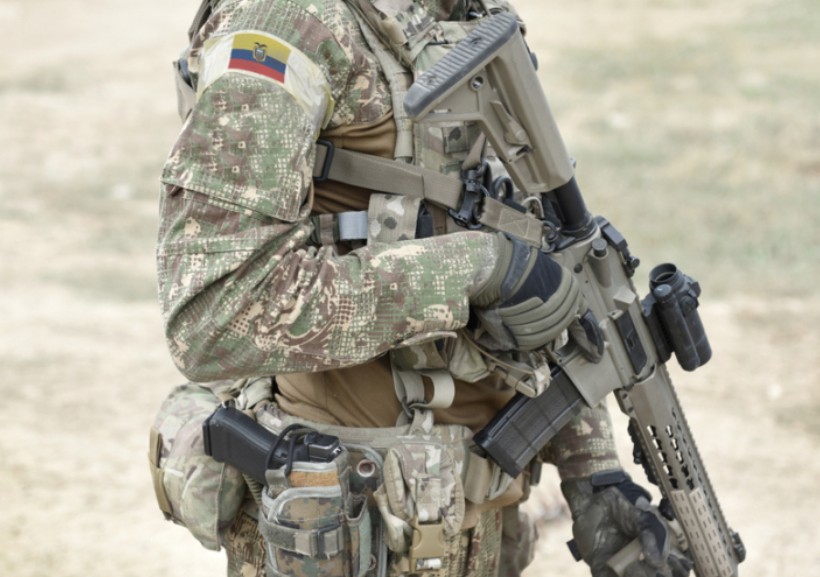
U.S. military advisers are actively assisting Ecuadorian armed forces.
The operation is the latest expansion of Operation Southern Spear, launched in September 2025, which has killed at least 157 people in strikes on vessels in the Eastern Pacific and Caribbean. While the Trump administration has claimed that it is targeting known traffickers, many of those killed are thought to be fishermen or workers not involved in the drug trade. The strikes have already drawn comparisons to Rodrigo Duterte’s campaign of extrajudicial killings in the name of combating ‘narco terrorism’.
Into the fire
Unlike its neighbours, Ecuador has no history of major internal armed conflict or prolonged dictatorship, and until recently had some of the lowest rates of violent crime on the continent. Drug trafficking was never generalised, it was localised, and never a large-scale public safety issue, explained Daniel Noroña, Americas Advocacy Director at Amnesty International.
But, from 2018 onwards, successive governments began dismantling state institutions, social safety nets, judicial capacity, and public services through ideologically driven decisions that left the state with, as Noroña puts it, “few hands and few capabilities.”
“Ecuador is living through probably its most violent crisis in its history,” Noroña told TalkingDrugs. “Everything has changed for ordinary people.”
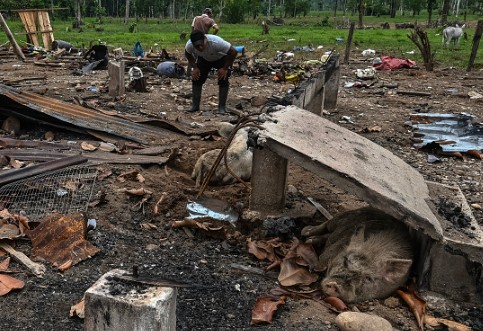
On March 6, Ecuadorian aircraft dropped bombs on a farm near the Colombian border the U.S. claims was used by drug traffickers.
The disruption of trafficking in Colombia after the 2016 FARC peace deal, combined with transnational organisations embedding themselves in Ecuador’s Pacific ports, created conditions for rapid gang expansion, exacerbated by the country’s economic struggles in the aftermath of the pandemic. By 2025, Ecuador recorded 9,216 intentional homicides, its most violent year on record, at a rate of 50.9 per 100,000 inhabitants. More than 70% of the population was exposed to organised crime, almost all of them in the coastal region and near the Colombian border.
Paradoxically, cities in the country’s Andean region, including Cuenca and Loja, have some of the lowest murder rates in Latin America
Gang violence is a real and legitimate concern for the people of Ecuador, and it was this that catapulted right-wing President Daniel Noboa power. What followed, Noroña argues, was a government built on strongman performance rather than real policy.
“He [Noboa] calls it Plan Phoenix, but nobody knows what it really entails, it’s mostly a communications scheme,” Noroña explained. The government declared a non-international armed conflict and handed prison management to the military, which only caused violence to increase.
Cause for concern
All of this could have remained a domestic issue for Ecuador, but not with Trump’s ‘Donroe Doctrine’ in place, a term used to refer to his version of the 19th century Monroe Doctrine to assert US dominance across the Americas. Noroña sees Washington as a prime mover in Ecuador’s crisis.
“The US is basically dictating how the policy is implemented,” he said. “They’ve provided the policy, the equipment, and they lead the strategy.” He believes that this calculation is not purely about narcotics. Ecuador holds a free trade agreement with Beijing, not Washington, including on minerals.
In a referendum on November 16, 2025, around two-thirds of Ecuadorians voted against allowing foreign military bases on their territory, a measure that would have required amending a constitutional ban in place since 2008. The result was a direct rebuke to Noboa, who had backed the proposal as a centrepiece of his security agenda.
After that route was closed off, a workaround was found. In December 2025, Washington announced a temporary deployment of Air Force personnel to the former US base at Manta on Ecuador’s Pacific coast, the same facility from which US forces operated between 1999 and 2009. In February 2026, Noboa ordered his foreign ministry to seek bilateral agreements permitting the incorporation of special forces on a short-term basis. Neither the Ecuadorian Congress nor the public were consulted.
Shield of the Americas
The Donroe Doctrine was in full view at the inaugural Shield of the Americas Summit at SOUTHCOM headquarters in Doral, Florida. Representatives from 17 nations attended alongside Trump, pledging to act against narco-terrorism’. White House Deputy Chief of Staff Stephen Miller framed the summit’s rationale in stark terms, describing cartels as “the ISIS and the al-Qaeda of the Western Hemisphere.”
The summit was billed as an international counter-narcotics event, but its true character was revealed in the wings. Chile’s newly inaugurated president José Antonio Kast signed a minerals deal with Washington, who also used the summit to push its economic and migration agendas.
John Walsh, senior fellow at the Washington Office on Latin America (WOLA) pointed out that bullying governments with force and buying them with economic clout form two parts of the same approach. “Argentines knew what would happen if they didn’t elect Milei,” he said, suggesting that Donroe policy included meddling in a country’s internal elections.
“For the administration, the narco-terrorism narrative provides an enabling narrative to justify a military hard power position in the Americas. It allows them to say: you’re going to do what we say, or suffer the consequences,” Walsh said. “This is not a gradual escalation. They say you are a narco-terrorist, so they have the right to kill you.”
There were some notable absentees from the Shield Summit: Mexico, Colombia, and Brazil. They’re the nations pushing back on Donroe, according to Walsh, partly because they represent the majority of the region’s population and so don’t have the “obvious imbalance” that faces smaller Latin American nations. Colombia is also the region’s largest cocaine producer and, without them, Walsh said, “there’s a huge hole in your strategy.”
On the ground
In Ecuador, violence is still escalating. Amnesty International has documented the disappearance of at least ten people across five security operations carried out in 2024. The national prosecutor has opened at least 51 investigations into enforced disappearances. In December 2025, eleven military officers were sentenced to over 34 years in prison for the enforced disappearance of four Afro-descendant teenagers from the Las Malvinas community in Guayaquil, a landmark ruling that was immediately appealed.
Just days before the March 3 joint operation, Amnesty International said the announcement raised “deep concern given the documented evidence of serious human rights violations, including enforced disappearances, and lack of transparency that have characterised execution of security operations under the so-called Phoenix Plan.”
Noroña is unsparing on who bears the cost: “The ones paying the price for raids are the people who were also being affected by the criminal gangs, because it’s in the poorest neighbourhoods.” The communities hardest hit by gang violence are the same communities most exposed to security operations whose rules of engagement remain undisclosed. They’re caught in the crossfire. More than 504 children and adolescents aged 10–19 were killed in the first half of 2025 alone, a 68% increase on the same period in 2024 and a 640% increase since 2019.
There is also a dimension to the Noboa government’s strategy that goes beyond security, Noroña argues. “It’s not just the militarisation, it’s the closing of civic space. It’s much harder for the public to form foundations, organisations. It’s a totalitarian trend.” Ecuador’s largest opposition party was recently dissolved on fraud charges. He situated this within a regional pattern across Venezuela, Nicaragua, and Peru of elites exploiting security crises for political consolidation.
“They are benefitting from the chaos to gain economic and political benefit.”
The social consequence is tangible. “Every person at every social level is scared to go out,” Noroña said. “During operations, you pray that people you know won’t be disappeared.”
What goes around
The Donroe Doctrine contains, at its core, the same logic as the war on terror; a nebulous, ill-defined ‘enemy’ used as cover for expanding imperialism. Extrajudicial killings, as in the now-infamous drone campaigns during the Bush and Obama years, are the unaccountable appendages of the American power, normalized and rationalized as a response to the perennial boogey-man: drugs.
“We now see at least one part of the US military, the Southern Command, as being willing to carry out orders to use lethal force against alleged narco terrorists,” Walsh said. The administration’s position rests on an executive memo rather than legal statute, and has been insulated from challenge by the systematic removal of dissenting lawyers at the Justice Department and Pentagon.
What’s different this time, Walsh argues, is that the violence might be coming home. The narco-terrorism narrative used to justify the Trump administration’s plans, he argues, has no natural boundary. Indeed, officials have already applied the same framing to political opponents and protesters inside the United States.
The hard power being trialed overseas, Walsh explained, could be seen as a rehearsal for a more dangerous kind of domestic politics. Midterms are coming up, and violence enacted on US citizens labeled as ‘enemies’ is becoming commonplace.
Stuck in the middle of all of this are the people of Ecuador. Lives are lost between gang violence and a policy of militarisation that intensifies the bloodshed. Deaths by overdose in the US have been falling steadily since 2024, according to the CDC, long before these policies were inaugurated. The people of both drug producing and drug consuming nations are being failed by an exercise in imperialism cloaked in the language of harm reduction. The Donroe doctrine only causes pain through the application of force, an application which is ever growing in scale.
_________________
Credit: Talking Drugs



Hogar Esperanza News

The Cuenca Dispatch

Week of September 20
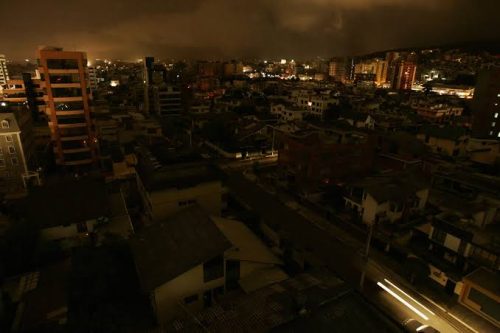
Ecuador turns to industrial power cuts to protect Mazar and keep homes from going dark.
Ecuador raises its 2026 growth forecast, but El Niño could spoil the outlook next year.
Cuenca retirees challenge medical and therapy changes at IESS senior center.
Fund Grace News

Fabianos Pizzeria News
