















The missing memoirs of Mrs. Hudson
Sherlock Holmes was able to solve an impressive number of crimes partly because he never had to do chores.
We are told that Holmes conducted chemical experiments, played the violin, studied cigar ash, disguised himself as an elderly woman, and occasionally fired bullets into the wall of 221B Baker Street while Dr. Watson practised medicine somewhere offscreen and wrote the first draft of detailed Holmesian memoirs and casebooks in longhand, possibly in between seeing patients.
Neither man appears to have spent much time peeling potatoes, beating carpets, polishing windows, shopping for groceries, or carrying buckets of coal upstairs. Mrs. Hudson and an almost invisible army of laundresses, delivery boys, tradesmen and domestic servants took care of such matters, and we take it for granted without giving any thought to the matter.
 So Holmes could devote himself to brainwork because other people were doing the work required to sustain his brain.
This was true throughout the prosperous sections of Victorian and Edwardian society. Upper-class families might have employed an entire hierarchy of servants. A respectable middle-class household might have had only one young maid-of-all-work, but she was still expected to cook, clean, light fires, carry coal, empty chamber pots and answer the door.
The less prosperous had no Mrs. Hudson and the wife and daughters did it all.
A fascinating demonstration of the labor involved can be found in The 1900 House, a British television series made by Channel 4. A modern family was placed in a London house that had been unmodernized to the exact conditions of 1900. Electricity, central heating and the indoor toilet were removed. A coal-fired kitchen range, laundry copper, gas lighting and outside lavatory were installed.
Although they were volunteers and enthusiastic participants, it did not take long for the novelty of Victorian life to wear off.
Clothes were incredibly uncomfortable and laundry involved heating water over a fire, scrubbing clothes, putting them through a mangle and hanging them to dry. Carpets had to be carried outside and beaten. The coal range required constant attention and had to be black-leaded to conceal rust and soot. (Black lead paste was actually made of graphite, not lead.) Water had to be heated over hot coals and carried. Even maintaining an acceptable Victorian hairstyle was surprisingly hard work without modern shampoo.
After several weeks, the mother of the TV family, Joyce Bowler, arrived at the solution commonly adopted by families of her social position in 1900. She hired a maid-of-all-work.
Joyce subsequently dismissed the maid because she felt that employing another woman as a servant conflicted with her belief in women’s emancipation. The maid was not particularly grateful to be emancipated from her wages, though perhaps appearing on TV was some kind of consolation.
The complete series is available in this YouTube playlist. It can also be found on the Channel 4 streaming service, although Channel 4 viewing may be restricted outside Britain and require a VPN.
Larga was born roughly half a century after the world recreated in The 1900 House, so he does not remember chimney sweeps arriving at the door. By the time of his childhood, coal fires did still exist in many homes, but many of the older household services were disappearing or changing form.
Some, however, never really went away. He remembers the window cleaners who arrived on foot carrying long and extremely heavy wooden ladders. They would prop a ladder against the house, climb to the upstairs windows with a bucket and cloth, and leave the outside glass shining. They might return once a month, performing a job that most householders could theoretically have done themselves but sensibly preferred not to and the ladders alone were enough to discourage amateur competition.
That service survived well into the 1960s and beyond, yet in five years of living in Cuenca, I have never had a window cleaner arrive at my door. This is slightly surprising in a city where domestic help and small household services remain relatively affordable. Perhaps Cuenca’s barred windows, balconies and concrete architecture make the traditional type of window cleaner with his ladder less practical. Perhaps the profession simply developed differently here.
Whatever the explanation, my outside windows are not inspected and polished monthly by a man carrying a ladder through the streets.
During the twentieth century, domestic technology gradually began to dismantle the enormous burden of running a household. Electricity, piped hot water, gas stoves, washing machines, vacuum cleaners, refrigerators, supermarkets, detergents, ready-made clothes and processed food transformed domestic life.
They did not completely eliminate housework, but they made it possible for one person to perform most of it after returning from a full-time job.
This was nevertheless a genuine liberation for women. Paid employment provided income, pensions, professional identity and the ability to leave an intolerable marriage. A Victorian wife might have been the chief executive of her household, but the chief executive frequently had no money of her own and no realistic means of resignation.
Somewhere along the way, however, society went beyond recognizing a woman’s right to work and began to treat paid employment as the highest form of personal fulfilment.
The ideal modern woman is apparently single, professionally successful and financially independent. She also maintains her own home, buys her own groceries, prepares her meals, does the laundry, arranges repairs, remembers appointments and cleans the toilet.
Holmes required Mrs. Hudson so that he could be Sherlock Holmes. The modern ideal expects Mrs. Hudson to be Sherlock Holmes as well.
The economic distinction is equally peculiar. If a woman spends three hours entering figures into the computer of an insurance company, she is economically productive. If she spends the same three hours caring for her elderly mother, preparing several nutritious meals or maintaining her home, she has officially produced almost nothing.
The difference is not that one activity is useful and the other useless. The difference is that money changed hands during one of them.
Nor did the disappearance of the Victorian servant mean that modern households stopped buying domestic labour. Much of it was simply reorganized into specialized services arriving by appointment or in a van.
In American suburbs, particularly those governed by homeowners associations, working residents frequently employ mobile lawn services. A crew arrives with mowers, trimmers and leaf blowers, completes the job in a few minutes and moves on to the next property.
The homeowner probably owns a lawn mower and is perfectly capable of pushing it, walking behind it, or riding on it. What the homeowner does not want is to devote Saturday morning to mowing, raking, edging and blowing leaves under a cruel Florida sun, particularly when the homeowners association may issue a warning if the grass grows half an inch beyond the approved suburban standard.
The Victorian household employed a gardener. The modern American household employs a man with a pickup truck, three lawn mowers and an industrial leaf blower. The principle is much the same, although the modern gardener arrives only when required and does not sleep above the stable.
But when retirement arrives, it turns the arrangement upside down again.
Once we stop receiving a salary, cooking, gardening and maintaining the house are suddenly rediscovered as worthwhile activities. A homemade stew or curry becomes superior to a hamburger collected from a drive-through window. Baking bread becomes therapeutic. Gardening becomes exercise. Repairing a chair becomes a hobby called carpentry or upholstery.
Nobody suggests that retirees should seek liberation by eating every meal from a plastic container while working unpaid overtime at an insurance company.
The high life in Cuenca offers an interesting compromise between Victorian domestic service and complete self-sufficiency.
Many retired foreigners employ someone for a few hours each week to do the heavy cleaning. This may include mopping floors, moving furniture, turning mattresses, scrubbing bathrooms and reaching awkward places that seem to become more awkward with every passing birthday.
Those fortunate enough to have a garden may employ someone occasionally to wiled a cutlass to cut back vegetation, move heavy pots or perform the more strenuous outdoor work. This does not mean that the householder has abdicated all responsibility for the home, but signifies that certain tasks are better performed by someone younger, stronger or simply more willing to do them.
The same retired person might still cook most days, wash dishes, do the laundry and keep a modest collection of tools. There is no contradiction between paying someone to mop a large tiled floor and owning a drill so that you can hang a picture, repair a shelf or attach a TV set to one of Cuenca’s remarkably resistant concrete walls.
Indeed, a useful household tool kit may be more liberating than many management seminars. A hammer, pliers, screwdrivers, adjustable pipe wrench, tape measure, spirit level, drill and a collection of tapes, screws, and wall plugs provide at least the possibility of solving a problem without telephoning three people and waiting until next Thursday.
Cuenca also provides the almuerzo, perhaps the most efficient piece of domestic technology never sold by an appliance company.
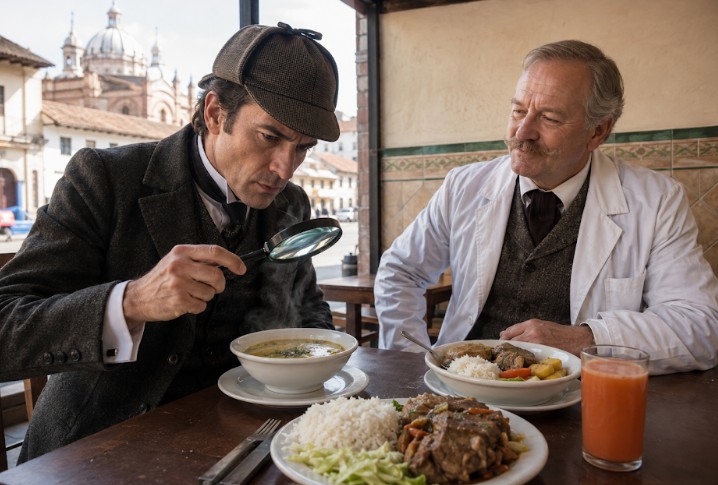
For about three dollars, someone else buys the ingredients, prepares soup, cooks a main course, pours juice, serves the meal, clears the table and washes the dishes. The customer walks in, eats and walks out. Sherlock Holmes would have approved, although he might have examined the soup with his magnifying glass.
Eating an almuerzo does not mean that one cannot cook. Cooking at home does not make one morally superior to someone eating an almuerzo. Employing a cleaner does not make one an exploitative Victorian patriarch, provided the worker is treated and paid properly. Drilling your own hole in the wall does not make you a heroic representative of the self-reliant frontier.
These are simply different ways of allocating time, money, ability and physical effort.
At 30, it may make sense to work an extra hour and buy a precooked dinner at the drive-in on the way home. At 75, it may make sense to spend an afternoon cooking something that will keep in the fridge for three days, while paying someone else to mop the floors, prune the garden or climb a ladder.
The essential mistake is to imagine that paid employment possesses an inherent moral value that domestic work lacks. Preparing food, maintaining a home and caring for people were always productive activities. They did not suddenly become worthwhile when retirees discovered them.
Society first employed servants to release prosperous people from domestic labour. It then invented machines to release women from much of that labour. It finally sent everyone into paid employment and expected them to complete the remaining housework during evenings and weekends.
The servants did not entirely disappear. They became cleaners, gardeners, window cleaners, handymen, delivery drivers and lawn crews. Instead of living downstairs and lighting the fire at 6:00 a.m., they arrive for an hour and then move on to the next customer.
Upon retirement, we are permitted to discover that there might be some satisfaction in keeping a household after all, especially when we can choose which parts to do ourselves and which parts to pay someone else to handle.
Mrs. Hudson probably understood that division of labour from the beginning, but unfortunately, nobody ever asked her to write her memoirs, which might have been a best-seller.



Hogar Esperanza News

Fabianos Pizzeria News

The Cuenca Dispatch

Week of September 20

Ecuador turns to industrial power cuts to protect Mazar and keep homes from going dark.

Ecuador raises its 2026 growth forecast, but El Niño could spoil the outlook next year.

Cuenca retirees challenge medical and therapy changes at IESS senior center.
Fund Grace News