
















Assembly revises traffic law, applies new rules to motorcycle deliveries, radars and electric scooters
The National Assembly approved major changes to the national traffic law on Thursday that include new requirement for motorcycle delivery services, photoradars, public transportation and electric scooters and motorcycles. Although supporters say the revisions will make Ecuador’s roads safer, critics claim they are a “power grab” by the national government and reduce the authority of municipal transportation offices.
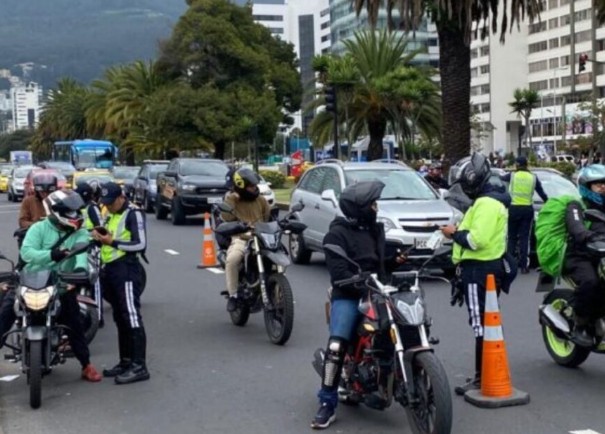
Transit police check the registration of motorcycles at a Quito interesection.
The revised law creates a national registry of motorcycle delivery drivers and requires that they display license numbers on helmets, vests and backpacks. It also requires non-Ecuadorian drivers to carry proof of legal immigration status and prohibits the transport of a second passenger while drivers are providing deliveries.
The Assembly gave the National Transit Agency (ANT) one year to establish the national registry.
The revised law also requires that electric motorcycles and scooters have license plates and that drivers have a valid driver’s license and adhere to all traffic laws governing the operation of motorcycles.
In addition, the changes require that operators of stand-up electric scooters and electric unicycles wear approved helmets. They require businesses that sell motorcycles and scooters to also sell helmets and prohibits customers from leaving the premises without wearing a helmet.
Other changes to the law include:
- Establishment of an electronic identification system for all licensed motor vehicles in the country
- Conversion of all road toll operations to electronic reading systems with pre-paid and post-paid options for motorists
- National authorization for photoradar installation with signage advising motorists of their location 500 meters in advance
- Prohibition of contracts with photoradar service providers who are paid through a percentage of fines collected
- That all public transportation buses maintain internal surveillance cameras
- That all public bus companies carry liability insurance covering death, injury and permanent disability of passengers
Among the controversial revisions was a provision giving the ANT power to monitor and possibly suspend the power of municipal transportation authorities. It allows local authority to be taken over by the national government in cases of “corruption, lack of resources and inefficiency.”
Paola Carvajal, director of the Coalition for Safe Mobility, said it was “hypocritical” to allow ANT to take authority from local governments. “ANT is one of the most corrupt agencies of any government, proven by the thousands of driver’s licenses illegally sold by ANT agents in recent years,” she said. “I view the measure as power grab by the national government and a way to intimidate local authority.”



Hogar Esperanza News

Nice apartment banner

Fund Grace News

Property Manabi

Fabianos Pizzeria News

The Cuenca Dispatch

Week of August 23

Ecuador’s economy grew 2% during the first half of 2026 compared with the same period a year earlier, according to new Banco Central del Ecuador data.

Cuenca gets a prime view of next week’s deep partial lunar eclipse.

Ecuador’s economy grows 2% in the first half of 2026.