














A brief history of time, South American edition
From time to time, an article or column surfaces or resurfaces warning expatriates that they will have to learn the hard way, that time works differently in Latin America. The warning is often delivered with the authority of someone who has just been embarrassed by showing up way too early to a dinner invite and feels that this near-tragic social faux-pas deserves a wider audience.
The claim gets presented as cultural insight, sometimes as anthropology, occasionally as something close to physics. South Americans have are generally not familiar with the works of Stephen Hawking, Newton, or Albert Einstein, so punctuality in South America is relaxed in a way that seems exotic to arrivals from the gringosphere. Something like “around seven” can mean around eight, can even mean nine, and on New Year’s Eve it could mean around midnight. It can mean whenever the host decides the gathering has reached a critical social mass and it is worth removing the roasted chicken from the oven and hunting down the carving knife.
 There is certainly something to this, but it is not enough to build a publishable guide to life in South America.
The mistake most new arrivals make is to treat time in Cuenca as a single concept, a numerical representation of the rotation of the earth at a degree of longtitude that can be applied equally from the bus terminal to the birthday party. This error alone produces most of the hard lessons, because time here does not operate as one system, but as three or four different schemes, and they do not overlap nearly as much as gringo mythology suggests.
The first is social time, which governs family gatherings, informal meals, neighborhood events, and anything that exists primarily for the pleasure of being together. Within this system, arriving exactly at the stated hour can read as slightly anxious, and arriving late carries no particular penalty. If someone invites you to Sunday lunch at one, you may find at two that the food is still in active negotiation with the stove, and no one is troubled by this. That is social time functioning exactly as intended.
The second is transactional time, which covers appointments, professional meetings, and service encounters of the kind where something is being exchanged. Here the picture gets murkier. A medical appointment may start late, or not at all if the doctor has been called elsewhere. A contractor’s estimate of arrival to give you an estimate can be optimistic by hours. This is the territory where frustration tends to accumulate the most commonly, because expectations are not clear and are not always shared between the people involved.
The third is institutional time, and this is the one that newcomers consistently fail to take seriously. Buses depart. Banks close. Offices lock. A tram does not consult your personal schedule before pulling away from the platform, the buses that leave Cuenca for Guayaquil every twenty minutes do not wait while the driver attends a family birthday party, and a security guard with a key does not reopen a door at the mall because you have decided that flexibility is a regional value. Institutional time is the least flexible of the three, operates with indifference to individual circumstances, and has the longest memory for anyone who tests it.
There is, however, a fourth kind of time which is often overlooked, and it is the one that causes the most difficulty. This is the one-to-one arrangement, where two individuals agree to meet at a specific time and the whole thing depends entirely on mutual respect for that agreement. Unlike social time, there is no group to absorb delay, and unlike institutional time, there is no external structure enforcing it. The cost of lateness falls entirely on the other person, who is left waiting, uncertain, and unable to proceed. In this setting, time is not flexible so much as shared, and when that sharing breaks down, so does the arrangement itself.
The failure to distinguish between these four dimensions of time is where things go wrong. Someone reads that Latin American culture is relaxed about punctuality, files this under general principles, and applies it to a situation that belongs to an entirely different category.
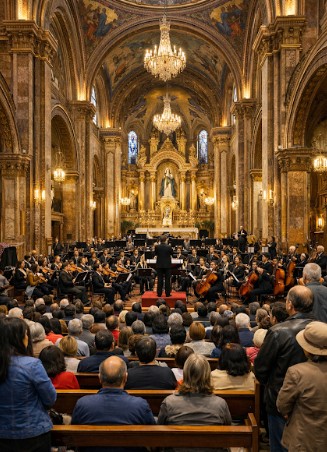
I was thinking about all of this at a free orchestral concert held in one of the old churches near the center of town, the kind of event that Cuenca does rather well. The doors opened a little before seven. The pews filled at a pace that made it clear there was no surplus of space. It had been mentioned in advance, plainly, in writing on an online etiquette guide for the occasion that the doors would close when all the seats in the church were full, and that prompt arrivees could not hold seats for other people who might or might not arrive.
I showed up at ten to seven and the doors were already open and since the pews were already half full, I took my ticket with the QR code for the program and took a place in a pew about halfway back.
The church continued to fill up until a few people were left standing in the side aisles and eventually at the back. Holding a place for someone absent would have required asking a standing stranger to remain on their feet for an unknown length of time, which seemed both unreasonable and unlikely to succeed without a severe breach of orchestra etiquette. Besides which, you really don’t want to cause a fracas in a church. The doors closed at half past seven, or thereabouts.
Shortly after the doors closed, a text message arrived from the person who had invited me, expressing mild surprise at being unable to get in.
I have thought about the right response to that kind of mild surprise, and I have not found one that improves on radio silence, especially in an environment where people had already been asked to turn off their cell phones and gag crying infants out of respect to the performers
There is a tendency, enthusiastically supported by the expat-advice genre, to read all lateness as a highly cultural texture, something to be observed with patient good humor and eventually absorbed into one’s worldview. The problem is that this framing papers over a crack that actually matters, which is the difference between a culture and a person.
If a dozen guests arrive at a party forty minutes after the stated time, that is social time at work and nobody suffers for it. If one person keeps another waiting ninety minutes on a park bench under a baking sun or in pouring rain, that is a decision made by an individual, and it deserves to be understood as such, and is best not laundered through the concept of mañana culture.
After enough of these encounters over my years in Cuenca, I settled on a straightforward approach. I arrive when I said I would. I send a message to confirm I am there and I wait ten minutes. If the other person arrives, we proceed with lunch, dinner, shopping, or whatever else might have been planned. If they do not, then I proceed with whatever I had previously decided would be Plan B.
This has not actually caused any great diplomatic incident. It has, however, clarified a number of relationships in a way that turned out to be useful. Some of those relationships continued and others simply dissolved themselves without requiring much explanation from either side.
The lesson is not that time in Ecuador, or Latin America is conceptually different from time elsewhere. The lesson is that time operates in modes, and that identifying the correct mode before the event is more productive than discovering the wrong one afterward.
The people who persist with treating all four modes as a single mode may indeed learn the hard way and the learning usually happens outside a locked door, somewhere between the tuning up and the first downstroke of the conductor’s baton.



Hogar Esperanza News

Fund Grace News

Fabianos Pizzeria News

The Cuenca Dispatch

Week of September 06

U.S. sinkings of Ecuadorian fishing vessels trigger court scrutiny after 28 crew members are released.

Cuenca targets a November launch for its first new international link to Chiclayo.

Exports hit a quarterly record, but Ecuador’s import bill is rising even faster.
Property Manabi
