













A humanoid robot climbs Ecuador’s Chimborazo volcano and sets his sites on Mount Everest
A humanoid robot named José Pemba summitted Ecuador’s 6,200 meter (20,341 ft.) Chimborazo volcano June 5, part of project to show that robots can accomplish human-like tasks in extreme environments. Although Pemba needed some human assistance, his support team says this is only the beginning to expand the range of robotic capabilities.
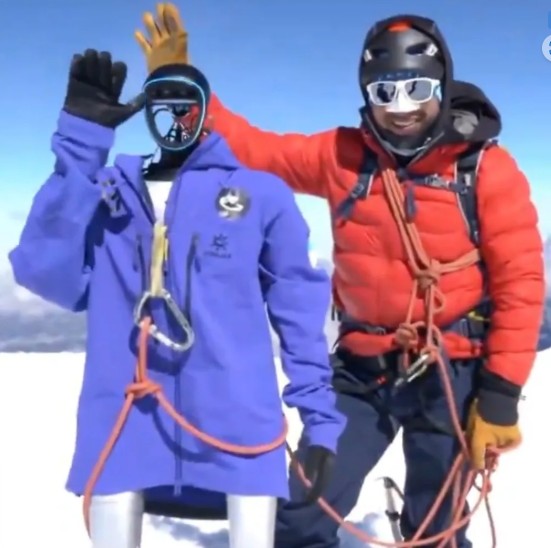
Pemba, a humanoid robot, stands atop Ecuador’s 20,341-foot Chimborazo volcano with fellow climber Oswaldo Freire on June 5.
Specifically, the climb was designed and planned to show that robots can serve as agents to patrol and protect sensitive environments that are difficult for humans to access. The project was sponsored and supported by the non-profit conservation organization Geologic Dome.
Pemba, a modified Unitree G1 robot, completed the 16-hour summit climb with help from the team behind him. The robot walked on its own during moderate sections of the ascent, while people carried him through steeper, more technical terrain. That makes the achievement less like a robot conquest of the Andes and more like a serious field test with a dramatic finish.
Pemba still needed human muscle, but it also faced conditions that most lab demos never face. He walked independently on sections where the incline was below 30 degrees, which is still a meaningful test for a humanoid machine at altitude.

Pemba did most of the climbing on his own but needed assistance on grades above 30%.
“When we launched the project, people called us crazy,” said Pablo Berlanga, a 23-year-old Spanish engineer who conceived and managed the project together with Ecuadorian engineer Titania Freire. “No one wanted to give us a robot for fear of a bad brand image if it fell or failed in extreme weather conditions,” he says. Finally, the Eastworlds firm donated a robot from the Chinese company Unitree.
According to Berlanga, the humanoid robot passed all mobility, battery efficiency and communication tests at an altitude of more than 6,000 meters. He credited the performance, in part, to advanced Chinese robotic engineering.
Pemba was accompanied and assisted in the climb by Oswaldo Freire, a mountain guide, with several eight thousand-foot summits to his credit, including more than a hundred ascents of Chimborazo.
Made of high-strength aluminum and carbon fiber, Pemba stands 132 centimeters high and weights 35 kilograms. Central to the project, Pemba is equipped with three cameras, one standard, one infrared and a third called ‘LiDAR’, which makes precise three-dimensional reconstructions using radar and laser technology.
Results from the LiDAR device gave “excellent results,” says Berlanga, collecting a large amount of data that could also be useful in the monitoring and study of glaciers and rivers. He added that this capability will be crucial in future environmental projects designed to study and protect ecosystems that are difficult to access.
Berlanga says that Chimborazo is just the first of Pemba’s challenges. “We consider it the first leg of the ‘Triple Crown’ — Mount Everest would be the third and we are working with Nepalese authorities for permission for an assault.” At present, he adds, there no standards for robotic climbers.