













After the fireworks
Every July 4th I find myself with a slightly uncomfortable question. Exactly what is it that Americans celebrate other than fireworks, barbecues and watermelons? The easy answer is freedom, but the harder answer is freedom for whom and from what?
what?
Growing up in England, the American Revolution was presented–if it was presented at all–as a colorful colonial squabble involving Boston, teapots and Indians with feather headdresses on the warpath. The Americans wanted tax-free tea parties and independence. The Brits lost the war against the colonists and their French and Spanish allies and life moved on to more important things. The other English-speaking dominions, Canada, Australia and New Zealand also eventually became self-governing without shooting quite so many people en route, but it would have happened anyway, sooner or later, because empires were a BAD THING.
 That last detail is worth revisiting, because it shapes how the British remember the whole affair. Most people in the UK have a rough sense that colonies like Guyana, Jamaica, Nigeria, Rhodesia, India and Pakistan all eventually won formal independence, complete with new flags, new constitutions and a defined anniversary date to celebrate the break from London, wave flags and set off fireworks.
Far fewer stop to consider that Canada, Australia and New Zealand never went through anything resembling that rupture. They drifted into full self-government over decades, kept the British monarch as head of state, and never needed an Independence Day of their own. The empire did not end so much as fade at different speeds in different places, and the British public’s vague, patchy memory of it reflects that unevenness rather than any single story.
Only much later in life did I realize that the American Revolution still sits at the center of a national identity in a way few historical events do elsewhere. Americans still quote the Founding Fathers as though they were living constitutional advisers. Politicians on both sides invoke 1776 almost daily and the justices of the Supreme Court try to channel the inner thoughts of the Founders like bench-bound mediums with ouija boards. The past is constantly re-excavated and never quite becomes buried in history.
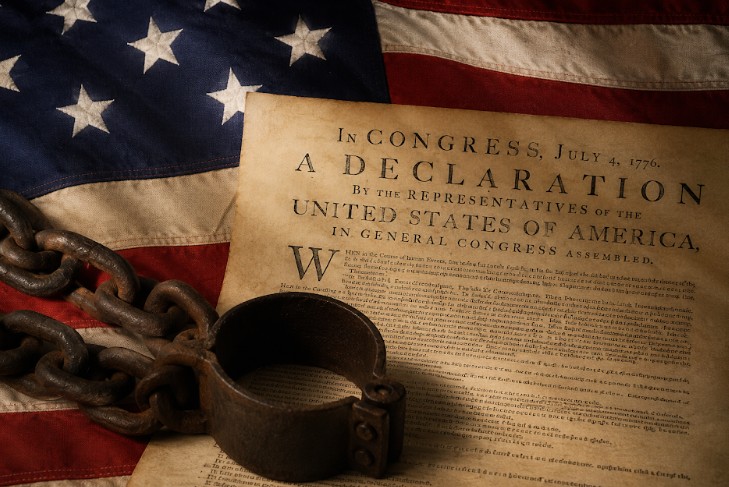
Then comes the uncomfortable part which is that many of the men who quill-penned their carefully practiced signatures to the Declaration of Independence sincerely believed in liberty, with the proviso that they also owned–as one did–other human beings whose entire families lived and worked on their estates free of charge.
Thomas Jefferson wrote that all men were created equal while enslaving hundreds of people during his lifetime. George Washington became the symbol of freedom while owning enslaved workers throughout most of his adult life. It is one of history’s great contradictions that a revolution fought in the name of liberty was mostly led by men determined to preserve a society built on human bondage.
That does not mean slavery was the only reason for independence. The colonists did have very genuine grievances about taxation, political representation and imperial control–sometimes the same kind of grievances that led to Spain’s central and south American colonies also seceding a few decades later under Simon Bolivar when Spain was invaded by Napoleon.
But it is impossible to ignore yet another very awkward fact. By the 1770s Britain was beginning to move, however slowly, toward questioning the legal basis of slavery. The Somerset judgment of 1772 had already shaken the institution within Britain itself when it declared that any slave who set foot in England was automatically a free man.
Then, in November 1775, Lord Dunmore, the royal governor of Virginia, offered freedom to any enslaved person willing to abandon a rebel master and take up arms for the Crown. Thousands tried to reach British lines, though not always successfully. The proclamation terrified southern planters far more than any tax on tea ever did. Historians still argue over how much weight to give this fear compared with other grievances, but it is hard to believe that it did not sharpen southern anxiety in the run-up to 1776.
Remaining within the British Empire carried risks, while independence gave slaveholders control over several aspects of their own future, including the future of slavery in the existing colonies and future colonies in the wild western territories that had yet to become states.
That thought leaves many modern Americans in an uncomfortable position. They want to celebrate freedom and let off fireworks without dwelling too long on some of the motives of its Revolutionary leaders.
Meanwhile, just across the border, another story unfolded and the colonies that we now know as Canada stayed loyal to the King. Their inhabitants were hardly saints, but they managed to evolve into an independent nation without a revolutionary war.
Slavery disappeared throughout the British Empire after 1833, a generation before the United States finally abolished it after an epocal civil war that cost more American lives than all its foreign wars combined.
Meanwhile it was the hard-pressed British taxpayer who compensated the slave-owners and made many of them and their descendants multi-millionaires to this day.
In the years after the American Revolution, British ships also evacuated thousands of formerly enslaved Black Loyalists, people who had answered Dunmore’s call, to Nova Scotia and eventually to the new African colony of Sierra Leone. This was not a lived happily ever after ending. Many faced discrimination and broken promises in their new homes. But it stands as an odd footnote: some of the earliest organized resettlement of free Black people in the modern world happened because they had sided with the King against the Founding Fathers.
History, unfortunately, refuses to produce neat morality plays.
The British Empire–let’s be honest–was capable of extraordinary brutality. America produced one of the world’s greatest constitutional democracies. Britain eventually abolished slavery throughout its empire. America ultimately abolished slavery too, but only after four years of tragic slaughter. From a historical perspective neither side emerges wearing a white hat and the best that can be said is that they didn’t know any better.
Perhaps that is why Americans remain so divided over their own history. One side prefers marble statues, Greek columns, and heroic myths and the other prefers to pull the statues down, but both approaches miss something important. The Founding Fathers were neither saints nor monsters. They were ambitious, intelligent, flawed men who created a remarkable republic while carrying with them many of the prejudices and economic interests of an age before the industrial revolution changed everything.
That is a far less satisfying story than the one that we may have learned in our schooldays, but much closer to the truth.
So every Fourth of July I raise a glass of iced tea to the Americans who celebrate their country’s astonishing achievements, while acknowledging that its birth certificate came with several uncomfortable asterisks. But the birth of nations is invariably a messy business and the wisest ones are those prepared to admit it and move forward towards forging a better world.



Hogar Esperanza News

Fabianos Pizzeria News

Nice apartment banner

Fund Grace News

The Cuenca Dispatch

Week of August 23

Ecuador’s economy grew 2% during the first half of 2026 compared with the same period a year earlier, according to new Banco Central del Ecuador data.

Cuenca gets a prime view of next week’s deep partial lunar eclipse.

Ecuador’s economy grows 2% in the first half of 2026.
Property Manabi

Property Kuralt