

















Airline boarding passes and check-ins could be scrapped under new airport rules
By Sam Courtney-Guy
Checking in for flights and traditional boarding passes could soon become a thing of the past.
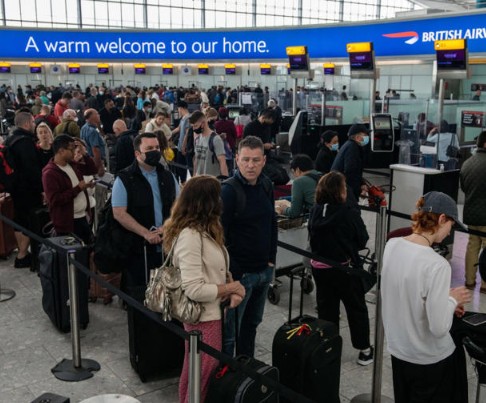
Passengers could pass to security using just their face under a plan being considered by airlines and airports.
Drastically new rules for air travel will be in place within two to three years, according to the International Civil Aviation Organisation (ICAO), the UN body responsible for policy. They would let passengers upload their passport to their phones and pass through departure gates by having their face scanned – the biggest shake-up of air travel in half a century.
This could mean the days of traditional check-in desks and handing a boarding pass and your passport over to security will soon be a thing of the past. Instead, passengers would now have a ‘digital travel credential’ stored on their mobile phones, containing everything they need to board a plane.
The new tech could massively speed up the airport check-in process, meaning the move will likely be popular with frequent fliers and holiday travellers alike.
Valérie Viale, the director of product management at Amadeus, a travel technology company, told the Times that the changes were ‘the biggest in 50 years’. She said: “The last upgrade of great scale was the adoption of e-ticketing in the early 2000s. Many airline systems haven’t changed for more than 50 years because everything has to be consistent across the industry and interoperable.”
“The industry has now decided it’s time to upgrade to modern systems that are more like what Amazon would use. At the moment airlines have systems that are very siloed. There’s the reservation system that, when check-in opens, makes a handshake with a delivery system and says ‘here are my reservations, you can now deliver them’.”
“In the future it’ll be far more continuous and the “journey pass” will be dynamic,” Viale says.
How would it work?
The ‘digital travel credential’ introduced by the ICAO would include a bundle of documents needed to board a plane, including passports and flight details.
Passengers would download a ‘journey pass’ when they book their flight, which would automatically update them if their flight is delayed or cancelled.
There could also be the option to automatically update hire car companies of any flight delays, potentially avoiding excess charges. At the airport they would be checked by facial recognition scanners, which will tell airlines and security whether they’re intending to fly or are just dropping someone off at the terminal.
Is it safe?
Industry figures say privacy concerns would be addressed by having passenger data deleted within 15 seconds of each point of contact.
The ICAO has said airports will not store any information scanned by computers in the check in process. And there are concerns about airports being left in the lurch if the technology it relies upon goes wrong.
Last July, a huge Microsoft outage caused by a CrowdStrike update grounded flights around the world, as well as disrupting the NHS.
Which airlines could roll it out first?
British Airways, Air France-KLM, Finnair and Saudia Airlines are some of the airlines investigating the new tech. U.S. airlines are also considering the move.
BA said its ‘suite of digital experience tools’ would allow it to ‘anticipate the needs of modern, digital travellers, providing them with exceptional experiences across their journey’, the Standard reports.
Meanwhile, the Home Office said last year it was looking at introducing e-gates with facial recognition technology, removing the need to produce a passport.
But the rollout wouldn’t be straightforward as airports would need to install facial recognition technology throughout their terminals in order for the tech to work.
_________________
Credit: Metro



Hogar Esperanza News

Fabianos Pizzeria News

Fund Grace News

The Cuenca Dispatch

Week of September 20

Ecuador turns to industrial power cuts to protect Mazar and keep homes from going dark.

Ecuador raises its 2026 growth forecast, but El Niño could spoil the outlook next year.

Cuenca retirees challenge medical and therapy changes at IESS senior center.