















All that glitters
There are moments in history when the world’s accountants quietly rearrange the furniture and everyone else spends the next fifty years living with the consequences. One of those moments took place in July 1944 in a grand old resort hotel in the mountains of New Hampshire called Bretton Woods.
The Second World War was still raging. Germany was fighting for survival, Japan still controlled much of Asia, and yet representatives of forty-four allied nations gathered at the Mount Washington Hotel to discuss a problem that would arrive the morning after victory: how to rebuild the global economy without repeating the disasters of the 1930s.
That earlier decade had been a financial demolition derby. Countries devalued their currencies, raised trade barriers, and printed money with enthusiasm but little coordination. International trade collapsed, governments fell, and extremist politics flourished. The men around the Bretton Woods conference tables understood that if nations could not agree on rules for money and trade, the next war might not take another twenty years to arrive.
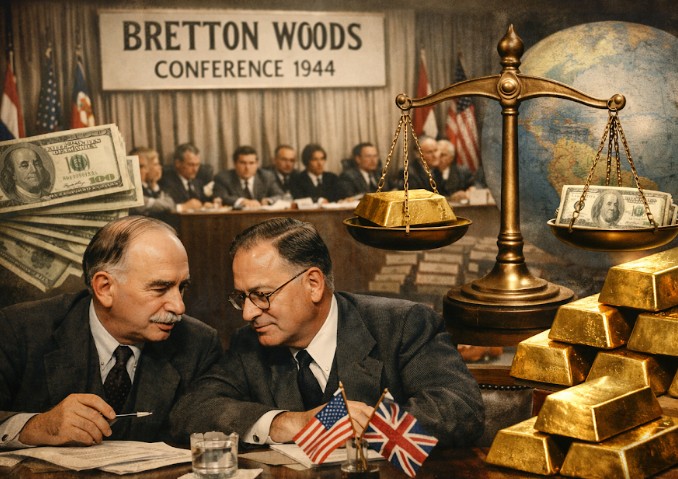 The solution they produced was both simple and ambitious. Currencies would be fixed to the U.S. dollar, and the dollar itself would be convertible into gold at $35 an ounce. The arrangement provided a stable anchor for exchange rates and international trade, while two new institutions were created to help keep the machinery running. The International Monetary Fund would assist countries facing short-term balance-of-payments problems, and the World Bank would finance reconstruction and development.
The importance of gold in those years was so widely understood that even James Bond films revolved around it. In the 1964 movie Goldfinger, the villain’s plan to sabotage the gold reserves at Fort Knox, assisted by the memorably named Pussy Galore, seemed a perfectly plausible way to destabilize the global economy. In the Bretton Woods era, after all, all that glittered really did matter.
For roughly a quarter century the arrangement worked remarkably well. Western Europe and Japan rebuilt themselves from the ruins of war, international trade expanded rapidly, and the global economy entered what historians later described as the golden age of postwar prosperity.
Even at Bretton Woods, however, there was disagreement about how the system should be designed. The British delegation was led by the economist John Maynard Keynes, who believed it was dangerous to build the entire structure of global finance around the currency of a single country. Instead he proposed creating a new international unit of account called the bancor, which would be used by a global clearing union to settle trade between nations.
Keynes’s idea had an unusual feature. It would pressure not only countries that ran trade deficits but also those that accumulated large surpluses. Nations exporting far more than they imported would be encouraged, or eventually required, to spend or invest those surpluses abroad so that global trade remained broadly balanced.
It was an elegant design, but it collided with political reality. The United States emerged from the war with the largest economy and most of the world’s gold reserves, which made a dollar-based system far easier to implement. The American plan, led by Treasury official Harry Dexter White, therefore prevailed, while Keynes’s clearing union was politely admired and quietly shelved.
Economists still enjoy debating whether Keynes might have been right. The modern global economy is full of the kind of imbalances he worried about, with some countries accumulating enormous surpluses while others run chronic deficits. A system that nudged both sides toward balance might have prevented some of the tensions that appear regularly in today’s trade disputes.
For a while, though, the Bretton Woods compromise functioned quite well. The system’s weakness only became visible during the late 1960s, when the arithmetic behind it grew increasingly awkward. Because the dollar served as the world’s reserve currency, the United States had to supply dollars to the rest of the world in order to keep trade moving. The easiest way to do that was by running trade deficits and exporting capital, which meant that over time more dollars accumulated overseas.
Eventually foreign governments noticed that the United States had issued far more dollars than it possessed gold to redeem.
In 1971 President Richard Nixon resolved the problem with the brisk practicality of a man who simply removes the scale from the kitchen when it shows an unwelcome number. The dollar was no longer convertible into gold, and the Bretton Woods system effectively ended overnight.
One might have expected the dollar to weaken dramatically after that decision. Instead the opposite happened, partly because of the peculiar role that oil began to play in the international financial system.
During the 1970s the United States reached an understanding with Saudi Arabia and other major OPEC oil producers that global petroleum sales would be priced primarily in dollars. Any country wishing to buy oil therefore needed dollars first, which led to the development of the so-called petrodollar system.
Oil exporters accumulated enormous dollar reserves, and much of that money eventually flowed back into American financial markets in the form of purchases of U.S. Treasury bonds and other investments. The United States thus acquired a remarkable privilege: it could buy real goods from the rest of the world while paying with financial assets that the rest of the world was perfectly happy to hold.
That privilege explains much of the modern American trade deficit.
When a country issues the currency used by the global trading system, other nations naturally accumulate that currency for reserves and for international payments. The United States imports televisions, machinery, clothing, and cars while exporting dollars, Treasury bonds, and financial investments.
Economists describe this situation through the balance of payments, which is simply the national accounting record of all the money flowing into and out of a country through trade, investment, and financial transactions. A country can import more goods than it exports and still balance its accounts if foreigners are willing to reinvest the difference in its financial markets, which is exactly what has happened with the United States for decades.
Tariffs enter the picture because they are one of the oldest tools governments possess for trying to correct trade imbalances. A tariff is essentially a tax on imported goods that raises their price and encourages consumers to buy domestically produced alternatives. In theory tariffs can protect local industries and reduce deficits, although in practice they often trigger retaliation from trading partners and can disrupt supply chains that now stretch across several continents.
There is also the complication that most countries need dollars in order to purchase oil and other commodities priced on global markets. If a country requires dollars for energy imports, it often has little choice but to export goods to the United States to obtain those dollars, which means that perfectly balanced trade between nations is harder to achieve than the theory might suggest.
Older readers in Britain may remember another attempt to correct trade imbalances through currency devaluation. In 1967 the British government reduced the value of the pound from $2.80 to $2.40, prompting Prime Minister Harold Wilson to reassure the public that “the pound in your pocket” had not been devalued.
The statement was politically understandable, although economically optimistic. The coins and banknotes remained the same, but imported goods inevitably became more expensive.
At the time Britain also limited the amount of foreign currency travelers could take abroad, which was how a seventeen-year-old version of Charlie Larga once set out to hitchhike across Europe with a travel allowance of fifty pounds that had to last three months. It seemed perfectly adequate while sleeping in youth hostels and occasionally on beaches, although the experience may have contributed to a lifelong curiosity about how currencies behave.
Devaluations usually make imported goods more expensive than locally produced ones, which is exactly why governments sometimes use them to stimulate domestic industry. Over time, however, higher import prices ripple through the economy and eventually contribute to inflation, which gradually erodes much of the original advantage.
Ecuador provides a more recent example of how countries sometimes solve a currency problem by simply abandoning the currency.
In the late 1990s the country experienced a severe financial crisis during which its national currency, the sucre, lost value so rapidly that prices were rising almost daily and several banks collapsed. In 2000 the government made the dramatic decision to replace the sucre entirely with the U.S. dollar.
The change stabilized prices almost immediately because people trusted the dollar far more than the local currency, although it also meant that Ecuador gave up the ability to control its own exchange rate or print money during difficult times. In effect the country traded monetary independence for stability, which is why today a taxi driver in Cuenca may hand you change in the same coins that circulate in New York, and Miami.
All of which raises the question economists occasionally ask today: whether the world might benefit from another Bretton Woods-style conference to rethink the rules of global finance.
The idea has a certain appeal. The modern global economy faces challenges that did not exist in 1944, including the rise of China, enormous global debt levels, volatile exchange rates, and the appearance of digital currencies. Organizing such a conference, however, would be considerably more complicated today because economic power is widely distributed among countries that do not always agree on the basics of international cooperation.
Still, economists occasionally sketch possible reforms. Some propose expanding the role of the IMF’s Special Drawing Rights as a neutral international reserve asset, while others suggest better coordination of currency policies so that trade imbalances shrink gradually instead of widening indefinitely. There are also proposals to establish clearer rules for restructuring sovereign debt, since many countries now carry financial burdens that cannot realistically be repaid.
None of these ideas would be easy to implement, and all would require levels of international cooperation that the current geopolitical climate does not naturally encourage.
History nevertheless suggests that financial systems eventually force cooperation. Bretton Woods itself emerged from the wreckage of the Great Depression and the largest war in human history, when policymakers understood that if nations did not design the financial system deliberately, the system would eventually design itself.
Which is why the ghost of Bretton Woods still hovers over the global economy.
And somewhere in the mountains of New Hampshire there is still an old hotel where, for a few weeks in 1944, the world tried to write those rules down while the war was still being fought.